

Over the past two years, “AI” has become one of the most searched career terms in Canada, and for good reason — generative tools like ChatGPT, Microsoft Copilot and Google Gemini have made artificial intelligence part of daily work for millions of people. But there is an important distinction that often gets lost in that conversation: knowing how to prompt an AI tool well is not the same as having the technical skills to build, train or deploy one. If you are considering a Diploma in Artificial Intelligence, it helps to understand exactly what separates the two, and what a structured AI program actually teaches.
This matters for a practical reason. Employers hiring for roles like AI Analyst, Machine Learning Engineer or Data Scientist are not primarily testing whether a candidate can write a good ChatGPT prompt. They are looking for people who understand how machine learning models are built, what data those models need, how to evaluate whether a model is actually working, and how to deploy it responsibly inside a real organization. This article breaks down what that technical foundation looks like — the kind of curriculum behind a program like the Diploma in Artificial Intelligence at Toronto Innovation College — so you can see exactly what you would be learning before you enroll.
Using AI Tools vs. Building AI Systems: What’s the Real Difference?
Using a generative AI tool like ChatGPT involves typing a request in plain language and receiving an output. It is genuinely useful, and organizations increasingly expect employees across departments — marketing, HR, finance, operations — to use these tools competently. But that skill sits entirely on top of the AI system, not inside it. A Machine Learning Engineer, by contrast, works with the underlying model itself: selecting an algorithm, preparing training data, tuning parameters, evaluating accuracy and deciding how the model should be deployed and monitored once it is in production.
This is roughly the difference between knowing how to drive a car well and understanding how the engine works. Both are valuable, but they are different skill sets, and a diploma program is designed to build the second one — the technical foundation that lets someone work on the systems themselves rather than only use the finished product.
Python: The Starting Point for Almost Every AI Career Path
Nearly every AI and machine learning curriculum begins with Python, and there is a practical reason for that. Python has become the dominant programming language for AI and data science work because of its readable syntax and its enormous ecosystem of machine learning libraries. Learning Python fundamentals — variables, functions, loops, data structures — gives students the tools to eventually work with libraries used throughout the AI field for building and training models.
For someone with no prior programming background, this is often the part of an AI diploma that feels most unfamiliar at first, but it is also the part that gets the most structured teaching time early in a well-designed program precisely because everything else builds on it. Students who arrive with some existing IT experience often move through this stage faster, but the Diploma in Artificial Intelligence at Toronto Innovation College is designed to support learners starting from the fundamentals, not just those upgrading existing technical skills.
Machine Learning Fundamentals: How Models Actually Learn
Machine learning is often described in marketing language as “AI that learns from data,” which is true but not very useful on its own. In a structured curriculum, machine learning fundamentals typically cover concepts like: the difference between supervised learning (training a model on labelled examples) and unsupervised learning (finding patterns in unlabelled data); how a model’s accuracy is measured and evaluated against test data separate from the data it was trained on; and why a model that performs well on its training data can still fail badly on new, real-world data — a problem known as overfitting.
Understanding these fundamentals is what allows someone to look critically at an AI system’s output, rather than simply trusting it. This critical evaluation skill has become increasingly valuable to employers, especially as organizations face more scrutiny over how their AI systems make decisions.
Deep Learning, Neural Networks and Natural Language Processing
Beyond foundational machine learning, most AI diploma curriculums move into more specialized areas. Deep learning and neural networks are the technology behind many of today’s most visible AI breakthroughs, including the large language models that power tools like ChatGPT. Understanding how neural networks are structured — layers of interconnected nodes that adjust their internal weights as they process training data — helps explain both the strengths and the limitations of modern AI systems.
Natural Language Processing (NLP) is the branch of AI focused specifically on how computers process and generate human language, and it underpins everything from chatbots and translation tools to sentiment analysis used in customer feedback systems. Computer vision, the AI field focused on interpreting images and video, powers applications ranging from quality-control inspection in manufacturing to medical imaging analysis. A well-rounded AI diploma program introduces students to each of these specializations so they can identify which direction interests them most before narrowing their career focus.
Data Science and Predictive Analytics: The Other Half of AI Work
AI systems are only as good as the data they are trained on, which is why data science skills sit alongside machine learning in most AI curriculums. This includes learning how to clean and prepare messy real-world data, how to explore a dataset to understand its patterns before building a model, and how to use predictive analytics to forecast future outcomes based on historical data. In many organizations, the job title “Data Scientist” reflects exactly this blend — someone who spends as much time preparing and understanding data as they do building models on top of it.
From Model to Deployment: AI Operations in the Real World
One area that often gets underemphasized in casual conversations about AI, but that employers care about a great deal, is model deployment — what happens after a machine learning model has been built and tested. A model sitting in a research notebook does not create business value on its own; it needs to be integrated into a real application, monitored for performance drift over time, and maintained as new data becomes available. This operational side of AI work, sometimes referred to as MLOps, is increasingly a distinct skill area that employers look for, since it bridges the gap between a working prototype and a production system that a business can actually rely on.
Responsible AI: A Skill Employers Increasingly Expect
As AI systems have moved from research labs into everyday business decisions — hiring screening, credit assessments, healthcare triage — the question of how those systems are built responsibly has become a core professional skill, not an afterthought. Responsible AI practices include understanding how bias can enter a model through its training data, being transparent about a model’s limitations, and following privacy principles when handling personal data used to train or run AI systems. Canada’s federal government has published its own national approach to artificial intelligence through Innovation, Science and Economic Development Canada, reflecting how seriously this area is now treated at a policy level. A modern AI diploma program should introduce these principles alongside the technical skills, since employers increasingly expect AI professionals to think about both.
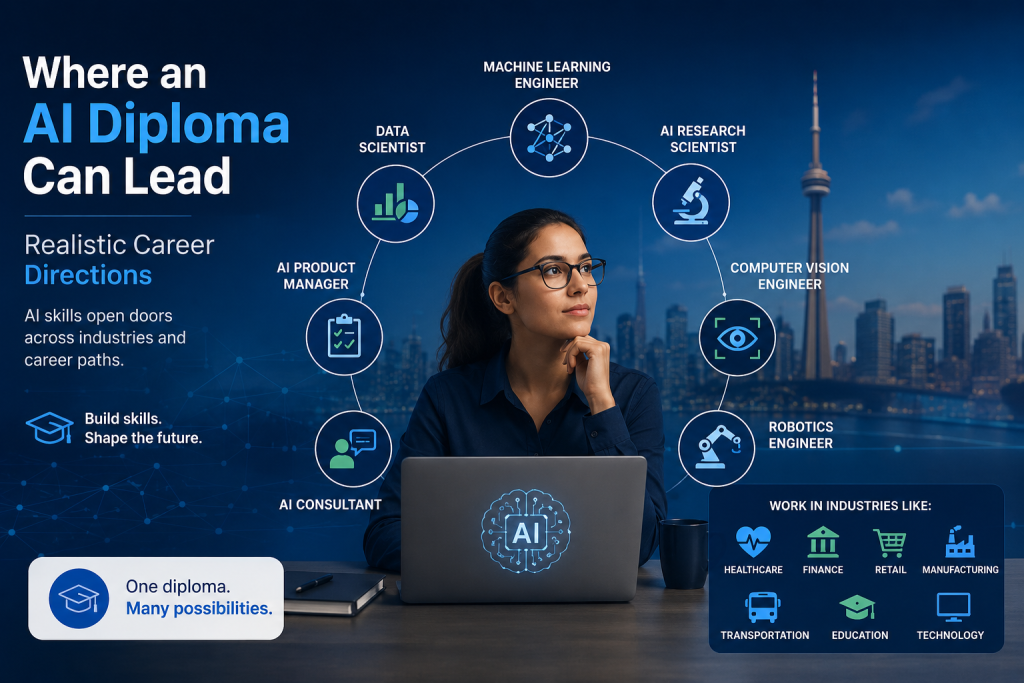
Where an AI Diploma Can Lead: Realistic Career Directions
Graduates of AI-focused diploma programs pursue a range of career directions depending on which parts of the curriculum resonated most, including roles such as Machine Learning Engineer, Data Scientist, AI Research Scientist, Computer Vision Engineer, Robotics Engineer, AI Product Manager and AI Consultant. These roles show up across a wide range of industries — technology, healthcare, finance, retail, manufacturing, transportation and education all increasingly employ people with AI and data skills, not just dedicated technology companies. Career outcomes vary based on an individual’s prior experience, the specific employer and current labour-market conditions, so it is worth treating any list of potential roles as a set of directions to explore rather than a guaranteed outcome.
For readers who are already using AI tools at work and want to understand how that everyday use connects to more technical AI career paths, TIC’s blog post on how AI is changing daily work for business professionals is a useful companion read that focuses specifically on the tool-use side of this picture.
How AI Skills Connect to Data Analytics
Artificial intelligence and data analytics are closely related disciplines that often share the same underlying tools and data-handling skills. Someone who understands how to clean, structure and interpret data — core skills taught in TIC’s Data Analytics and Reporting with Power BI course — has a meaningful head start when it comes to preparing data for machine learning models. Many AI professionals move between data analytics and AI-focused roles over the course of their careers as organizations blend business intelligence and predictive modelling work together.
Admission Requirements and Funding Considerations
TIC’s Diploma in Artificial Intelligence is a 52-week program, and admission requires an Ontario Secondary School Diploma or equivalent, along with being 18 years of age or older. Because this is a full diploma program rather than a short course, it is presented on TIC’s homepage among the programs that may be eligible for Better Jobs Ontario support. Eligibility is not automatic — it depends on an individual assessment carried out by an Employment Ontario service provider, and the amount of any funding support depends on individual financial circumstances. According to the current Better Jobs Ontario guidance on ontario.ca, eligible applicants pursuing training of one year or less may receive support of up to $28,000 toward tuition, books and related costs. Anyone considering this path should confirm current eligibility directly with an Employment Ontario service provider, and TIC’s Better Jobs Ontario information page and Financial Assistance page outline how this and other funding options apply to TIC’s diploma programs specifically.
Frequently Asked Questions
Do I need to already know how to code before starting an AI diploma?
No. Programs designed for beginners typically start with Python fundamentals and build up from there. A basic comfort with logical thinking and problem-solving matters more at the outset than prior coding experience, though some familiarity with basic mathematical concepts like linear algebra can make the early stages feel more familiar.
Is an AI diploma the same as a computer science degree?
No. A diploma program is typically more applied and career-focused, concentrating on the practical AI and machine learning skills employers are hiring for now, rather than covering the full breadth of a multi-year computer science degree. Both paths can lead to AI-related careers, but they differ in length, depth and academic structure.
What is the difference between AI, machine learning and data science?
Artificial intelligence is the broad field of building systems that perform tasks normally requiring human intelligence. Machine learning is a specific approach within AI where systems learn patterns from data rather than following explicitly programmed rules. Data science is a closely related discipline focused on extracting insights from data, which often feeds directly into machine learning work. The three fields overlap heavily in practice.
Can I switch into an AI career from a non-technical background?
Many people entering AI-focused diploma programs are career changers without a technical degree. Structured programs are generally designed to build technical skills from the ground up rather than assuming prior IT experience, though a willingness to work through unfamiliar technical concepts is important.
Will Better Jobs Ontario automatically fund my AI diploma?
No. Better Jobs Ontario funding is not automatic or guaranteed. Eligible applicants may qualify for financial support, but eligibility and the amount of support depend on an individual assessment by an Employment Ontario service provider, and final program approval rests with the Ministry. Confirm current eligibility directly with an Employment Ontario service provider before assuming a specific program will be funded.
Final Thoughts
Prompting a chatbot well is a genuinely useful modern skill, but it is not the same as understanding how AI systems are actually built, trained, evaluated and deployed. A structured AI diploma program is designed to teach that deeper technical foundation — starting with Python, moving through machine learning and specialized areas like deep learning and natural language processing, and ending with practical skills in deployment and responsible AI practice.
If this kind of technical foundation is what you are looking for, review the current curriculum and admission requirements for the Diploma in Artificial Intelligence at Toronto Innovation College, or explore TIC’s broader Programs & Courses listing to see how AI fits alongside related programs like Data Analytics and Cloud Computing.