
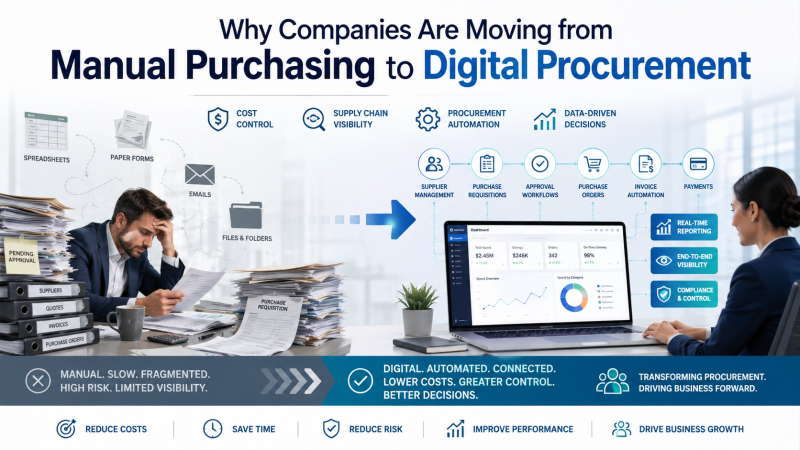
For many years, purchasing in companies was handled through emails, spreadsheets, paper forms, phone calls, and manual approvals. A department needed something, someone filled out a purchase request, another person checked the budget, a manager approved it, procurement contacted suppliers, prices were compared manually, and then a purchase order was created.
This process worked when businesses were smaller and supply chains were less complex. But today, companies operate in a faster, more competitive, and more data-driven world. They deal with multiple suppliers, changing prices, compliance requirements, global delivery challenges, and pressure to reduce costs. Manual purchasing is no longer enough for many organizations.
That is why companies are moving from manual purchasing to digital procurement.
Digital procurement means using technology to manage purchasing, sourcing, supplier communication, purchase orders, approvals, contracts, invoices, and spend analysis. Instead of depending only on manual work, companies use digital systems to make procurement faster, more transparent, and easier to control.
Modern procurement is not just about buying goods and services. It is about making smarter business decisions. It helps companies control spending, reduce risk, build better supplier relationships, and improve supply chain performance.
This is one reason why tools like SAP S/4HANA Sourcing and Procurement, SAP Ariba, cloud ERP systems, automation platforms, and spend management software are becoming important in many industries.
What Is Manual Purchasing?
Manual purchasing is the traditional way of buying goods and services for a business. It usually depends on human effort, emails, phone calls, Excel sheets, printed documents, and manual approvals.
For example, imagine a company needs office equipment. A team member sends an email to the manager. The manager approves it by replying to the email. Someone from procurement asks three suppliers for quotations. The quotes are saved in a spreadsheet. Then another manager checks the budget. After that, a purchase order is created manually. When the invoice comes, accounting checks it against the purchase order and delivery receipt.
This may sound simple, but in a real business, hundreds or thousands of such purchases may happen every month. When everything is handled manually, mistakes become common.
Manual purchasing may include:
- Email-based purchase requests
- Paper approval forms
- Spreadsheet-based supplier lists
- Manual price comparisons
- Manual purchase order creation
- Manual invoice matching
- Limited visibility into spending
- Slow communication between departments
- Difficulty tracking supplier performance
The biggest problem with manual purchasing is that it depends too much on people remembering, checking, following up, and updating information correctly. When one step is missed, the entire process can be delayed.
What Is Digital Procurement?
Digital procurement is the use of digital tools and software to manage the complete purchasing process. It helps businesses move from slow, disconnected, and paper-based purchasing to faster and more organized procurement.
Digital procurement can include:
- Online purchase requests
- Automated approval workflows
- Supplier portals
- Digital purchase orders
- Contract management
- Spend analytics
- Invoice automation
- Inventory integration
- Real-time reporting
- Supplier performance tracking
- Risk and compliance monitoring
In simple words, digital procurement gives companies one connected system where they can manage purchasing from start to finish.
A common term used in procurement is source-to-pay. Source-to-pay covers the complete process from finding suppliers to paying them. It includes sourcing, supplier selection, contract negotiation, purchasing, receiving goods or services, invoice matching, and payment.
Digital procurement makes this process easier because all important information is stored in one system. Teams can see what was requested, who approved it, which supplier was selected, what price was agreed, when delivery is expected, and whether payment has been completed.
Why Manual Purchasing Is Becoming a Problem
Manual purchasing creates several challenges for modern companies. These challenges become bigger as the business grows.
1. Manual Purchasing Is Slow
When purchasing depends on emails and manual approvals, delays are common. A manager may miss an email. A supplier quote may be lost. A purchase request may sit in someone’s inbox for days. The finance team may wait for documents before approving payment.
These delays affect business operations. If raw materials are not purchased on time, production may slow down. If IT equipment is delayed, employees may not be able to work efficiently. If supplier payments are late, supplier relationships may suffer.
Digital procurement helps reduce these delays by automating workflows. The system can send approval requests, reminders, and updates automatically.
2. Manual Purchasing Increases Errors
In manual purchasing, people often copy data from one place to another. They may copy supplier names, prices, item numbers, quantities, tax details, and payment terms.
Every time data is entered manually, there is a chance of error. A small mistake can create bigger problems. For example, entering the wrong quantity may lead to over-ordering. Entering the wrong supplier price may affect the budget. Missing tax details may create accounting issues.
Digital procurement reduces manual data entry and improves accuracy.
3. Manual Purchasing Gives Poor Spend Visibility
Spend visibility means knowing where company money is going. It answers questions like:
- Which departments are spending the most?
- Which suppliers receive the most orders?
- Are we buying the same item from different suppliers at different prices?
- Are employees purchasing outside approved contracts?
- Are there opportunities to reduce costs?
In manual purchasing, spend data is often spread across spreadsheets, emails, invoices, and accounting systems. This makes it hard for managers to see the full picture.
Digital procurement systems help companies track spending in real time. This allows leaders to make better purchasing decisions.
4. Manual Purchasing Makes Supplier Management Difficult
Suppliers play an important role in business success. A good supplier provides quality products, fair pricing, reliable delivery, and strong communication.
But when supplier data is stored manually, it becomes difficult to manage. Companies may not know which suppliers are performing well and which ones are causing problems.
Digital procurement helps track supplier performance, delivery timelines, pricing history, contract terms, and compliance documents.
5. Manual Purchasing Can Create Compliance Risk
Many companies have purchasing policies. For example, purchases above a certain amount may require manager approval. Some purchases may need three supplier quotes. Certain suppliers may need to meet legal or industry requirements.
In manual purchasing, employees may forget policies or skip steps. This can create compliance risk.
Digital procurement systems can build rules into the workflow. For example, if a purchase is above a certain amount, the system automatically sends it to the right person for approval.
Why Companies Are Moving to Digital Procurement
Companies are moving to digital procurement because it solves many of the problems created by manual purchasing. It also helps procurement teams become more strategic.
1. Faster Purchasing Process
Digital procurement makes purchasing faster by reducing waiting time. Purchase requests can be submitted online. Approvals can be routed automatically. Suppliers can receive purchase orders digitally. Invoices can be matched with purchase orders and goods receipts more efficiently.
When the process becomes faster, departments get what they need on time. This improves productivity across the business.
2. Better Cost Control
One of the biggest goals of procurement is cost control. Companies want to buy the right products and services at the right price.
Digital procurement helps by giving clear visibility into spending. It allows businesses to compare suppliers, analyze purchase history, identify unnecessary spending, and negotiate better contracts.
For example, a company may discover that different departments are buying the same item from different suppliers. By centralizing procurement, the company can negotiate better pricing with one approved supplier.
3. Improved Supplier Relationships
Digital procurement improves communication between companies and suppliers. Suppliers can receive purchase orders faster, submit invoices electronically, and track payment status.
This creates a more professional and transparent relationship. Suppliers are more likely to perform well when communication is clear and expectations are properly documented.
4. Real-Time Data and Reporting
In manual purchasing, managers often wait until the end of the month to review reports. By then, the spending has already happened.
Digital procurement provides real-time data. Managers can monitor purchasing activity, supplier performance, approval delays, budget usage, and invoice status.
This helps companies respond quickly instead of reacting late.
5. Better Risk Management
Supply chain risk has become a major concern for businesses. Companies need to know whether suppliers are reliable, whether materials will arrive on time, and whether there are risks related to pricing, quality, compliance, or delivery.
Digital procurement systems can help track supplier risk and provide better visibility into supply chain issues.
6. Less Paperwork
Manual purchasing creates a lot of paperwork. Purchase requests, approval forms, supplier quotes, purchase orders, delivery notes, and invoices may all exist as separate documents.
Digital procurement reduces paperwork by storing information electronically. This saves time and makes it easier to search for documents when needed.
7. Stronger Collaboration Between Departments
Purchasing is not only the job of the procurement department. Finance, operations, supply chain, warehouse, HR, IT, and management may all be involved.
Digital procurement creates a shared system where departments can work together. Everyone can see the status of requests, approvals, orders, and payments.
This reduces confusion and improves teamwork.
How Digital Procurement Works in a Company
Digital procurement usually follows a structured process.
Step 1: Purchase Request
An employee or department identifies a need. They create a digital purchase request in the system. This request may include item details, quantity, reason for purchase, estimated cost, and required delivery date.
Step 2: Approval Workflow
The system sends the request to the right manager or department for approval. Approval rules may depend on budget, department, purchase type, or amount.
Step 3: Supplier Selection
The procurement team reviews approved suppliers, compares pricing, checks contracts, and selects the best supplier.
Step 4: Purchase Order Creation
Once the supplier is selected, the system creates a purchase order. A purchase order is an official document that confirms what the company is buying, from whom, at what price, and under what terms.
Step 5: Delivery and Goods Receipt
When the goods or services are delivered, the receiving team confirms the delivery in the system.
Step 6: Invoice Matching
The supplier sends an invoice. The system can compare the invoice with the purchase order and delivery receipt. This is called three-way matching.
Step 7: Payment
Once everything matches, the finance team can process the payment.
This complete flow is much easier to manage digitally than manually.
Role of SAP in Digital Procurement
SAP is widely used by companies to manage business processes such as finance, procurement, supply chain, sales, manufacturing, inventory, and human resources.
In procurement, SAP helps companies manage purchasing in a structured and integrated way. SAP S/4HANA Sourcing and Procurement supports processes such as purchase requisitions, purchase orders, supplier management, invoice verification, sourcing, contract management, and spend analysis.
The benefit of using SAP is that procurement does not work separately from the rest of the business. It connects with finance, inventory, warehouse, production, and reporting.
For example, when a purchase order is created, the finance team can see the financial impact. When goods are received, inventory is updated. When invoices are verified, accounting records are created. This integration helps companies reduce errors and improve control.
Students and professionals who want to understand how modern procurement works can explore structured learning through the SAP S/4HANA Sourcing and Procurement Course in Canada at Toronto Innovation College.
How AI Is Entering Procurement
Digital procurement is now moving beyond basic automation. Artificial intelligence is becoming part of procurement systems.
AI can help procurement teams by:
- Analyzing supplier performance
- Identifying spending patterns
- Recommending better suppliers
- Detecting unusual purchases
- Supporting contract review
- Helping forecast demand
- Reducing repetitive administrative work
- Improving risk alerts
For example, if a supplier is often late, AI can help identify that pattern. If prices are increasing, analytics can show where costs are rising. If employees are buying outside approved suppliers, the system can highlight this behavior.
AI does not replace procurement professionals. Instead, it helps them make faster and smarter decisions.
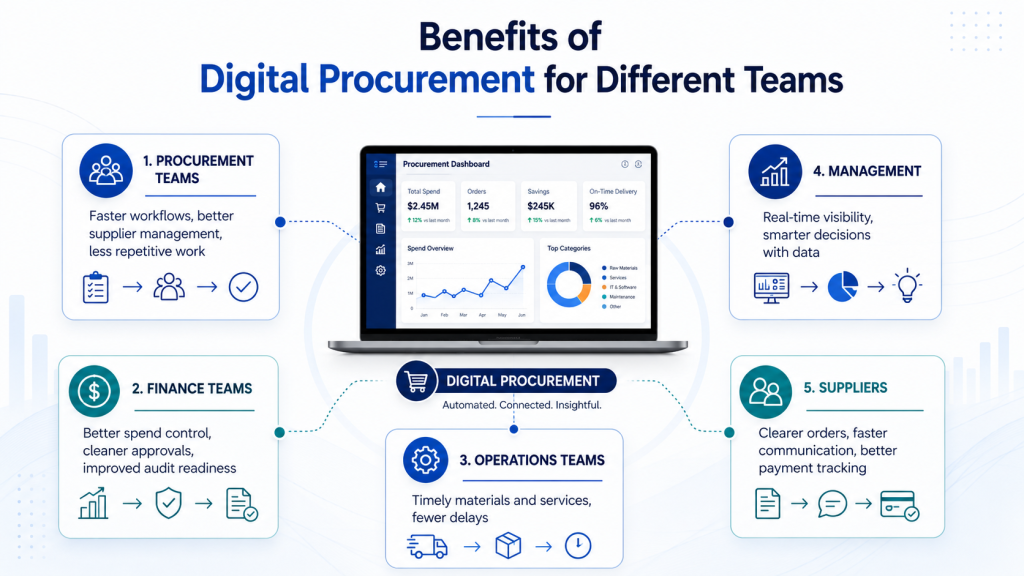
Benefits of Digital Procurement for Different Teams
Digital procurement benefits many departments, not only procurement.
For Procurement Teams
Procurement teams can work faster, manage suppliers better, and spend less time on repetitive tasks. They can focus more on strategy, negotiation, and supplier relationships.
For Finance Teams
Finance teams get better control over spending, invoices, approvals, and payment records. Digital procurement also helps improve audit readiness.
For Operations Teams
Operations teams receive materials, equipment, and services on time. This helps avoid delays in production, service delivery, and daily work.
For Management
Leaders get better visibility into company spending. They can make decisions based on real data instead of assumptions.
For Suppliers
Suppliers receive clearer purchase orders, faster communication, and better payment tracking.
Common Examples of Digital Procurement in Real Life
Digital procurement is used in many industries.
Manufacturing
Manufacturing companies use digital procurement to buy raw materials, machine parts, packaging, and maintenance services. Timely purchasing is important because delays can stop production.
Retail
Retail companies use digital procurement to manage inventory, suppliers, pricing, and product availability.
Healthcare
Healthcare organizations use procurement systems to buy medical supplies, equipment, pharmaceuticals, and facility services while maintaining compliance.
Construction
Construction companies use procurement tools to manage materials, subcontractors, equipment rentals, and project-based purchasing.
Education
Colleges and schools use procurement systems to buy technology, furniture, books, software, and maintenance services.
IT and Technology
IT companies use procurement systems to manage software licenses, hardware, cloud services, and vendor contracts.
Skills Needed for Digital Procurement
As procurement becomes more digital, professionals need more than traditional purchasing knowledge. They need a mix of business, technology, and analytical skills.
Important skills include:
- Understanding purchase-to-pay and source-to-pay processes
- Supplier management
- Contract management
- Spend analysis
- ERP system knowledge
- SAP procurement knowledge
- Data analysis
- Communication skills
- Problem-solving
- Compliance awareness
- Basic understanding of automation and AI tools
A procurement professional does not need to be a software developer. But they should understand how digital systems support business processes.
Challenges Companies Face When Moving to Digital Procurement
Moving from manual purchasing to digital procurement is beneficial, but it can also be challenging.
1. Employee Resistance
Some employees may be comfortable with old ways of working. They may resist new systems because they feel the process is unfamiliar.
Companies can solve this through training, clear communication, and step-by-step implementation.
2. Poor Data Quality
Digital systems depend on good data. If supplier records, item details, or pricing information are incorrect, the system will not work properly.
Before moving to digital procurement, companies often need to clean and organize their data.
3. Integration Issues
Procurement systems must often connect with finance, inventory, warehouse, and supplier systems. Integration requires planning and technical support.
4. Lack of Skills
A digital procurement system is only useful when people know how to use it. Companies need employees who understand both procurement processes and digital tools.
5. Choosing the Right System
Not every system is suitable for every company. Businesses need to choose tools based on size, industry, budget, supplier network, and reporting needs.
Why Digital Procurement Matters in Canada
Canadian businesses operate in a competitive market where efficiency, compliance, cost control, and supply chain reliability are important.
Many companies in Canada work with local and international suppliers. They must manage changing prices, delivery schedules, tax rules, documentation, and internal approvals. Digital procurement helps them stay organized and competitive.
For professionals in Canada, understanding digital procurement can open doors in roles related to procurement, supply chain, inventory, purchasing, ERP support, business analysis, and SAP consulting.
Companies increasingly value people who can understand business processes and work with digital systems.
Manual Purchasing and Digital Procurement: A Simple Example
Imagine two companies need to buy laptops for new employees.
Company A uses manual purchasing. The HR team sends an email to IT. IT asks procurement to contact suppliers. Procurement collects quotes in Excel. A manager approves by email. The purchase order is created manually. The invoice is checked later by finance. If any document is missing, payment is delayed.
Company B uses digital procurement. HR creates a request in the system. The system sends approval to the manager. Procurement selects an approved supplier. A purchase order is created automatically. Delivery is recorded. The invoice is matched with the purchase order and receipt. Finance can approve payment faster.
Company B saves time, reduces errors, and has better visibility.
This is why digital procurement is becoming the preferred approach.
Future of Procurement
Procurement is becoming more strategic. In the past, procurement was often seen as a back-office function. Today, it plays an important role in cost savings, supplier innovation, risk management, sustainability, and business growth.
Future procurement teams will likely use:
- AI-assisted sourcing
- Automated supplier recommendations
- Real-time spend dashboards
- Predictive supply chain risk alerts
- Digital contracts
- Automated invoice matching
- Cloud-based ERP systems
- Integrated supplier portals
- Better analytics for decision-making
Professionals who understand these trends will be better prepared for the future of work.
Conclusion
Companies are moving from manual purchasing to digital procurement because the old way of buying is too slow, risky, and difficult to manage in today’s business environment.
Manual purchasing creates delays, errors, poor visibility, supplier confusion, and compliance problems. Digital procurement helps companies work faster, control costs, manage suppliers better, reduce risk, and make smarter decisions using real-time data.
Modern procurement is no longer just about placing orders. It is about improving business performance. It connects purchasing with finance, supply chain, inventory, operations, and management.
As digital procurement continues to grow, professionals who understand procurement systems, SAP S/4HANA, source-to-pay processes, automation, and data-driven decision-making will become more valuable in the job market.
For learners who want to understand how modern procurement works in real business systems, Toronto Innovation College offers training related to SAP S/4HANA Sourcing and Procurement, helping learners develop practical knowledge of SAP S/4HANA Sourcing and Procurement concepts and business processes.
FAQs
1. What is digital procurement?
Digital procurement is the use of technology to manage purchasing, sourcing, supplier communication, approvals, purchase orders, invoices, and spend analysis.
2. Why are companies moving away from manual purchasing?
Companies are moving away from manual purchasing because it is slow, error-prone, hard to track, and difficult to control as the business grows.
3. How does digital procurement reduce costs?
Digital procurement helps companies compare suppliers, track spending, avoid duplicate purchases, negotiate better contracts, and identify cost-saving opportunities.
4. Is SAP used for procurement?
Yes. SAP is widely used for procurement, sourcing, supplier management, purchase orders, invoice verification, inventory integration, and spend reporting.
5. What skills are needed for digital procurement?
Important skills include procurement process knowledge, supplier management, SAP basics, data analysis, communication, compliance awareness, and understanding of automation tools.
6. Is digital procurement useful for small businesses?
Yes. Even small businesses can benefit from organized purchasing, better supplier records, faster approvals, and improved cost control.
7. What is source-to-pay?
Source-to-pay is the complete procurement process from finding suppliers and negotiating contracts to purchasing, receiving goods or services, invoice matching, and payment.
8. How does automation help procurement teams?
Automation reduces repetitive tasks, speeds up approvals, improves accuracy, sends reminders, and helps procurement teams focus on more strategic work.