

Starting a career in a new country can feel exciting, but it can also feel confusing. Many newcomers arrive in Canada with education, work experience, and strong motivation, but they are not always sure how the Canadian job market works. This is especially true for accounting, bookkeeping, and payroll roles.
Accounting jobs in Canada can be a good option for newcomers because almost every business needs financial records, invoices, payroll support, tax documents, expense tracking, and bookkeeping. Small businesses, corporations, non-profit organizations, schools, clinics, retail companies, logistics firms, and professional service companies all need people who can help manage financial information.
But accounting work in Canada may be different from accounting work in another country. The software may be different. The tax system may be different. Payroll rules may be different. Employers may expect knowledge of Canadian workplace communication, documentation, compliance, and accounting tools such as QuickBooks, Sage, Excel, and payroll systems.
For newcomers, the goal is not only to say, “I have accounting experience.” The goal is to show that you understand how accounting work is done in Canada.
This blog explains what newcomers should know about accounting jobs in Canada, what skills are useful, what entry-level roles are common, and how to prepare for the Canadian workplace.
Why Accounting Skills Are Useful in Canada
Accounting is important because businesses need accurate financial information. Without proper accounting, companies cannot clearly understand income, expenses, profit, taxes, payroll, cash flow, and financial performance.
Accounting helps businesses answer important questions:
- How much money did we earn?
- How much did we spend?
- Which customers have not paid yet?
- Which bills are due soon?
- Are payroll deductions correct?
- Are business records ready for tax filing?
- Are expenses increasing?
- Is the business profitable?
- Are financial records accurate?
Because these questions matter to every company, accounting and bookkeeping skills remain useful in many industries.
Newcomers with accounting knowledge may find opportunities in roles related to bookkeeping, payroll, accounts payable, accounts receivable, accounting administration, office accounting support, and junior finance work.
Accounting is also a practical field because skills can be used in different types of businesses. A person with bookkeeping and payroll knowledge may work in a small business, accounting firm, corporate office, non-profit organization, or public sector environment.
Understanding Accounting Roles in Canada
One of the first things newcomers should understand is that accounting job titles can vary. Two companies may use different titles for similar work.
Common accounting-related job titles in Canada include:
- Bookkeeper
- Accounting Clerk
- Accounts Payable Clerk
- Accounts Receivable Clerk
- Payroll Clerk
- Payroll Administrator
- Accounting Assistant
- Finance Assistant
- Junior Accountant
- Accounting Technician
- Billing Clerk
- Office Administrator with Accounting
- Administrative Assistant with Bookkeeping
- Tax Assistant
- Accounting Coordinator
Some roles are more entry-level. Others require more experience, certifications, or knowledge of Canadian tax and payroll rules.
For many newcomers, entry-level or junior roles can be a good starting point. These roles help you learn Canadian accounting systems, workplace expectations, software, and local business processes.
What Accounting Technicians and Bookkeepers Do
In Canada, accounting technicians and bookkeepers often help businesses maintain complete financial records. Their work may include recording transactions, posting journal entries, reconciling accounts, preparing trial balances, maintaining general ledgers, and supporting financial statements.
In simple words, they help keep the financial records organised and accurate.
Common duties may include:
- Recording income and expenses
- Posting journal entries
- Reconciling bank accounts
- Preparing invoices
- Tracking customer payments
- Processing supplier bills
- Maintaining ledgers
- Preparing reports
- Supporting payroll calculations
- Organizing tax-related documents
- Using computerized accounting systems
- Helping with month-end closing tasks
This type of work requires accuracy, attention to detail, and basic accounting knowledge.
For newcomers, understanding the Canadian version of these duties is important. Employers may expect candidates to know common Canadian accounting terms, payroll deductions, sales tax basics, and software tools used in local workplaces. National Occupational Classification: Accounting Technicians and Bookkeepers
Entry-Level Accounting Jobs Newcomers Can Target
Newcomers do not always need to start with a senior accounting role. Many people begin with practical support roles and grow from there.
1. Accounting Clerk
An accounting clerk usually helps with basic financial records. This may include entering invoices, filing documents, updating spreadsheets, checking payments, and supporting the accounting team.
This can be a good starting role for newcomers because it helps build Canadian workplace experience.
2. Bookkeeper
A bookkeeper manages daily financial records for a business. This may include recording sales, expenses, bank transactions, invoices, payments, and payroll information.
Bookkeeping roles are common in small and medium-sized businesses.
3. Accounts Payable Clerk
Accounts payable means money the company owes to suppliers. An accounts payable clerk processes supplier invoices, checks purchase orders, prepares payment records, and helps ensure bills are paid on time.
4. Accounts Receivable Clerk
Accounts receivable means money customers owe to the company. An accounts receivable clerk creates invoices, tracks payments, follows up on overdue accounts, and updates customer records.
5. Payroll Clerk
A payroll clerk helps process employee pay. This may include hours, wages, deductions, benefits, vacation pay, and payroll records.
Payroll in Canada requires careful attention because deductions and employment rules must be handled properly.
6. Accounting Assistant
An accounting assistant supports accountants, bookkeepers, or finance managers. The role may include data entry, reconciliation, invoice processing, report preparation, and document organization.
7. Office Administrator with Accounting Duties
Many small businesses hire office administrators who also handle bookkeeping, invoicing, payroll records, and expense tracking. This role can be useful for newcomers who have both administrative and accounting skills.
Industries Hiring Accounting Professionals in Canada
One helpful thing newcomers should understand is that accounting jobs in Canada are not limited to accounting firms. Many industries need accounting, bookkeeping, payroll, invoicing, and financial administration support.
This means newcomers can explore opportunities in different business environments depending on their skills, interests, and experience.
1. Healthcare
Clinics, dental offices, pharmacies, long-term care homes, and healthcare service providers often need accounting support for billing, payroll, invoices, expenses, and financial records.
2. Retail
Retail stores, supermarkets, franchises, and e-commerce businesses need people to manage sales records, supplier invoices, payroll, inventory-related expenses, and daily bookkeeping tasks.
3. Logistics and Transportation
Logistics companies, trucking businesses, warehouses, and delivery service providers often require accounting staff to handle billing, fuel expenses, vendor payments, payroll, and customer accounts.
4. Manufacturing
Manufacturing companies may need accounting professionals to support cost tracking, supplier payments, inventory records, payroll, purchase orders, and financial reporting.
5. Professional Services
Law firms, consulting firms, marketing agencies, IT companies, and business service providers often hire bookkeepers, accounting assistants, payroll staff, and accounts payable or receivable clerks.
6. Education
Private colleges, training institutes, schools, and educational service providers need accounting support for tuition records, payroll, vendor payments, student accounts, and administrative finance tasks.
7. Government and Non-Profit Organizations
Government offices, community organizations, charities, and non-profits may hire accounting clerks, finance assistants, payroll assistants, and administrative staff with bookkeeping knowledge.
For newcomers, this is good news because accounting skills can be used in many industries. You do not have to focus on only one type of employer. By searching across different sectors, you may find more entry-level opportunities and build Canadian experience faster.
Canadian Accounting Knowledge Newcomers Should Learn
Accounting principles may be similar around the world, but every country has its own rules, taxes, payroll systems, and workplace expectations.
Newcomers should understand the following Canadian accounting basics.
1. Canadian Sales Tax
Canada has different types of sales tax depending on the province or territory. These may include GST, HST, and PST.
Businesses need to charge, collect, track, and remit sales taxes correctly. Even if a newcomer has accounting experience from another country, Canadian sales tax rules may be new.
Understanding basic GST/HST concepts can help with bookkeeping and invoicing roles.
2. Payroll Deductions
Payroll in Canada includes deductions such as income tax, Canada Pension Plan contributions, and Employment Insurance premiums. Some provinces may also have specific rules or employer obligations.
Payroll roles require accuracy because employees depend on correct pay, and employers must follow government requirements.
3. Record Keeping
Canadian businesses must keep proper financial records for tax and audit purposes. Bookkeepers and accounting staff help organize invoices, receipts, payroll records, bank statements, tax documents, and financial reports.
4. Bank Reconciliation
Bank reconciliation is a common accounting task. It means comparing company accounting records with bank statements to make sure the numbers match.
This is a basic but very important skill for accounting jobs.
5. Accounts Payable and Accounts Receivable
Many entry-level roles involve accounts payable and accounts receivable. Newcomers should understand how invoices, payments, credits, statements, and aging reports work.
6. Month-End Activities
Many companies close their books at the end of each month. This may include reconciliations, adjustments, reports, and review of accounts.
Understanding month-end processes can help newcomers perform better in accounting roles.
Software Skills That Matter in Canada
Accounting jobs in Canada often require software skills. Employers may not expect beginners to know every system, but they usually value candidates who can learn tools quickly.
1. Microsoft Excel
Excel is one of the most important tools for accounting and finance jobs. Even companies with accounting software still use Excel for reports, analysis, tracking, and reconciliations.
Useful Excel skills include:
- Basic formulas
- SUM, IF, VLOOKUP, XLOOKUP
- Pivot tables
- Filters and sorting
- Data cleaning
- Formatting reports
- Charts
- Conditional formatting
- Basic financial calculations
A newcomer who is strong in Excel can stand out in many entry-level accounting roles.
2. QuickBooks
QuickBooks is commonly used by small and medium-sized businesses. It helps with invoicing, expenses, payroll records, bank feeds, reports, and bookkeeping.
Knowing QuickBooks can be helpful for bookkeeping, small business accounting, and accounting assistant roles.
3. Sage
Sage accounting software is also used in Canadian workplaces. Some employers may ask for Sage 50 or Sage 300 experience.
Sage knowledge can be useful for bookkeeping, accounting clerk, and payroll-related roles.
4. Payroll Software
Payroll software helps companies calculate pay, deductions, vacation, benefits, and payroll reports. Newcomers interested in payroll roles should understand payroll basics and be comfortable learning payroll systems.
5. ERP Systems
Larger companies may use ERP systems such as SAP, Oracle, Microsoft Dynamics, or NetSuite. ERP systems connect accounting with purchasing, inventory, sales, HR, and operations.
Entry-level candidates may not always need advanced ERP experience, but basic understanding can be useful.
Why Payroll Knowledge Is Valuable
Payroll is one area where newcomers should pay special attention. Payroll is more than calculating salary. It includes employee records, hours worked, overtime, vacation pay, deductions, taxable benefits, remittances, T4 slips, Records of Employment, and compliance.
Payroll mistakes can affect employees and create problems for employers.
This is why Canadian payroll knowledge is valuable for accounting and administrative roles.
Payroll skills can help newcomers apply for roles such as:
- Payroll Clerk
- Payroll Assistant
- Payroll Administrator
- Accounting Clerk
- Bookkeeper
- HR and Payroll Assistant
- Office Administrator with Payroll Duties
Payroll knowledge also helps people working in small businesses where one person may handle both bookkeeping and payroll support.
Newcomers who understand payroll basics, deductions, documentation, and compliance can be more confident when applying for accounting-related jobs.
Soft Skills Employers Look For
Accounting jobs are not only about numbers. Employers also look for workplace skills.
Important soft skills include:
- Attention to detail
- Time management
- Communication
- Confidentiality
- Problem-solving
- Organization
- Reliability
- Teamwork
- Professional email writing
- Ability to meet deadlines
- Willingness to learn
- Accuracy under pressure
Accounting staff often handle sensitive information such as salaries, invoices, bank records, customer accounts, and tax documents. Employers need people they can trust.
For newcomers, communication skills are especially important. You should be able to explain issues clearly, ask questions politely, and confirm instructions when needed.
Canadian Workplace Expectations
Newcomers may notice that Canadian workplaces have certain expectations around communication, punctuality, teamwork, and documentation.
1. Clear Communication
If you do not understand a task, it is better to ask than to guess. Employers usually prefer clear questions instead of silent mistakes.
2. Documentation
Accounting work requires records. Keep notes, save documents properly, and follow company naming and filing procedures.
3. Confidentiality
Financial information must be protected. Do not share payroll, salary, customer, or business financial details with unauthorized people.
4. Meeting Deadlines
Accounting tasks often have deadlines. Invoices, payroll, month-end reports, and tax documents must be completed on time.
5. Accuracy
Small mistakes can create bigger problems. Always double-check numbers, dates, account codes, and formulas.
6. Professional Email Etiquette
Many accounting tasks involve communicating with suppliers, customers, managers, and colleagues. Emails should be polite, clear, and professional.
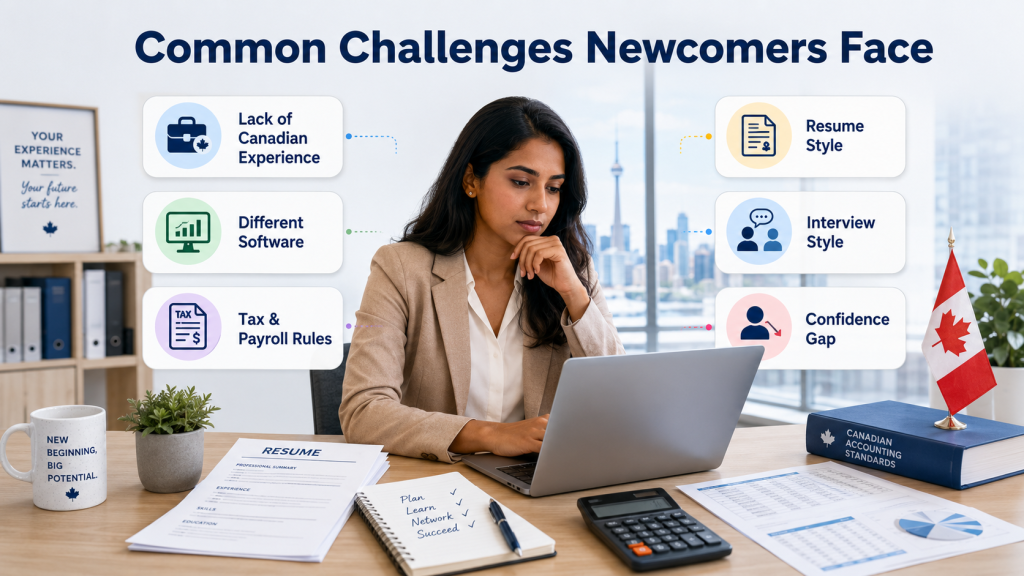
Common Challenges Newcomers Face
Newcomers may face some challenges when applying for accounting jobs in Canada. Understanding these challenges can help you prepare better.
1. Lack of Canadian Experience
Some employers prefer candidates with Canadian experience. This can be frustrating for newcomers who already have experience from another country.
One way to overcome this is to apply for entry-level roles, volunteer for bookkeeping opportunities, internships, contract roles, or small business support roles. Building even a few months of Canadian experience can help.
2. Different Software
A newcomer may know accounting software from another country, but Canadian employers may use QuickBooks, Sage, Excel, or local payroll tools.
Learning commonly used software can improve job readiness.
3. Canadian Tax and Payroll Rules
Tax and payroll rules are different in each country. Newcomers should learn Canadian basics so they can speak confidently in interviews.
4. Resume Style
Canadian resumes are usually concise and focused on skills, experience, and achievements. Personal details such as age, marital status, photo, and religion are not included.
5. Interview Style
Canadian interviews often focus on examples. Employers may ask about a time you solved a problem, handled a deadline, found an error, or worked with a team.
Preparing examples in advance can help.
6. Confidence Gap
Some newcomers have strong skills but feel unsure because they are new to the country. Confidence improves when you understand local job titles, software, duties, and employer expectations.
How to Prepare a Resume for Accounting Jobs in Canada
A strong resume can help newcomers get interviews.
Your accounting resume should include:
- A clear professional summary
- Accounting and bookkeeping skills
- Software skills
- Payroll knowledge
- Excel skills
- Work experience
- Education
- Certifications or training
- Achievements
- Keywords from the job posting
Avoid making the resume too general. If you are applying for an accounting clerk role, your resume should highlight invoice processing, reconciliations, data entry, accounts payable, accounts receivable, Excel, and attention to detail.
If you are applying for payroll roles, highlight payroll calculations, employee records, deductions, timesheets, confidentiality, and compliance.
Use action words such as:
- Prepared
- Reconciled
- Processed
- Recorded
- Verified
- Maintained
- Reviewed
- Assisted
- Generated
- Updated
- Organized
Example resume bullet:
“Reconciled monthly bank statements and identified transaction differences to support accurate financial reporting.”
This is stronger than simply writing:
“Worked in accounting.”
How to Prepare for Accounting Interviews
Accounting interviews often test both technical and practical skills.
You may be asked questions such as:
- What accounting software have you used?
- How do you handle errors in financial records?
- What is bank reconciliation?
- How do you manage deadlines?
- Have you worked with accounts payable or accounts receivable?
- How do you protect confidential information?
- What Excel functions do you know?
- How do you check your work for accuracy?
- What do you know about Canadian payroll?
- Tell us about a time you found a mistake in a report.
Prepare simple and honest answers. If you do not know something, show that you are willing to learn.
For example:
“I have used accounting software in my previous role, and I am currently learning QuickBooks and Canadian payroll basics so I can adapt to Canadian workplace requirements.”
This shows honesty and initiative.
How Newcomers Can Build Canadian Accounting Experience
Building experience is often the hardest part. But there are several ways to start.
1. Apply for Entry-Level Roles
Look for accounting clerk, bookkeeping assistant, payroll assistant, billing clerk, and office administrator roles.
2. Volunteer Carefully
Some non-profit organizations or community groups may need help with basic bookkeeping or admin work. Volunteer experience can help build confidence, but make sure the role is legitimate and appropriate.
3. Support Small Businesses
Some small businesses need help organizing receipts, invoices, spreadsheets, and basic records. This can provide practical exposure.
4. Learn Canadian Software
Practice with QuickBooks, Sage, Excel, and payroll examples. Practical software skills can help during interviews.
5. Take Short Training
Short programs focused on accounting and payroll can help newcomers understand Canadian workplace expectations.
Toronto Innovation College offers an Accounting and Payroll Course Canada that introduces accounting and payroll concepts useful for Canadian business environments.
6. Network With Professionals
Join newcomer groups, LinkedIn communities, employment centres, and local business events. Many opportunities come through connections.
7. Use Job Bank and LinkedIn
Search job titles regularly and study the skills employers request. This helps you understand market expectations. Government of Canada Job Bank
Keywords Newcomers Should Search
When looking for jobs, newcomers should search for different job titles, not only “accountant.”
Useful job search keywords include:
- Accounting Clerk
- Bookkeeper
- Payroll Clerk
- Payroll Assistant
- Accounts Payable Clerk
- Accounts Receivable Clerk
- Accounting Assistant
- Junior Accountant
- Billing Clerk
- Finance Assistant
- Accounting Technician
- Office Administrator Accounting
- QuickBooks Bookkeeper
- Sage Accounting Assistant
Searching multiple titles can help you find more opportunities.
Understanding Canadian Payroll Basics
Payroll is an important part of many accounting jobs. Even if you do not become a payroll specialist, basic payroll understanding can help.
Canadian payroll may include:
- Gross pay
- Net pay
- Income tax deductions
- CPP contributions
- EI premiums
- Vacation pay
- Overtime
- Statutory holiday pay
- Benefits
- Payroll remittances
- T4 slips
- Record of Employment
- Employee timesheets
A payroll professional must be careful because payroll affects employee trust. If employees are paid late or incorrectly, it can create stress and workplace issues.
Understanding payroll also helps accounting staff work better with HR and management. National Payroll Institute
The Importance of Accuracy and Ethics
Accounting professionals work with financial information. This requires honesty, responsibility, and ethics.
Newcomers should understand that accuracy is not optional in accounting. If you are unsure, ask. If you find an error, report it. If information is confidential, protect it.
Accounting ethics include:
- Being honest
- Keeping records accurate
- Protecting confidential data
- Following company policies
- Avoiding conflicts of interest
- Not changing records without approval
- Reporting mistakes properly
- Keeping supporting documents
Employers value candidates who are trustworthy and responsible.
How Technology Is Changing Accounting Jobs
Accounting jobs are becoming more digital. Many companies use cloud accounting, automated invoices, bank feeds, digital receipts, payroll software, and dashboards.
This does not mean accounting jobs are disappearing. It means accounting professionals need to become comfortable with technology.
Useful technology skills include:
- Excel
- QuickBooks
- Sage
- Payroll software
- Cloud accounting tools
- PDF and document management
- Online banking portals
- ERP systems
- Basic data analysis
- Report generation
Newcomers who combine accounting knowledge with software skills can be more competitive.
Accounting Jobs in Small Businesses
Small businesses are important employers for accounting and bookkeeping roles. In a small business, one person may handle many tasks.
A small business accounting role may include:
- Invoicing customers
- Recording expenses
- Paying bills
- Tracking receipts
- Preparing bank deposits
- Reconciling accounts
- Supporting payroll
- Filing documents
- Preparing reports for the owner
- Working with an external accountant
Small business roles can be great for learning because they expose you to many parts of the accounting process.
Accounting Jobs in Larger Companies
Larger companies may have separate departments for accounts payable, accounts receivable, payroll, tax, financial reporting, and budgeting.
In a larger company, your role may be more specialised. For example, you may only work with supplier invoices or only customer payments.
This can be useful if you want to build expertise in one area.
Larger companies may also use ERP systems, stronger internal controls, and formal reporting processes. This experience can help long-term career growth.
Career Growth in Accounting
Newcomers can grow in accounting over time. A person may start as an accounting clerk and later move into bookkeeping, payroll, junior accounting, financial analysis, or supervisory roles.
A possible career path may look like:
Accounting Clerk → Bookkeeper → Accounting Technician → Junior Accountant → Accountant → Finance Manager
Another path may be:
Payroll Clerk → Payroll Administrator → Payroll Specialist → Payroll Manager
Career growth depends on education, experience, certifications, software skills, communication, and workplace performance.
Some newcomers may also choose to pursue Canadian accounting designations later, depending on their long-term goals.
How to Stand Out as a Newcomer
To stand out, newcomers should focus on practical readiness.
You can improve your chances by:
- Learning Canadian accounting basics
- Building strong Excel skills
- Practising QuickBooks or Sage
- Understanding payroll basics
- Preparing a Canadian-style resume
- Using job posting keywords
- Practising interview answers
- Improving workplace communication
- Applying to entry-level roles
- Building local experience
- Staying patient and consistent
Employers want candidates who are accurate, reliable, trainable, and professional.
Mistakes Newcomers Should Avoid
1. Applying Only for Accountant Titles
Many newcomers search only for “accountant” jobs. This may be too narrow. Also search for clerk, assistant, bookkeeper, payroll, and technician roles.
2. Ignoring Software Skills
Even strong accounting knowledge may not be enough if you are not familiar with commonly used tools.
3. Using a Very Long Resume
Canadian resumes should usually be focused and easy to read. Highlight relevant skills and experience.
4. Not Learning Payroll Basics
Payroll knowledge can make your profile stronger for small business and admin-accounting roles.
5. Not Preparing Interview Examples
Employers like real examples. Prepare stories about accuracy, deadlines, teamwork, and problem-solving.
6. Waiting for the Perfect Job
Your first Canadian role may not be your dream role. It can still help you build experience and confidence.
Conclusion
Accounting jobs in Canada can offer practical opportunities for newcomers, but preparation is important. Newcomers should understand Canadian job titles, workplace expectations, accounting software, payroll basics, sales tax concepts, communication style, and resume requirements.
Accounting work in Canada may include bookkeeping, payroll, accounts payable, accounts receivable, invoicing, bank reconciliation, financial records, and reporting. Entry-level roles such as accounting clerk, bookkeeper, payroll assistant, and accounting assistant can help newcomers build Canadian experience.
The most important skills include accuracy, Excel, QuickBooks, Sage, payroll knowledge, attention to detail, confidentiality, and communication. Technology is also changing accounting work, so newcomers should be comfortable learning digital tools.
Success in the Canadian accounting job market does not happen overnight. It requires patience, learning, practice, and consistent applications. But with the right preparation, newcomers can build a strong foundation and grow into better accounting, payroll, bookkeeping, or finance roles over time.
For newcomers who want to strengthen their understanding of Canadian accounting and payroll basics, Toronto Innovation College’s Accounting and Payroll Course Canada can be a helpful starting point for learning practical business-focused accounting concepts.
FAQs
1. Are accounting jobs good for newcomers in Canada?
Yes. Accounting, bookkeeping, payroll, and accounting assistant roles can be good options for newcomers because many businesses need financial record-keeping and payroll support.
2. What accounting jobs can newcomers apply for in Canada?
Newcomers can apply for roles such as accounting clerk, bookkeeper, payroll clerk, accounts payable clerk, accounts receivable clerk, accounting assistant, and finance assistant.
3. Do I need Canadian experience for accounting jobs?
Some employers prefer Canadian experience, but newcomers can start with entry-level roles, short training, volunteer experience, contract work, or small business support roles.
4. Which software is useful for accounting jobs in Canada?
Useful software includes Microsoft Excel, QuickBooks, Sage, payroll software, and sometimes ERP systems such as SAP, Oracle, Microsoft Dynamics, or NetSuite.
5. Is payroll knowledge useful for newcomers?
Yes. Payroll knowledge is useful because many accounting and administrative roles include payroll-related tasks such as deductions, timesheets, vacation pay, and employee records.
6. What skills do employers look for in accounting candidates?
Employers look for accuracy, attention to detail, Excel skills, bookkeeping knowledge, payroll basics, communication, confidentiality, organization, and software knowledge.
7. What is the easiest accounting job to start with in Canada?
Many newcomers start with accounting clerk, bookkeeping assistant, accounts payable clerk, accounts receivable clerk, payroll assistant, or office administrator roles with accounting duties.
8. Do I need QuickBooks for accounting jobs in Canada?
QuickBooks is not required for every job, but it is commonly used by small and medium-sized businesses, so learning it can improve job readiness.
9. How can I improve my accounting resume for Canada?
Use a clear Canadian-style resume, include accounting keywords, highlight software skills, show achievements, and focus on relevant duties such as reconciliation, invoicing, payroll, and reporting.
10. Can accounting lead to long-term career growth in Canada?
Yes. Newcomers can grow from entry-level accounting roles into bookkeeping, payroll, junior accountant, accounting technician, finance assistant, or more advanced finance positions over time.