
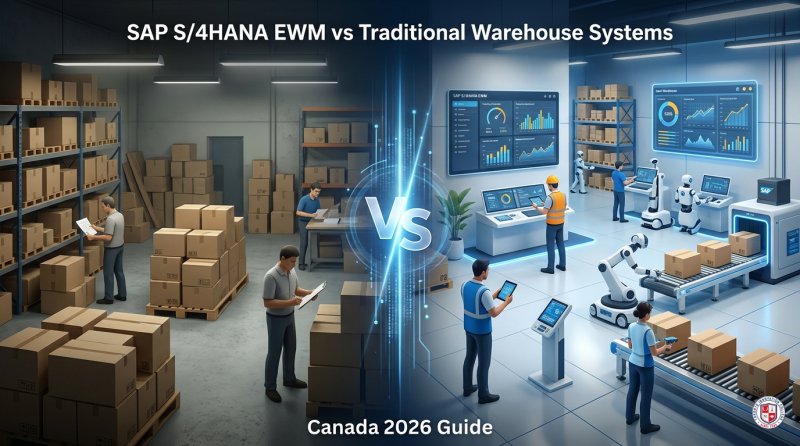
Canada’s supply chain and logistics industry is at an inflection point. With e-commerce volumes surging, cross-border trade growing, and warehouses under mounting pressure to do more with less, businesses from Vancouver to Halifax are rethinking how they manage their operations. Digital transformation — once a boardroom buzzword — is now a ground-floor reality for warehouse managers, logistics coordinators, and supply chain professionals across the country.
At the centre of this shift is a fundamental question: should Canadian businesses stick with traditional warehouse management systems that have worked for decades, or leap to modern platforms like SAP S/4HANA Extended Warehouse Management?
If you work in logistics, warehousing, or supply chain — or if you are looking to build a career in this space — understanding the difference matters. And for those looking to stay ahead of the curve, SAP S/4HANA EWM Training in Canada is quickly becoming one of the most sought-after professional development paths in the industry.
This blog breaks down exactly what separates traditional warehouse systems from SAP EWM, why Canadian businesses are making the switch, and what career opportunities are opening up for trained professionals right now.
What Are Traditional Warehouse Systems?
Traditional warehouse management systems (WMS) have been around since the 1970s and 1980s. For a long time, they did the job well. At their core, these systems were designed to track inventory, manage stock locations, and coordinate the movement of goods in and out of a facility.
Key Features of Traditional WMS
- Basic inventory tracking (in/out movements)
- Barcode scanning and manual data entry
- Bin and location management
- Simple order picking and packing workflows
- Periodic stock reporting
These systems were largely built on-premise, meaning they ran on local servers and required IT teams to maintain them. Updates were slow, integrations were limited, and the data they produced was often delayed or incomplete.
The Limitations Start to Show
As supply chains became more complex and customer expectations shifted, the cracks in traditional systems started to show. Here is where they typically fall short:
- Batch processing delays: Many legacy systems process transactions in batches rather than in real time, which means warehouse managers often do not have an accurate picture of inventory until hours later.
- Poor integration: Connecting a traditional WMS to an ERP system, transportation management platform, or e-commerce storefront is often a painful, costly process requiring custom middleware.
- Limited scalability: These systems struggle to handle rapid growth, seasonal spikes, or new fulfillment models like same-day delivery or omnichannel operations.
- Weak analytics: Reporting is often basic. Getting actionable insights from the data requires manual extraction and separate tools.
- Costly maintenance: On-premise infrastructure requires ongoing investment in hardware, IT staff, and software licensing.
For small operations with straightforward needs, a traditional WMS can still be adequate. But for growing businesses or enterprise-level operations, these limitations create real bottlenecks.
What Is SAP S/4HANA EWM?
SAP Extended Warehouse Management, embedded within the SAP S/4HANA platform, is a next-generation warehouse management solution built to handle the complexity of modern supply chains. Unlike traditional systems bolted onto older ERP platforms, EWM is natively integrated into SAP S/4HANA — which means real-time data flows seamlessly across finance, procurement, production, and logistics.
SAP’s official product page describes EWM as a solution designed to manage high-volume warehouse operations with precision, automation, and full visibility.
Core Features of SAP S/4HANA EWM
- Real-time inventory visibility: Every movement is tracked and reflected immediately across the system.
- Advanced slotting and storage optimization: The system can automatically determine the best storage location based on multiple parameters, including size, weight, demand frequency, and expiry dates.
- Labour management: Built-in tools to track workforce productivity, assign tasks efficiently, and optimize staffing levels.
- Yard and dock management: Manages the movement of vehicles in and out of distribution centres, reducing wait times and improving throughput.
- Wave and task management: Automates the planning and sequencing of picking tasks to reduce travel time and improve order accuracy.
- Multi-step goods movements: Handles complex putaway and picking strategies, including cross-docking, pick-and-pack, and value-added services.
- Integration with IoT and automation: Connects directly with automated storage and retrieval systems (AS/RS), conveyor belts, robots, and RFID readers.
Why Businesses Are Adopting It
The benefits go beyond features. SAP EWM gives businesses the ability to adapt quickly, scale without disruption, and make decisions based on live data. In a world where a single delay can cost a company a major customer relationship, that kind of agility is not optional — it is essential.
SAP S/4HANA EWM vs Traditional Warehouse Systems: A Detailed Comparison
Let us look at the key differences side by side.
Real-Time vs Batch Processing
Traditional WMS platforms often rely on batch updates — transactions are recorded and processed at set intervals. This creates a data lag. Warehouse managers may not know their actual inventory position until the next processing cycle completes.
SAP EWM operates in real time. Every scan, every movement, every transaction updates the system instantly. This means fewer picking errors, more accurate inventory counts, and faster response to disruptions.
Automation Capabilities
Most legacy systems were not designed with automation in mind. Connecting them to robotics or automated equipment typically requires expensive custom development.
SAP EWM is built to integrate with modern automation technologies out of the box — including robotic picking systems, autonomous mobile robots (AMRs), conveyor systems, and voice-directed picking tools. As Canadian warehouses invest more in automation, having a system that can communicate directly with that equipment is a significant advantage.
Integration with the Broader Business
A traditional WMS is often an island. It does its job in isolation, and syncing it with financial systems or customer-facing platforms requires significant effort.
SAP EWM sits inside SAP S/4HANA, which means it shares a single data model with finance, procurement, sales, and manufacturing modules. There is no need for middleware or manual reconciliation. A sales order placed in the morning flows through to the warehouse floor within seconds.
Scalability
Traditional systems can buckle under sudden volume increases — think peak holiday season, a new product launch, or rapid business growth. They often require hardware upgrades or manual reconfigurations to handle more throughput.
SAP S/4HANA EWM scales with the business. Cloud deployment options mean capacity can be adjusted on demand, and the system’s architecture handles multi-site, multi-country, and multi-currency operations natively.
Analytics and Reporting
Legacy WMS reporting is typically limited to static reports generated on a schedule. Getting meaningful insights requires exporting data and processing it in separate tools.
SAP EWM includes embedded analytics powered by SAP HANA’s in-memory database. Managers can monitor KPIs, track labour efficiency, and identify bottlenecks in real time — directly within the system.
Why Canada Is Moving Toward SAP EWM
Several converging forces are driving Canadian businesses to adopt SAP S/4HANA EWM at a faster rate than ever before.
E-Commerce Growth Is Raising the Bar
Canada’s e-commerce market has grown substantially over the past several years and shows no sign of slowing. According to data from Statista and various Canadian retail industry reports, online retail penetration continues to climb, pushing fulfilment centres to process higher volumes with faster turnaround times and greater accuracy. Traditional systems simply cannot keep pace with same-day and next-day delivery expectations.
SAP S/4HANA Adoption Is Accelerating
SAP has set a deadline for businesses to migrate from its legacy ECC platform to S/4HANA. Many Canadian enterprises that have been running SAP ECC for years are now mid-migration, and they need skilled people who understand EWM in the new environment. This migration wave is creating significant demand for SAP EWM professionals across the country.
Smart Warehouses Are Moving from Concept to Reality
Canadian distribution hubs — particularly in the Greater Toronto Area, Vancouver, Calgary, and Montreal — are actively investing in smart warehouse technology. From automated picking robots to RFID-enabled tracking and AI-based demand forecasting, the physical infrastructure is evolving rapidly. SAP EWM is the software layer that makes all of that technology work together.
Career Opportunities in Canada for SAP EWM Professionals
The demand for SAP EWM expertise in Canada is real, and it is growing. As more businesses complete their S/4HANA migrations and invest in warehouse automation, they need people who understand both the technology and the operational context.
In-Demand Job Roles
- SAP EWM Consultant (functional and technical)
- SAP Supply Chain Analyst
- Warehouse Management Systems Specialist
- SAP S/4HANA Implementation Lead
- Logistics Technology Manager
- ERP Business Analyst (with EWM specialization)
Salary Insights
SAP functional consultants with EWM experience in Canada typically earn between CAD $85,000 and $130,000 per year, depending on experience level, industry, and location. Senior consultants and project leads in the Greater Toronto Area and Vancouver can command rates well above this range, particularly in contract roles.
Where the Demand Is Strongest
The strongest demand is concentrated in:
- Ontario (manufacturing, retail, 3PL, distribution)
- British Columbia (port logistics, e-commerce, retail)
- Alberta (energy sector supply chains, industrial distribution)
- Quebec (manufacturing, agri-food, pharmaceutical)
Roles are available both with end-user companies implementing SAP EWM internally and with consulting firms managing implementation projects for clients.
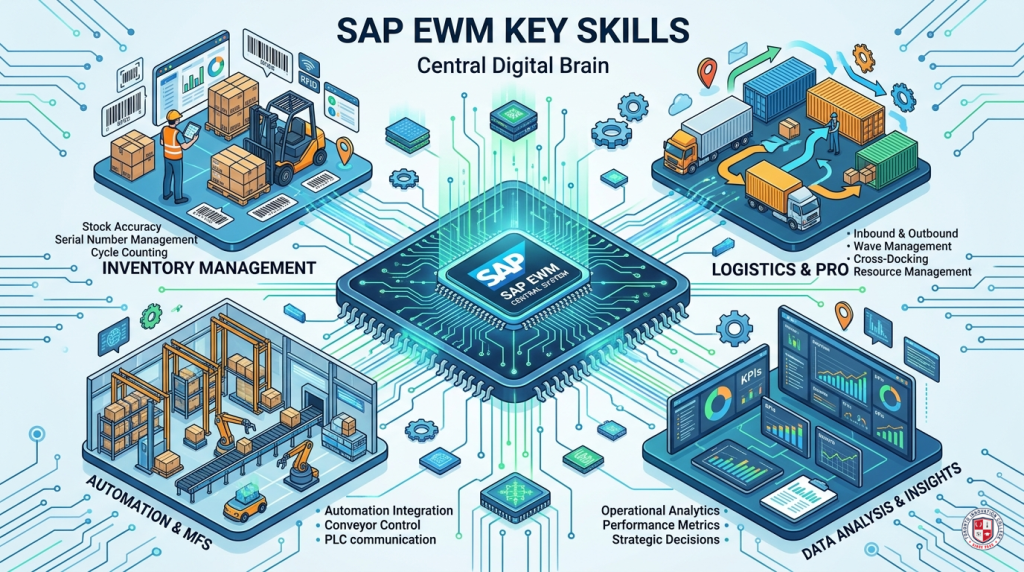
Why Learning SAP EWM Is a Smart Career Move Right Now
If you are weighing your options as a logistics professional or recent graduate in Canada, SAP EWM training is one of the highest-return investments you can make in your career today.
Future-Proof Skills
Warehousing and supply chain management are not going away — they are becoming more central to how businesses compete. And as automation, AI, and real-time data reshape those functions, the professionals who understand the underlying technology will be the ones directing operations, not being replaced by them.
SAP S/4HANA is not a niche platform. It powers some of the world’s largest and most complex supply chains. Expertise in SAP EWM gives you credibility across industries and geographies.
Certification Adds Marketability
Earning an SAP S/4HANA EWM Certification signals to employers that your skills have been validated against a recognized standard. In a competitive job market, this distinction matters. Many companies specifically filter candidates by SAP certification status when hiring for implementation roles.
If you are looking for a structured path to get there, the SAP S/4HANA EWM Training in Canada offered by Toronto Innovation College is one of the most comprehensive programs available for Canadian learners, combining practical, scenario-based learning with exam preparation.
Challenges to Be Aware Of
It would not be a fair assessment without acknowledging the challenges. SAP EWM is a powerful tool, but it is not a simple one.
Learning Curve
SAP EWM has significant depth. Understanding how to configure warehouse structures, define process types, manage transfer orders, and work with labour management features takes time and guided instruction. Learners with no prior SAP exposure should expect a steeper initial climb.
Complexity of Real-World Implementations
In practice, no two EWM implementations are exactly alike. Every warehouse has its own processes, constraints, and legacy data challenges. Translating theoretical knowledge into implementation skills requires hands-on experience — ideally through project work or a well-designed SAP warehouse management course that incorporates real-world scenarios.
Cost of Training
Quality SAP training is an investment. However, given the salary premium that certified SAP professionals command in Canada, the return on that investment is typically strong for those who commit to the learning process.
Future Trends Shaping SAP EWM and Warehousing in Canada (2026 and Beyond)
Looking ahead, several trends will shape how SAP EWM evolves and how demand for skilled professionals continues to grow.
Artificial Intelligence in Warehouse Operations
AI-powered demand forecasting, slotting optimization, and predictive maintenance are moving from experimental to operational. SAP is embedding AI capabilities directly into its supply chain suite, and EWM will be a primary beneficiary. Professionals who understand both AI concepts and EWM architecture will be especially well-positioned.
Warehouse Automation at Scale
The adoption of autonomous mobile robots, goods-to-person systems, and AI-guided picking technology is accelerating across North American distribution centres. SAP EWM’s ability to serve as the orchestration layer for these technologies means its strategic importance will only increase.
Cloud ERP as the Default
SAP is pushing aggressively toward cloud-based deployment. RISE with SAP — its managed cloud offering — is helping mid-market and enterprise companies migrate to S/4HANA in the cloud. This shift broadens the market for SAP EWM beyond large enterprises and creates new opportunities for consultants and system administrators with cloud ERP experience.
Sustainability Reporting and Green Logistics
Regulatory pressure around sustainability in Canada is growing. SAP S/4HANA increasingly supports sustainability data tracking and ESG reporting. Warehouse operations will be expected to contribute data to these frameworks, and EWM will play a role in capturing and reporting on energy use, returns processing, and waste reduction.
Conclusion
The gap between traditional warehouse management systems and SAP S/4HANA EWM is not just technical — it represents a fundamentally different approach to how modern supply chains are run. Traditional systems were built for a simpler era. SAP EWM was built for the complexity and speed of today’s logistics landscape.
For Canadian businesses, the direction of travel is clear. E-commerce growth, SAP migration timelines, and investment in automation are all pushing the industry toward more sophisticated, integrated, and intelligent warehouse management. The professionals who will thrive in this environment are those who understand EWM and can apply it in real-world settings.
If you are ready to build that expertise, exploring a structured SAP S/4HANA EWM Course in Canada is the logical next step. The SAP S/4HANA EWM Training in Canada at Toronto Innovation College is designed specifically for learners looking to enter or advance in this field, with a curriculum aligned to current industry demands and SAP certification standards.
The warehouses of 2026 will look very different from those of 2016. The question is whether your skills will be ready for them.
This article is intended for informational purposes for professionals and students interested in SAP EWM and supply chain careers in Canada.