

Procurement may look simple from the outside: a business needs something, finds a supplier, places an order, receives the goods, and pays the invoice.
In a real organization, however, procurement is connected with inventory, finance, suppliers, approvals, planning, warehousing, and business reporting. A small purchasing decision can affect several departments at the same time.
This is where enterprise systems such as SAP become important.
Professionals exploring SAP supply chain training in Canada often begin by learning how purchasing activities move through an integrated SAP environment. Instead of looking at procurement as a series of separate tasks, learners begin to understand it as one connected business process.
A typical procurement flow can include a requirement for material, a purchase requisition, supplier selection, a purchase order, goods receipt, invoice verification, and finally payment processing.
Understanding this flow is especially useful for beginners interested in procurement, supply chain, inventory management, logistics, or SAP functional careers.
Toronto Innovation College’s SAP S/4HANA Sourcing and Procurement Course is designed around areas such as material management, procurement processes, vendor management, Material Requirements Planning, practical exercises, and business scenarios.
This guide explains the SAP procurement process step by step and shows what beginners can expect to learn when building practical sourcing and procurement skills.
Why Procurement Is More Than Simply Buying Products
Every organization needs goods or services to operate.
A manufacturing company may purchase raw materials. A retailer may purchase products for resale. A hospital may purchase equipment and supplies. A technology company may purchase laptops, software licenses, and professional services. An educational institution may purchase classroom equipment, office materials, technology services, and facility-related items.
The procurement department helps ensure those requirements are fulfilled appropriately.
But procurement is not simply about finding the lowest price.
Businesses also need to consider supplier reliability, quantity, quality, delivery dates, inventory availability, contracts, approval processes, payment terms, and internal policies.
This means procurement interacts with multiple areas of the organization.
A purchasing decision can affect inventory levels, warehouse activities, accounts payable, cash flow, production planning, and operational continuity.
One major value of an ERP environment is that these activities can be connected through a common system rather than managed as completely separate processes.
What SAP S/4HANA Sourcing and Procurement Means
SAP S/4HANA Sourcing and Procurement supports purchasing, materials, supplier, and procurement-related business processes within the broader SAP enterprise environment.
Beginners researching this career area may frequently come across the term SAP MM, or Materials Management. SAP MM remains a commonly used industry and search term associated with traditional SAP materials management concepts such as purchasing, inventory management, material master data, and related processes.
However, learners should not assume that SAP MM and SAP S/4HANA Sourcing and Procurement are simply two identical names for the same offering. In the current SAP S/4HANA environment, sourcing and procurement capabilities are structured within the broader S/4HANA business-process landscape, and modern training is often positioned around SAP S/4HANA Sourcing and Procurement.
For beginners, the most useful approach is to understand the underlying business processes first: organizations need to plan materials, maintain supplier information, purchase goods or services, receive those purchases, manage inventory, and verify supplier invoices.
A structured SAP S/4HANA procurement training path therefore teaches more than system navigation.
Students need to understand the business reason behind each activity. Why does a business create a purchase requisition before creating a purchase order? Why must goods receipt be recorded? Why does an invoice need to be checked against purchasing and receiving information? Why do material and supplier records matter?
Once these questions make sense, the SAP procurement process becomes much easier to understand.
The Procure-to-Pay Process Beginners Should Understand
One of the most important concepts for anyone studying SAP procurement is the procure-to-pay process.
The process can be summarized as:
Business Requirement → Purchase Requisition → Supplier Selection → Purchase Order → Goods Receipt → Invoice Verification → Payment
Not every organization uses exactly the same workflow, and real procurement scenarios can become much more complex. However, this sequence gives beginners a useful foundation.
Each stage creates information that can influence the next.
For example, the purchase order tells the supplier what the organization expects to receive. The goods receipt confirms what was actually received. The invoice represents what the supplier wants to be paid. The finance process then uses this information when determining whether payment can proceed.
This connection is why SAP procurement knowledge can be useful to professionals beyond traditional purchasing roles.
Step 1: Identifying a Business Requirement
Procurement begins with a need.
Suppose a manufacturing company discovers that it will require 5,000 additional units of a raw material next month.
The organization must determine what material is needed, how much is required, when it is needed, where it should be delivered, whether the item is already available in inventory, whether there is an approved supplier, and whether purchasing authorization is required.
The requirement may originate from a department, inventory planning, production planning, maintenance needs, or another business process.
This first step teaches beginners an important lesson: SAP procurement starts with business requirements, not with clicking a Purchase Order button.
A strong functional learner should understand why the transaction exists before learning how it is entered into the system.
Step 2: Creating a Purchase Requisition
A purchase requisition is generally an internal request to procure a material or service.
Think of it as the organization saying: “We need this item.”
It is not necessarily the document sent to the supplier.
The requisition communicates the internal purchasing requirement and can contain information such as the material or service required, quantity, requested delivery date, and other relevant details.
Depending on the organization’s process, the requisition may need approval before purchasing continues.
For beginners in SAP training for beginners, understanding the difference between a purchase requisition and a purchase order is essential.
A purchase requisition represents an internal need. A purchase order is generally the formal purchasing document used to communicate the order to the supplier.
Confusing these two documents makes the rest of procurement more difficult to understand.
Why Approval Workflows Matter
Organizations usually do not want every employee purchasing anything they want without controls.
Procurement processes may therefore include approval requirements.
For example, a small purchase may require one level of approval, while a high-value purchase may require additional authorization.
The precise workflow varies between organizations. The important concept for beginners is control.
Enterprise procurement systems help organizations apply business rules to purchasing processes. This supports consistency and gives organizations clearer visibility into who requested something, who approved it, and what purchasing action followed.
For someone building a career in SAP procurement, understanding the business logic behind approvals can be just as useful as knowing which system screen supports them.
Step 3: Supplier Selection
After a requirement is recognized, the organization must determine where the material or service should come from.
Supplier selection can involve factors such as price, quality, availability, delivery performance, payment terms, existing agreements, supplier reliability, and business requirements.
A company may already have an established supplier for a particular material. In other cases, the purchasing team may need to evaluate different options.
Beginners studying SAP supply chain training in Canada should understand that sourcing decisions affect more than procurement.
A poor supplier decision can create delayed production, stock shortages, quality problems, additional transportation costs, or customer-service issues.
Procurement professionals therefore need both system understanding and business judgment.
Why Supplier Data Is Important
Enterprise systems depend heavily on reliable data.
If supplier information is incorrect, business transactions may also become incorrect.
Supplier-related information may influence addresses, purchasing details, payment information, organizational relationships, and other transaction data.
This introduces beginners to a major SAP concept: master data.
Master data is information that is reused across many transactions. Instead of entering the same supplier or material information from scratch every time, organizations maintain structured records that can support recurring business processes.
Understanding master data is essential because many SAP issues are not caused by the transaction itself. Sometimes the transaction is behaving exactly as configured – the underlying data is the real problem.
Material Master Data and Procurement
The same principle applies to materials.
An organization’s system needs to know what the material is and how it should be handled.
Different materials may have different units of measure, purchasing requirements, inventory behaviour, planning settings, valuation rules, and organizational information.
Material master data has traditionally been an important concept associated with SAP Materials Management (SAP MM). Learners searching online for SAP MM training Canada will therefore frequently encounter material master data, purchasing, and inventory management as core learning areas.
In a modern SAP S/4HANA learning path, these concepts can be studied within the broader context of Sourcing and Procurement and related materials-management processes.
Beginners need to understand the connection between the material record and actual purchasing behaviour.
If an organization purchases thousands of different materials, reliable material information becomes fundamental to efficient procurement.
A learner who understands master data begins to see SAP not simply as a collection of screens, but as a connected business information environment.
Step 4: Creating the Purchase Order
After the requirement and source have been determined, the purchasing process can move toward the purchase order.
A purchase order communicates what the organization intends to purchase from the supplier.
It may include information such as supplier, material or service, quantity, price, delivery date, delivery location, and purchasing terms.
The purchase order becomes a central reference point for later stages.
When goods arrive, employees can compare the delivery with what was ordered. When the supplier sends an invoice, the organization can compare the invoice with the purchasing and receiving information.
This is one reason the purchase order should not be viewed as an isolated document. It connects purchasing with downstream processes.
Purchase Requisition vs Purchase Order
This distinction is important enough to repeat.
A purchase requisition represents the internal request or requirement.
A purchase order represents the purchasing commitment or order placed with the supplier according to the organization’s process.
For example, a department realizes that it needs 20 laptops. It raises an internal request. After approvals and supplier selection, purchasing creates the formal order.
That simple scenario helps beginners understand how business controls and purchasing documents work together.
When you study SAP S/4HANA procurement training, understanding these relationships is more valuable than memorizing document names without context.
Step 5: Goods Receipt
Creating a purchase order does not mean the goods have arrived.
When the supplier delivers the material, the organization needs to record that receipt. This is known as goods receipt.
Suppose the purchase order was for 100 units. Did the supplier deliver all 100? Were only 80 received? Was the correct material delivered? Was it delivered to the expected location?
Recording receipt is important because physical movement and system information should remain aligned.
If the warehouse contains goods that the system does not know about – or the system shows goods that do not physically exist – inventory decisions become unreliable.
Why Goods Receipt Matters for Inventory
This is where procurement connects directly with inventory management.
Once goods are received and appropriately recorded, the organization’s inventory position may change.
Other teams can then work with more accurate availability information.
A production planner may need to know whether materials are available for manufacturing. A warehouse employee may need to know where incoming items should be handled. A buyer may need to know whether the supplier fulfilled the order. An accountant may need evidence that the goods were received before an invoice is processed.
This cross-functional connection is one reason an SAP inventory management course or procurement program should teach business processes rather than individual transactions in isolation.
Step 6: Invoice Verification
After delivering goods or services, the supplier normally sends an invoice requesting payment.
The organization should not automatically pay every invoice without checking it.
The invoice needs to be evaluated against the relevant purchasing information.
Conceptually, the organization wants to confirm: What did we order? What did we receive? What is the supplier billing us for?
If those pieces of information align appropriately, the invoice can move forward according to the organization’s process.
If they do not align, the discrepancy may need investigation.
For example, the supplier might invoice 100 units while only 80 units were recorded as received. The price on the invoice may differ from the expected price. Or the invoice may reference an incorrect purchase order.
This makes invoice verification an important control point.
Understanding the Three-Way Match Concept
A useful beginner concept is the relationship between Purchase Order, Goods Receipt, and Supplier Invoice.
These three pieces of information help organizations validate procurement and payment activities.
The purchase order represents what was ordered. The goods receipt represents what was received. The invoice represents what the supplier wants to be paid for.
Understanding this relationship helps learners see why procurement and finance are closely connected.
A buyer may think primarily about the supplier and material. An accounts payable professional may think primarily about the invoice. SAP connects those perspectives through the underlying business process.
Step 7: Payment and the Finance Connection
The purchasing team does not necessarily perform the final supplier payment.
Payment is normally connected with finance and accounts payable processes.
However, procurement activities create much of the information needed earlier in the cycle.
This demonstrates a core principle of enterprise resource planning: One department’s transaction can become another department’s input.
Purchasing creates an order. Warehouse operations record receipt. Invoice verification confirms supplier billing. Finance handles the financial obligation and payment according to the organization’s procedures.
For students interested in supply chain management with SAP, this cross-functional understanding is extremely valuable.
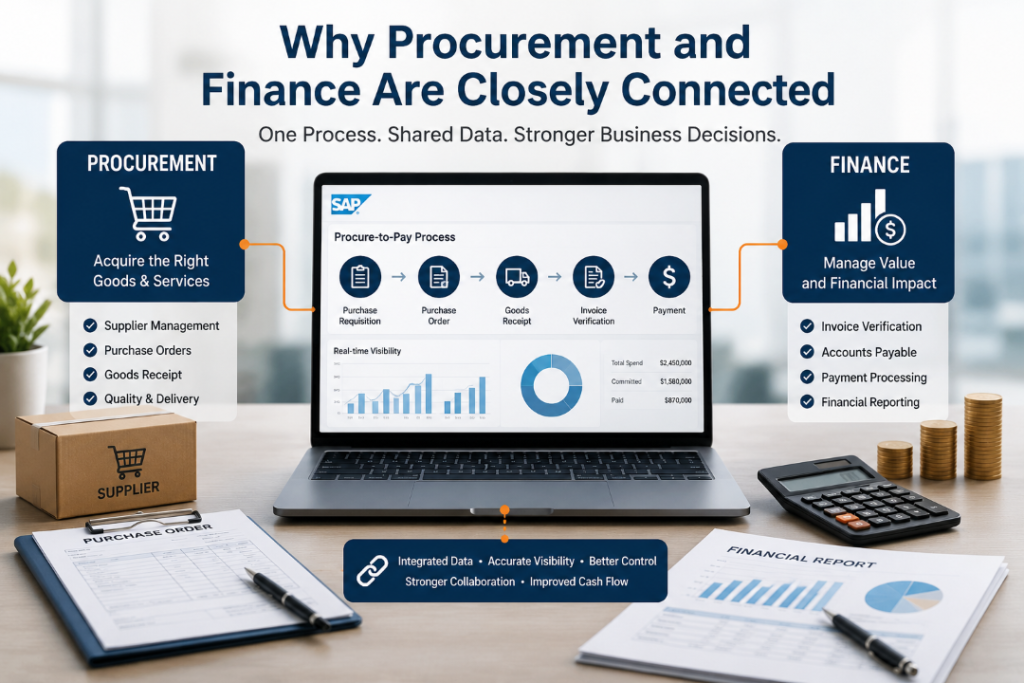
Why Procurement and Finance Are Closely Connected
Every purchase has a financial impact.
If an organization buys raw materials, services, equipment, or operating supplies, money is ultimately involved.
Procurement professionals therefore interact indirectly – and sometimes directly – with financial processes.
This becomes especially important in consulting or implementation environments.
A procurement configuration decision can have consequences for accounting. Similarly, finance requirements may influence how purchasing activities are structured.
A strong SAP functional learner gradually develops the ability to think beyond one screen or module.
Instead of asking only “How do I create this document?” they begin asking “What happens before this transaction, and what happens after it?”
That is a much more valuable enterprise mindset.
Where Material Requirements Planning Fits
Material Requirements Planning, commonly called MRP, helps businesses think about what materials will be needed and when they may be required.
For example, a manufacturer may know that it plans to produce a certain number of finished products next month. Those finished products require raw materials.
The business needs to understand whether enough material is already available or whether additional supply may be needed.
This connects planning with procurement.
For beginners, the important idea is that procurement is frequently responding to broader operational demand. Purchasing decisions therefore need to support business planning rather than happen randomly.
Inventory Management Is Part of the Bigger Picture
Inventory management deals with how organizations track and manage materials in their operations.
Procurement brings goods into the organization. Inventory processes help track what is available and how materials move. Warehouse processes deal with the physical handling of those materials. Production may consume materials. Sales and distribution may move finished products toward customers. Finance records the financial effects.
Understanding these relationships is one of the biggest benefits of structured SAP supply chain training in Canada.
Instead of viewing supply chain functions as disconnected jobs, learners see how the processes interact through an enterprise system.
Understanding SAP MM and SAP S/4HANA Sourcing and Procurement
People researching SAP procurement careers frequently encounter the term SAP MM.
SAP MM, or Materials Management, is a long-established and commonly used SAP term associated with areas such as purchasing, material master data, inventory management, and related materials processes. Because the term remains widely recognized among employers, professionals, and learners, searches such as SAP MM training Canada are still common.
However, beginners should understand the distinction between this familiar terminology and the way modern SAP S/4HANA learning is structured.
Current SAP S/4HANA procurement learning is commonly framed around SAP S/4HANA Sourcing and Procurement, which reflects procurement capabilities within the broader S/4HANA environment.
Therefore, SAP MM should not be treated as the official name of every current S/4HANA procurement course or as a term that is automatically interchangeable with SAP S/4HANA Sourcing and Procurement.
For beginners, the best approach is to focus first on the underlying business processes:
- How materials are defined and managed
- How purchasing requirements arise
- How supplier information supports procurement
- How purchase requisitions and purchase orders work
- How materials are received
- How inventory is affected
- How supplier invoices connect with purchasing
- How procurement integrates with finance and other business functions
Once learners understand these processes, it becomes much easier to understand how familiar SAP MM concepts relate to today’s SAP S/4HANA procurement environment.
What Beginners Should Learn Before Memorizing Transactions
A common beginner mistake is trying to memorize SAP transactions or screen navigation without understanding what the process does.
That approach may help someone reproduce a classroom demonstration, but it does not necessarily build real understanding.
Instead, start with questions such as: Why does the business need this document? Who creates it? Who approves it? Which information does it contain? What process occurs before it? What process comes after it? Which department uses the information next? What could go wrong? What business control is being applied?
Once these questions are clear, the technical steps become easier to remember because they have meaning.
A Practical Example of the Complete Procurement Flow
Imagine a Canadian manufacturer needs additional packaging material.
The production team expects demand to increase next month. The organization identifies a need for 10,000 additional packaging units. An internal requirement is created. The purchasing team reviews the request and confirms the appropriate supplier. A purchase order is created for 10,000 units. The supplier delivers 10,000 units to the warehouse. Warehouse staff record the goods receipt. Inventory information reflects the newly received material. The supplier sends an invoice. The invoice is checked against the purchasing and receiving information. Once the process is validated according to company procedures, the financial side can proceed toward payment.
One business requirement has now touched planning, procurement, supplier management, warehouse operations, inventory, invoice processing, and finance.
That is the value of learning procurement as an end-to-end process.
What Hands-On SAP Practice Should Teach You
A practical course should help learners move beyond reading process definitions.
Students benefit from seeing how business information flows through the system.
For example, a beginner should eventually be able to explain why a purchase requisition exists, how it differs from a purchase order, what supplier information is required, how material information affects purchasing, what happens when goods are received, how receipt affects inventory, why invoice verification matters, and how procurement connects with finance.
These are transferable concepts.
Even when system layouts, organizations, or implementations differ, the learner understands the underlying business logic.
Do You Need Supply Chain Experience Before Learning SAP Procurement?
Not necessarily.
Previous experience can certainly help. A buyer may already understand purchase orders. A warehouse employee may understand receiving and inventory. An accounts payable employee may understand supplier invoices. A logistics professional may understand material movement. A supply chain graduate may understand procurement principles.
However, beginners can also learn the process step by step.
This makes the learning path relevant not only to experienced supply chain professionals but also to learners who want to build foundational SAP procurement knowledge.
Which Backgrounds Can Connect Well With SAP Procurement?
Several professional backgrounds can relate naturally to procurement-focused SAP learning.
Purchasing and procurement professionals already understand suppliers, pricing, orders, and sourcing.
Supply chain professionals understand the broader movement of materials and information.
Warehouse professionals understand goods receipt and inventory realities.
Inventory coordinators understand material availability and stock accuracy.
Accounts payable professionals understand invoices and supplier payment processes.
Manufacturing professionals understand material requirements and production dependencies.
Business analysts may already understand process mapping and business requirements.
Even learners without direct SAP experience can use their existing business knowledge as a foundation.
If you want a broader view of how SAP skills connect to supply chain careers, read How SAP Supply Chain Training Can Boost Your Career in Canada.
What Is the Difference Between Procurement and Warehouse Management?
Procurement and warehouse management are related, but they are not the same.
Procurement focuses largely on obtaining the goods and services the organization needs.
Warehouse management focuses more on how goods are physically received, stored, moved, picked, packed, and managed within warehouse operations.
An organization may use procurement functionality alongside specialized warehouse capabilities such as SAP Extended Warehouse Management.
Beginners should understand this distinction before deciding which SAP specialization best matches their background.
If your interest is mainly suppliers, purchase orders, sourcing, materials, and purchasing processes, S/4HANA Sourcing and Procurement may be more directly relevant.
If your interest is mainly warehouse operations, storage, picking, packing, and complex warehouse execution, EWM may deserve deeper exploration.
Why End-to-End Thinking Matters for SAP Careers
SAP functional roles are not simply data-entry roles.
Professionals often need to understand how business requirements translate into system processes.
That requires end-to-end thinking.
Suppose a company reports that invoices are frequently blocked because received quantities do not match purchasing information. Someone investigating the issue needs to understand purchasing, receiving, business rules, and invoice verification.
Knowing only how to create a purchase order would not be enough.
This is why practical SAP learning should help students understand process relationships and business consequences.
Common Mistakes SAP Procurement Beginners Should Avoid
The first mistake is memorizing screens without understanding processes.
The second is trying to learn every SAP module at once. Start with one functional area and understand it properly.
The third is ignoring master data. Transactions depend heavily on accurate business data.
The fourth is studying only definitions without practicing realistic scenarios.
The fifth is assuming SAP procurement is only for people with technical or programming backgrounds. Procurement is primarily a functional business area.
The sixth mistake is treating procurement as independent from inventory and finance. Real SAP processes are integrated.
How to Learn SAP Procurement Step by Step
A practical beginner learning sequence can look like this:
First, understand ERP and SAP fundamentals.
Next, learn the basic procurement organizational concepts.
Then study master data, especially materials and supplier-related information.
After that, understand the purchase requisition.
Then learn supplier selection and sourcing concepts.
Move into purchase orders.
Understand goods receipt and inventory impact.
Then study invoice verification.
Learn how procurement connects with finance.
Explore Material Requirements Planning.
Finally, practice complete end-to-end procurement scenarios.
Learners may encounter many of these topics when researching SAP MM training Canada, but in a current S/4HANA learning environment they should understand them as part of a broader sourcing, procurement, materials, and inventory process landscape rather than assuming SAP MM is the formal name of the modern course.
This learning order provides context. Instead of learning isolated system activities, you gradually construct a complete business process in your mind.
How SAP Supply Chain Training Can Support Your Learning Path
Someone interested in supply chain does not necessarily need to specialize in every SAP area.
The better approach is to identify where your interests and existing experience fit.
If you enjoy purchasing and supplier relationships, explore sourcing and procurement. If you enjoy warehouse operations, explore EWM. If you enjoy sales processes, another functional path may be more suitable. If you prefer broad supply chain education, a wider program with SAP specialization may make sense.
The existing TIC guide How SAP Supply Chain Training Can Boost Your Career in Canada explains these possible directions in more detail.
This procurement-focused guide should be used as the next layer: understanding what actually happens inside one of those core SAP supply chain processes.
What to Look for in SAP S/4HANA Procurement Training
When evaluating a training option, look beyond the words “SAP course.”
Ask whether the curriculum explains the complete procurement process. Does it cover material management? Does it explain supplier-related processes? Will you understand requisitions and purchase orders? Does it include goods receipt? Will you learn inventory-related concepts? Does it introduce invoice verification? Does it cover planning concepts such as MRP? Does it include practical exercises? Can you practice realistic business scenarios?
These questions help distinguish process-based learning from simple system demonstrations.
Toronto Innovation College’s SAP S/4HANA Sourcing and Procurement Course in Canada is the target program page for this learning path.
Final Thoughts: Learn the Process Before the System Becomes Complicated
SAP can initially look complicated because there are many business processes, documents, screens, organizational structures, and system terms.
The procurement process becomes much easier when you reduce it to a logical business story.
The organization needs something. A requirement is identified. A purchase request is created. The supplier is selected. A purchase order is issued. The goods arrive. Receipt is recorded. The invoice is verified. Finance proceeds according to the organization’s payment process.
Once you understand this sequence, SAP procurement starts to feel less like a collection of transactions and more like a connected business process.
That is the foundation beginners need.
An effective SAP supply chain training in Canada path should therefore teach both the system and the business logic behind it.
Learners may still search for terms such as SAP MM training Canada because SAP MM remains widely recognized terminology associated with materials management, purchasing, and inventory processes. However, students evaluating current training should also understand the modern SAP S/4HANA Sourcing and Procurement context rather than treating the two terms as completely interchangeable.
Students exploring an SAP inventory management course, SAP logistics training Canada, or broader supply chain management with SAP should focus on building this end-to-end understanding first.
From there, learners can deepen their knowledge in areas such as sourcing, procurement, inventory, planning, warehousing, integration, analytics, and other SAP supply chain functions.
To learn more about how SAP skills connect with broader career opportunities, read How SAP Supply Chain Training Can Boost Your Career in Canada.
If your main interest is procurement and materials management, explore the SAP S/4HANA Sourcing and Procurement Course at Toronto Innovation College.
The best first step is not memorizing SAP. It is understanding how the business process works from beginning to end. Once that foundation is strong, the technology becomes much easier to learn.