

Human resources is no longer only about hiring employees, keeping records, and processing payroll. Today, HR teams manage employee experience, digital onboarding, performance, learning, workforce planning, compliance, payroll, analytics, and employee engagement. Because of this shift, companies need better HR technology.
Two important names often appear in SAP HR discussions: SAP HCM and SAP SuccessFactors.
Many students, HR professionals, payroll professionals, and newcomers in Canada ask the same question: Should I learn SAP HCM or SAP SuccessFactors?
The answer depends on your career goals, background, and the type of HR work you want to do. SAP HCM is strongly connected with traditional on-premise HR and payroll processes, while SAP SuccessFactors is SAP’s modern cloud-based HCM suite for core HR, talent management, learning, performance, workforce planning, and employee experience.
Both are important, but they are not exactly the same. Understanding the difference can help you make a smarter learning decision.
This blog explains SAP HCM and SAP SuccessFactors in simple words, how they are used, what skills matter, and which one may be better for learners and professionals in Canada.
What Is SAP HCM?
SAP HCM stands for SAP Human Capital Management. It is SAP’s traditional HR module used to manage employee-related business processes.
SAP HCM helps organizations manage HR functions such as:
- Employee master data
- Organizational management
- Personnel administration
- Time management
- Payroll
- Benefits
- Recruitment support
- Training and event management
- Reporting
- HR compliance
In simple words, SAP HCM helps companies manage employee information and HR processes inside an SAP ERP environment.
For many years, SAP HCM was widely used by large organizations to manage HR and payroll. It is especially known for strong payroll and time management capabilities. Many companies with complex payroll rules, unionized environments, multiple employee groups, and country-specific requirements have used SAP HCM because it can handle detailed HR and payroll processes.
SAP HCM is often used in organizations that already have SAP ERP or SAP S/4HANA environments. It connects HR data with other business areas such as finance, controlling, and organizational reporting.
What Is SAP SuccessFactors?
SAP SuccessFactors is SAP’s cloud-based human capital management suite. It is designed to help companies manage modern HR processes in the cloud.
SAP SuccessFactors supports areas such as:
- Core HR
- Employee Central
- Recruiting
- Onboarding
- Performance management
- Goals management
- Learning
- Compensation
- Succession planning
- Workforce analytics
- Employee experience
- Payroll integration
- Skills and talent development
In simple words, SAP SuccessFactors is built for modern cloud HR. It helps companies manage the complete employee journey, from hiring to retirement.
One of the most important parts of SAP SuccessFactors is Employee Central. Employee Central acts as the core HR system where employee data, organizational structures, job information, and HR transactions are managed.
SAP SuccessFactors is popular because many businesses are moving from traditional HR systems to cloud-based HR platforms. Cloud HR systems are easier to access, update, integrate, and scale across different locations.
Main Difference Between SAP HCM and SAP SuccessFactors
The biggest difference is that SAP HCM is traditionally on-premise HR software, while SAP SuccessFactors is cloud-based HR software.
SAP HCM is usually connected with traditional ERP-based HR and payroll processes. It is strong in payroll, personnel administration, time management, and deep configuration.
SAP SuccessFactors is focused on cloud HR, employee experience, talent management, workforce planning, learning, performance, and modern HR processes.
Here is a simple explanation:
SAP HCM is more process-heavy and payroll-focused.
SAP SuccessFactors is more cloud-based, employee-focused, and talent-focused.
That does not mean one is good and the other is bad. They serve different needs, and many organizations may use them together in hybrid environments.
For example, a company may use SAP SuccessFactors Employee Central for core HR and still use SAP HCM payroll for payroll processing. This is common because payroll is complex, and some organizations continue using SAP’s strong payroll capabilities while modernizing other HR areas through SuccessFactors.
Why SAP HCM Still Matters
Some people think SAP HCM is old and no longer useful. That is not completely true.
SAP HCM still matters because many large organizations continue to use it, especially for payroll, time management, personnel administration, and complex HR processes.
Payroll is one of the most sensitive business functions. Employees must be paid correctly and on time. Payroll must follow tax rules, deductions, benefits, overtime, union agreements, leave rules, and country-specific regulations. Because of this complexity, companies do not always replace payroll systems quickly.
SAP HCM is still useful for understanding:
- How HR master data is structured
- How employee records are maintained
- How organizational management works
- How payroll processes are executed
- How time data affects payroll
- How HR connects with finance
- How enterprise HR processes are configured
For learners who want to work in SAP payroll, ERP HR support, HRIS, or enterprise HR operations, SAP HCM knowledge can still be valuable.
Why SAP SuccessFactors Is Growing
SAP SuccessFactors is growing because companies are moving toward cloud-based HR systems.
Modern HR teams need more than payroll and employee records. They need tools for:
- Digital hiring
- Remote onboarding
- Employee self-service
- Manager self-service
- Learning and development
- Career growth
- Performance tracking
- Employee engagement
- Workforce planning
- Skills management
- HR analytics
- AI-supported HR decisions
SAP SuccessFactors supports these modern HR needs through cloud-based modules.
Cloud HR systems are attractive because employees and managers can access HR services from different locations. HR teams can also update processes more easily, connect with other systems, and support global workforce requirements.
For learners in Canada, SAP SuccessFactors can be especially useful if they are interested in modern HR roles, talent management, HR technology, HR analytics, employee experience, or cloud HR transformation.
SAP HCM Payroll and Why It Is Important
Payroll is one of the strongest reasons SAP HCM remains important.
SAP HCM Payroll helps companies calculate employee pay based on many factors, including:
- Basic salary
- Hourly wages
- Overtime
- Absences
- Vacation
- Benefits
- Tax deductions
- Pension contributions
- Bonuses
- Retroactive changes
- Statutory requirements
- Payroll periods
- Employee groups
Payroll must be accurate because even small mistakes can affect employee trust and legal compliance.
In many companies, payroll is connected with time management, employee records, finance, and reporting. SAP HCM Payroll helps manage these relationships.
For professionals with accounting, payroll, HR, or finance backgrounds, learning SAP HCM Payroll can be useful because it combines HR knowledge with business process understanding.
SAP SuccessFactors Employee Central
Employee Central is one of the most important modules in SAP SuccessFactors.
It acts as the core HR system for managing employee and organizational data. It helps companies store and manage information such as:
- Employee profiles
- Job information
- Employment details
- Organizational structure
- Departments
- Positions
- Manager relationships
- Work locations
- Employment history
- HR transactions
- Self-service requests
Employee Central is important because clean and accurate employee data is the foundation for many HR processes. Recruiting, onboarding, payroll, performance, learning, and analytics all depend on reliable employee information.
For learners, Employee Central is a good starting point because it helps explain how cloud HR systems manage employee data.
SAP SuccessFactors Talent Management
One area where SuccessFactors is especially strong is talent management.
Talent management includes processes such as:
- Recruiting
- Onboarding
- Performance management
- Goal setting
- Learning
- Compensation
- Succession planning
- Career development
These areas are important because companies want to attract, develop, and retain employees.
For example, a company may use SuccessFactors Recruiting to manage job postings and candidates. It may use Onboarding to help new employees complete documents and training. It may use Performance and Goals to track employee progress. It may use Learning to provide training programs. It may use Succession Planning to prepare future leaders.
This is different from traditional HR systems that mainly focus on employee records and payroll. SuccessFactors supports the full employee lifecycle.
Cloud HR and the Future of Work
Cloud HR is becoming more important because work has changed.
Many companies now have remote workers, hybrid teams, international employees, contractors, flexible schedules, and digital onboarding. HR systems need to support this new way of working.
Cloud HR platforms like SAP SuccessFactors help companies provide online HR services to employees and managers. Employees may update personal information, request leave, access learning, complete goals, and review HR documents through self-service tools.
Managers may approve requests, review team data, track performance, and support employee development.
This creates a more digital HR experience.
In the future, HR teams will likely use more cloud tools, automation, analytics, and AI. This makes SuccessFactors knowledge useful for professionals who want to work with modern HR systems.
HR Analytics and Workforce Planning
Another reason SAP SuccessFactors is important is analytics.
HR teams need data to answer questions such as:
- How many employees do we have?
- Which departments are growing?
- What is employee turnover?
- Which skills are missing?
- How effective is training?
- Are employees meeting performance goals?
- Which roles are difficult to fill?
- Where are workforce costs increasing?
- What is the future talent need?
HR analytics helps companies make better workforce decisions.
SAP SuccessFactors supports analytics and workforce planning by helping HR teams understand employee data, talent trends, and business needs.
For learners interested in HR analytics, reporting, or business decision support, SuccessFactors can be a strong area to explore.
How AI Is Changing HR Technology
Artificial intelligence is also entering HR technology.
AI can help HR teams by:
- Supporting candidate screening
- Suggesting learning paths
- Improving employee search
- Helping write job descriptions
- Summarizing HR information
- Supporting workforce planning
- Identifying skill gaps
- Recommending career development options
- Improving employee experience
AI does not replace HR professionals. HR still requires human judgment, fairness, empathy, legal awareness, and communication. But AI can support repetitive tasks and help teams work faster.
SAP SuccessFactors is more connected with modern AI-supported HR trends because it is part of SAP’s cloud HCM direction.
For learners who want to prepare for the future of HR, understanding cloud HR and AI-supported HR processes can be useful.
Which One Should HR Professionals Learn?
If you are an HR professional, SuccessFactors may be more useful for modern HR career growth, especially if you work in recruitment, onboarding, learning, performance, employee engagement, or HR operations.
SuccessFactors can help HR professionals understand how modern companies manage employee data, talent processes, and workforce planning in the cloud.
However, SAP HCM is also valuable if your work involves payroll, employee administration, time management, HRIS support, or companies that still use SAP ERP-based HR systems.
A practical approach is:
Learn SAP HCM if you want to understand traditional HR processes and payroll.
Learn SAP SuccessFactors if you want to understand cloud HR and talent management.
Learn both if you want to build a stronger SAP HR career.
Which One Should Payroll Professionals Learn?
Payroll professionals should not ignore SAP HCM.
SAP HCM Payroll remains important because payroll is complex, rule-based, and deeply connected with employee data and finance. Professionals who understand payroll processes can benefit from SAP HCM knowledge.
However, payroll professionals should also understand SuccessFactors because many companies use Employee Central with payroll integration. Employee data may be maintained in SuccessFactors and then sent to payroll systems for processing.
For payroll professionals, the best path may be:
Start with SAP HCM Payroll basics.
Then understand SuccessFactors Employee Central.
Then learn how Employee Central and payroll systems connect.
This combination can make payroll professionals more prepared for modern HR technology environments.
Which One Should Beginners Learn?
For beginners, the answer depends on interest.
If you are completely new to SAP HR, it may help to first understand basic HR processes:
- Employee records
- Organizational structure
- Hiring
- Payroll
- Time management
- Performance
- Learning
- Reporting
After that, you can choose SAP HCM or SAP SuccessFactors based on your career direction.
If your goal is modern HR, recruitment, onboarding, learning, and cloud HR, start with SuccessFactors concepts.
If your goal is payroll, ERP HR support, or backend HR processes, start with SAP HCM.
If you are unsure, begin with human capital management fundamentals and then explore both areas. This will help you understand the full SAP HR landscape.
Toronto Innovation College’s SAP S/4HANA HCM Human Capital Management page is a useful internal resource for learners who want to understand SAP HCM concepts, payroll, employee data, and HR process learning in a structured way.
Which One Is Better for Canada?
In Canada, both SAP HCM and SAP SuccessFactors can be useful, but for different reasons.
Canada has many organizations that use SAP systems, especially in industries such as:
- Government
- Utilities
- Manufacturing
- Retail
- Banking
- Insurance
- Healthcare
- Higher education
- Transportation
- Consulting
- Professional services
Some organizations may still use SAP HCM for payroll and HR administration. Others may be moving to SuccessFactors for cloud HR. Some may use both.
For Canadian learners, SuccessFactors may be better for future-facing HR technology roles because cloud HR is growing. SAP HCM may be better for payroll-heavy roles and organizations with existing SAP HR systems.
The strongest career approach is to understand how both fit together.
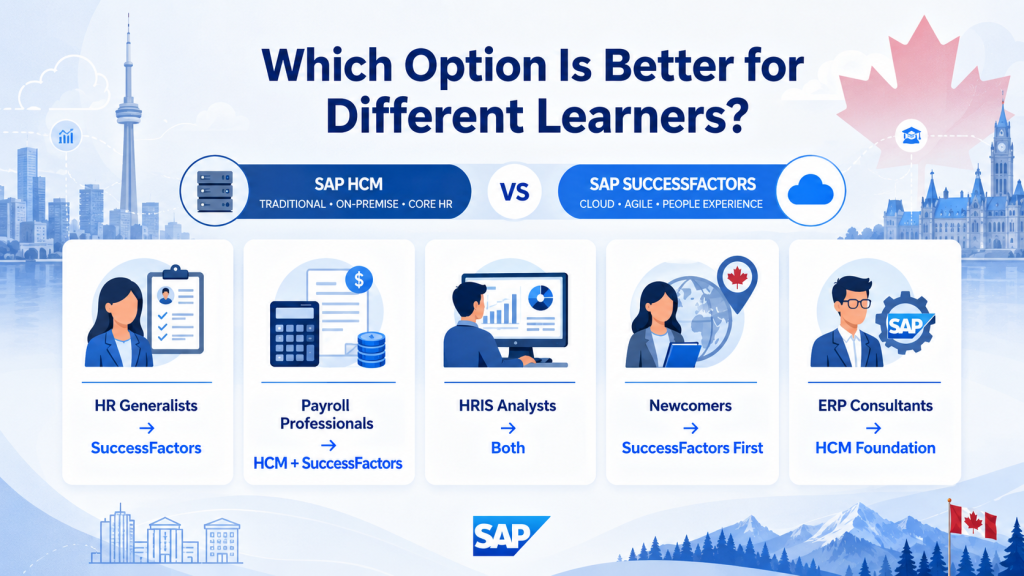
Which Option Is Better for Different Learners?
The best choice between SAP HCM and SAP SuccessFactors depends on your background, career goal, and the type of HR role you want to build in Canada. Not every learner needs the same starting point.
1. HR Generalists
For HR generalists, SAP SuccessFactors may be a better starting point.
HR generalists usually work with employee records, onboarding, performance, learning, employee engagement, and HR operations. SuccessFactors supports many of these modern HR functions through cloud-based modules such as Employee Central, Recruiting, Onboarding, Performance, Goals, and Learning.
If your goal is to work in modern HR operations, employee experience, recruitment, onboarding, or HR coordination, SuccessFactors can help you understand how today’s HR teams use cloud HR software.
2. Payroll Professionals
For payroll professionals, SAP HCM plus SuccessFactors is a strong combination.
SAP HCM is valuable because it has strong payroll, time management, personnel administration, and rule-based HR processing capabilities. Payroll professionals need to understand how employee data, attendance, absences, deductions, benefits, tax rules, and payroll calculations work together.
At the same time, many companies now use SuccessFactors Employee Central as the main HR data system and connect it with payroll solutions. This means payroll professionals can benefit from learning SAP HCM Payroll first and then understanding how SuccessFactors Employee Central supports payroll integration.
3. HRIS Analysts
For HRIS analysts, learning both SAP HCM and SAP SuccessFactors can be very useful.
HRIS analysts often work between HR, IT, payroll, finance, and business teams. They may support employee data, system updates, reports, workflows, testing, user issues, and integrations.
SAP HCM helps HRIS analysts understand traditional ERP-based HR processes, payroll structures, time management, and employee master data. SuccessFactors helps them understand cloud HR, Employee Central, talent modules, workflows, reporting, and employee self-service.
Because many organizations may use hybrid HR environments, HRIS analysts who understand both systems can be better prepared for real workplace requirements.
4. Newcomers to Canada
For newcomers, SAP SuccessFactors may be a better first step, especially if they are entering HR, recruitment, administration, or HR technology roles.
SuccessFactors is easier to connect with modern HR topics such as cloud HR, employee experience, recruiting, onboarding, learning, performance, and workforce analytics. These areas are useful for learners who want to understand how Canadian companies are moving toward digital HR systems.
However, newcomers with payroll, accounting, finance, or ERP experience should also consider SAP HCM Payroll because payroll knowledge can be valuable in organizations with complex HR and payroll processes.
5. ERP Consultants
For ERP consultants, SAP HCM foundation is important.
ERP consultants often need to understand how HR connects with finance, controlling, organizational structures, reporting, payroll, and business processes. SAP HCM provides a strong foundation for understanding traditional enterprise HR processes inside SAP environments.
After building an SAP HCM foundation, ERP consultants can move toward SuccessFactors to understand cloud HR transformation, Employee Central, talent management, and integration with modern SAP landscapes.
Simple Decision Guide
| Learner Type | Better Option | Why |
| HR Generalists | SAP SuccessFactors | Better for modern HR, onboarding, performance, learning, and employee experience |
| Payroll Professionals | SAP HCM + SuccessFactors | HCM helps with payroll; SuccessFactors helps with Employee Central and payroll integration |
| HRIS Analysts | Both | Useful for system support, reporting, workflows, employee data, and hybrid environments |
| Newcomers | SuccessFactors first | Easier entry into cloud HR, HR operations, recruitment, and modern HR technology |
| ERP Consultants | SAP HCM foundation, then SuccessFactors | Helps understand ERP HR processes before moving into cloud HCM |
In simple terms, SuccessFactors is a strong choice for learners who want to enter modern HR technology, cloud HR, and talent management. SAP HCM is a strong choice for learners who want to understand payroll, time management, employee administration, and ERP-based HR processes. For long-term SAP HR career growth in Canada, learning both over time can give learners a stronger advantage.
Career Roles Connected to SAP HCM
SAP HCM knowledge can support roles such as:
- SAP HCM Consultant
- SAP Payroll Consultant
- SAP HRIS Analyst
- Payroll Analyst
- HR Systems Analyst
- SAP Support Analyst
- HR Operations Specialist
- Time Management Analyst
- ERP HR Consultant
- Business Analyst for HR systems
These roles often require understanding of employee master data, payroll rules, time data, organizational management, configuration, reporting, and integration with finance.
SAP HCM is especially useful for people who like structured processes, rules, payroll calculations, and system configuration.
Career Roles Connected to SAP SuccessFactors
SAP SuccessFactors knowledge can support roles such as:
- SAP SuccessFactors Consultant
- Employee Central Consultant
- HRIS Analyst
- Talent Management Systems Analyst
- HR Technology Specialist
- Cloud HR Consultant
- Recruiting Systems Specialist
- Learning Management System Specialist
- HR Transformation Analyst
- Workforce Analytics Specialist
These roles often involve cloud HR modules, employee data, workflows, reporting, business process design, user support, and system implementation.
SuccessFactors is especially useful for people interested in HR transformation, talent management, employee experience, and cloud-based systems.
Important Skills for SAP HR Learners
Whether you choose SAP HCM or SuccessFactors, you need more than software navigation.
Important skills include:
- Understanding HR processes
- Understanding payroll basics
- Employee data management
- Organizational structure knowledge
- Reporting and analytics
- Communication skills
- Problem-solving
- Business process thinking
- Data accuracy
- System testing
- Documentation
- Change management
- User support
- Basic integration knowledge
SAP HR professionals often work between HR, IT, payroll, finance, managers, and employees. This means communication and process understanding are just as important as technical knowledge.
Common Mistakes Learners Make
Many learners make mistakes when choosing between SAP HCM and SAP SuccessFactors.
1. Thinking SAP HCM Is Completely Dead
SAP HCM is not useless. Many organizations still depend on it, especially for payroll and traditional HR processes.
2. Thinking SuccessFactors Is Only for HR Managers
SuccessFactors is not only for HR managers. It is also important for consultants, analysts, administrators, implementation teams, and HR technology professionals.
3. Ignoring Payroll
Payroll is one of the most important HR functions. Even if you focus on SuccessFactors, understanding payroll basics can help you understand how HR systems affect real employees.
4. Learning Only Screens Without Understanding Process
SAP skills are not only about clicking buttons. You need to understand why a process exists and how it affects the business.
5. Not Understanding Cloud HR
Modern HR is moving toward cloud systems, self-service, analytics, automation, and employee experience. Learners should understand this direction.
Simple Learning Roadmap
Here is a beginner-friendly roadmap.
Step 1: Learn HR Basics
Understand employee records, hiring, payroll, time management, performance, learning, and organizational structure.
Step 2: Learn SAP HCM Fundamentals
Study personnel administration, organizational management, payroll basics, time management, and reporting.
Step 3: Learn SuccessFactors Basics
Understand Employee Central, recruiting, onboarding, performance, learning, compensation, and analytics.
Step 4: Understand Integration
Learn how employee data flows between HR systems, payroll systems, finance, and reporting tools.
Step 5: Practice Real Scenarios
Practice examples such as hiring an employee, updating employee data, running payroll steps, creating reports, managing onboarding, and tracking goals.
Step 6: Build Business Understanding
Understand how HR technology supports real business needs such as compliance, employee experience, payroll accuracy, and workforce planning.
Final Recommendation
If you want to work in traditional SAP HR, payroll, time management, or ERP-based HR support, SAP HCM is a strong choice.
If you want to work in modern cloud HR, talent management, HR transformation, employee experience, and HR analytics, SAP SuccessFactors is a strong choice.
For HR generalists and newcomers, SuccessFactors may be a better starting point because it connects with modern HR roles and cloud-based HR systems. For payroll professionals, SAP HCM Payroll is still very important, but understanding SuccessFactors Employee Central can also help because many companies connect cloud HR data with payroll systems. For HRIS analysts and ERP consultants, learning both can provide stronger career value.
The best long-term approach is to understand the foundation of SAP HCM and then move toward SAP SuccessFactors. SAP HCM helps learners understand the structure of HR, payroll, time management, and employee administration, while SuccessFactors helps learners understand where modern HR technology is going.
For Canada, a combined understanding can be powerful because different companies are at different stages of HR digital transformation. Some still use SAP HCM. Some use SuccessFactors. Some use both. Professionals who understand both traditional HR processes and modern cloud HCM systems can be better prepared for long-term SAP HR career growth.
Conclusion
SAP HCM and SAP SuccessFactors are both important in the SAP HR world, but they serve different purposes.
SAP HCM is strongly connected with traditional HR, payroll, employee administration, time management, and ERP-based processes. It is valuable for learners interested in payroll, HRIS, SAP support, and structured HR operations.
SAP SuccessFactors is SAP’s cloud-based HCM suite. It supports modern HR areas such as Employee Central, recruiting, onboarding, learning, performance, compensation, workforce analytics, and employee experience. It is valuable for learners interested in cloud HR, HR transformation, talent management, and future HR technology.
For learners in Canada, the best choice depends on career goals. Payroll-focused learners may benefit from SAP HCM. HR technology and cloud HR learners may benefit from SuccessFactors. Beginners who want a strong foundation may benefit from learning both over time.
The future of HR is digital, cloud-based, data-driven, and increasingly supported by AI. Professionals who understand both traditional HR processes and modern cloud HCM systems will be better prepared for long-term career growth.
FAQs
1. What is the main difference between SAP HCM and SAP SuccessFactors?
SAP HCM is traditionally an on-premise HR system focused on employee administration, payroll, time management, and ERP HR processes. SAP SuccessFactors is a cloud-based HCM suite focused on core HR, talent management, learning, performance, analytics, and employee experience.
2. Is SAP HCM still useful?
Yes. SAP HCM is still useful, especially for payroll, time management, personnel administration, and organizations that continue to use SAP ERP or SAP S/4HANA HR processes.
3. Is SAP SuccessFactors better for the future?
SAP SuccessFactors is strongly aligned with modern cloud HR, employee experience, workforce planning, AI-supported HR, and talent management. It is a strong future-facing option.
4. Should beginners learn SAP HCM or SuccessFactors first?
Beginners should first understand HR basics. After that, SAP HCM is useful for payroll and traditional HR processes, while SuccessFactors is useful for cloud HR and talent management.
5. Is SAP HCM good for payroll professionals?
Yes. SAP HCM Payroll is valuable for payroll professionals because it supports complex payroll rules, employee data, time management, deductions, and payroll processing.
6. Is SAP SuccessFactors only for HR professionals?
No. SAP SuccessFactors is useful for HR professionals, consultants, HRIS analysts, business analysts, cloud HR specialists, implementation teams, and system support professionals.
7. Can companies use SAP HCM and SuccessFactors together?
Yes. Some companies use SuccessFactors for core HR or talent management while continuing to use SAP HCM or related payroll solutions for payroll processing.
8. Which is better for jobs in Canada?
Both can be useful. SAP HCM is valuable for payroll and ERP HR roles, while SuccessFactors is valuable for cloud HR, HRIS, and HR transformation roles.
9. Does SuccessFactors include payroll?
SAP SuccessFactors can support payroll through Employee Central Payroll and integrations with payroll systems. Payroll setup depends on company requirements and country-specific needs.
10. What skills should I learn with SAP HR?
Important skills include HR processes, payroll basics, employee data management, organizational management, reporting, analytics, documentation, communication, and business process understanding.