

Starting an SAP career can feel confusing when you are a beginner.
Many students, newcomers, business graduates, accounting professionals, supply chain workers, HR professionals, and career changers hear that SAP is a valuable skill, but they do not know where to begin. They may ask questions like: What is SAP? Which SAP module should I choose? Do I need coding? What jobs can I apply for? How do I become an SAP consultant in Canada?
If you are asking these questions, you are not alone. SAP is a large enterprise software system used by companies to manage business operations such as finance, sales, procurement, inventory, human resources, logistics, reporting, and customer processes. Because SAP is connected to many business areas, it offers different career paths for different types of learners.
The good news is that you do not need to understand everything on day one. The best way to start is to follow a clear SAP career path for beginners. This means learning what SAP is, choosing the right module, building practical skills, preparing your resume, and applying for beginner-friendly SAP roles step by step.
This guide will explain how to start a career in SAP, what skills beginners need, which SAP jobs are suitable for beginners, and how to move toward an SAP consultant career path in Canada.
What Is SAP in Simple Words?
SAP is a business software system that helps companies manage their daily operations in one connected platform.
In a company, many departments work together. Finance teams manage invoices, payments, and reports. Procurement teams buy goods and services. Sales teams manage customer orders. Warehouses manage inventory and deliveries. HR teams manage employee data and workforce processes.
SAP helps connect these departments so that business information can move smoothly from one area to another.
For example, when a customer places an order, SAP can help record the order, check stock, create delivery information, generate billing, and connect the transaction to finance. This means SAP is not only a technology tool. It is also a business process system.
That is why SAP careers are not only for IT professionals. People from business, finance, accounting, supply chain, sales, HR, operations, and administration backgrounds can also build SAP careers.
If you are completely new to SAP, you can first read Is SAP Hard to Learn? A Beginner-Friendly Guide to understand SAP in simple beginner-friendly language.
Why SAP Can Be a Good Career Choice for Beginners
SAP can be a strong career option because it combines business knowledge with digital skills.
Many organizations use ERP systems to manage important business operations. These systems help companies improve accuracy, reduce manual work, manage data, and connect departments. Professionals who understand SAP can support these business processes and help organizations work more efficiently.
For beginners, SAP can be valuable because it offers different entry points. You do not have to become a programmer to work with SAP. You can choose a functional SAP path if you are interested in business processes, or a technical SAP path if you enjoy coding and system work.
SAP skills can also support career growth because they are connected to practical job functions. For example, accounting students can connect SAP with finance roles. Supply chain students can connect SAP with procurement and inventory roles. HR professionals can connect SAP with employee data and HR system roles. Sales professionals can connect SAP with order management and customer process roles.
This makes SAP a useful option for students, newcomers, and career changers who want to build career-focused technology skills.
Understanding the SAP Career Path for Beginners
The SAP career path for beginners usually starts with learning the basics, choosing one module, practicing real scenarios, and applying for entry-level roles.
A beginner should not try to learn every SAP module at once. SAP is too large for that approach. Instead, you should start with one clear direction.
The first stage is awareness. You learn what SAP is and how companies use it.
The second stage is module selection. You choose the SAP module that matches your background.
The third stage is training. You learn the system, business processes, transactions, and practical examples.
The fourth stage is resume building. You explain your SAP training and transferable skills clearly.
The fifth stage is job searching. You apply for beginner-friendly SAP jobs or related business roles where SAP is used.
The sixth stage is growth. After gaining experience, you can move toward advanced roles, specialization, certification, or consultant-level opportunities.
This step-by-step approach makes SAP easier to understand and more realistic for beginners.
Step 1: Learn the Basics of SAP
Before choosing a module or job role, understand what SAP is used for.
Many beginners make the mistake of jumping directly into module names like SAP FI, SAP MM, SAP SD, or SAP HCM without understanding the basic purpose of SAP. This can create confusion.
Start with simple questions. Why do companies use SAP? What is ERP? How do departments share data? What happens when a purchase order is created? How does an invoice connect to finance? How does a sales order connect to inventory and delivery?
Once you understand SAP as a business system, the module names become easier to understand.
At this stage, your goal is not to become an expert. Your goal is to build a simple foundation. Learn basic terms such as ERP, SAP S/4HANA, module, transaction, master data, business process, end user, functional consultant, and technical consultant.
Step 2: Choose the Right SAP Module
Choosing the right SAP module is one of the most important decisions in your SAP career path.
SAP has many modules, and each module is connected to a different business area. Beginners should choose a module based on their education, previous work experience, and career goal.
If you are from accounting, finance, bookkeeping, or payroll, SAP FI or SAP S/4HANA Finance may be a strong choice. This module focuses on financial accounting, accounts payable, accounts receivable, general ledger, asset accounting, and reporting. You can explore SAP FI / SAP S/4HANA Finance to learn more about this path.
If you are from supply chain, procurement, purchasing, logistics, or operations, SAP MM or SAP S/4HANA Sourcing and Procurement may be a better fit. This area focuses on purchasing, vendors, materials, inventory, goods receipts, and procurement processes. You can explore SAP S/4HANA Sourcing and Procurement for this path.
If you are interested in sales, customer service, order processing, or business development, SAP SD may be suitable. This module focuses on quotations, sales orders, pricing, delivery, billing, and customer order processes. You can explore SAP S/4HANA SD Sales to learn more.
If you are from human resources, recruitment, payroll, administration, or employee management, SAP HCM may be a practical choice. This module focuses on employee records, organizational structure, HR operations, time management, and workforce data. You can explore SAP S/4HANA HCM Human Capital Management.
If you are from warehouse, logistics, shipping, receiving, or inventory control, SAP EWM may be useful. This area focuses on warehouse management, picking, packing, stock movement, and advanced logistics processes. You can explore SAP S/4HANA EWM Training in Canada.
Step 3: Match Your Background With the Right SAP Path
Your background can help you choose the SAP path that makes the most sense.
A beginner with accounting experience does not need to start from zero. Their finance knowledge can support SAP FI learning. A supply chain student already understands purchasing, inventory, and vendors, so SAP MM may feel more natural. An HR professional may understand employee data and HR processes, so SAP HCM may be easier to connect with.
This is important because SAP careers are not only about system knowledge. They are also about understanding business processes.
For example, if you are applying for a finance-related SAP role, your accounting knowledge can support your profile. If you are applying for a procurement-related SAP role, your supply chain knowledge can help. If you are applying for an HR systems role, your HR experience can become an advantage.
Instead of thinking, “I am new to SAP,” think, “Which part of my background can connect with SAP?”
This mindset helps you build a stronger career plan.
Step 4: Understand Functional SAP vs Technical SAP
Beginners should understand the difference between functional SAP and technical SAP before choosing a career direction.
Functional SAP focuses on business processes. Functional SAP professionals work with departments like finance, procurement, sales, HR, warehouse, and operations. They understand how the business process works and how SAP supports that process.
Technical SAP focuses on system development, coding, administration, security, integrations, and backend support. Technical SAP professionals may work with ABAP programming, BASIS administration, system configuration, data migration, or integrations.
If you do not have an IT background, a functional SAP path may be easier to start with. Functional modules include SAP FI, SAP MM, SAP SD, SAP HCM, and SAP EWM.
If you enjoy coding, system logic, and technical problem-solving, then technical SAP may be suitable. A technical path may include SAP ABAP, SAP BASIS, SAP Security, SAP Integration, or SAP Analytics.
Neither path is better for everyone. The right path depends on your strengths and career goal.
Step 5: Learn Business Processes, Not Just Screens
SAP learning becomes stronger when you understand the business process behind each system step.
A beginner should not only memorize where to click. You should understand why each action is done.
For example, in procurement, you should understand why a purchase requisition is created, how it becomes a purchase order, how goods are received, and how the invoice is verified.
In finance, you should understand how vendor invoices, customer payments, general ledger entries, and financial reports connect.
In sales, you should understand how a customer order moves from quotation to delivery and billing.
In HR, you should understand how employee data, organizational structure, and workforce records are managed.
When you understand the process, SAP becomes more meaningful. You are not just learning software. You are learning how companies operate.
Step 6: Build Hands-On Practice
SAP is best learned through practice, not only reading or watching videos.
Beginners often think they understand SAP after watching tutorials, but real confidence comes from practicing scenarios. You need to see the system, follow steps, enter data, review results, and understand what happens after each transaction.
Hands-on practice helps you remember concepts. It also prepares you for interviews and job tasks because employers often want to know whether you understand practical workflows.
For example, if you are learning SAP FI, practice scenarios related to invoices, payments, accounts, and reports. If you are learning SAP MM, practice purchase orders, material records, vendors, and goods receipts. If you are learning SAP SD, practice sales orders, deliveries, and billing.
Practice helps turn SAP from a confusing system into a professional skill.
Step 7: Learn Basic SAP Terminology
SAP has many terms, but beginners can learn them step by step.
You do not need to memorize every SAP term at the beginning. Start with common words that appear across modules.
Learn terms like ERP, SAP S/4HANA, module, master data, transaction, configuration, business process, end user, consultant, implementation, support, testing, migration, reporting, and integration.
Then learn module-specific terms. For SAP FI, learn general ledger, accounts payable, accounts receivable, asset accounting, and cost center. For SAP MM, learn purchase order, vendor, material master, goods receipt, and invoice verification. For SAP SD, learn sales order, quotation, pricing, delivery, and billing. For SAP HCM, learn personnel administration, organizational management, payroll, and time management.
Terminology becomes easier when you connect each term to a real business example.
Step 8: Build Transferable Skills
SAP beginners should build both technical system knowledge and professional workplace skills.
SAP professionals often work with business users, managers, consultants, technical teams, and project stakeholders. This means communication skills are important.
You should be able to explain a problem clearly, document steps, ask the right questions, and understand business requirements.
Problem-solving is also important. SAP users may face errors, missing data, process issues, or reporting problems. A good SAP professional can investigate the issue and find a logical solution.
Attention to detail is another key skill. SAP transactions often require accurate information. Small mistakes can affect reports, orders, invoices, or business records.
Time management, teamwork, documentation, and willingness to learn are also useful skills for SAP beginners.
Step 9: Create an SAP Learning Plan
A clear learning plan helps beginners avoid confusion and stay focused.
Start with the basics of SAP and ERP. Then choose one module. After that, learn the main business process of that module. Next, practice transactions and real-world scenarios. Then create a beginner SAP resume. Finally, start applying for roles that match your background and SAP training.
For example, a finance learner can create this path: understand ERP basics, choose SAP FI, learn finance master data, practice invoice and payment processes, learn reporting basics, update resume, and apply for finance systems or SAP support roles.
A supply chain learner can create this path: understand ERP basics, choose SAP MM, learn vendor and material master data, practice purchase orders and goods receipts, learn inventory process basics, update resume, and apply for procurement or ERP support roles.
A learning plan makes your SAP journey more organized.
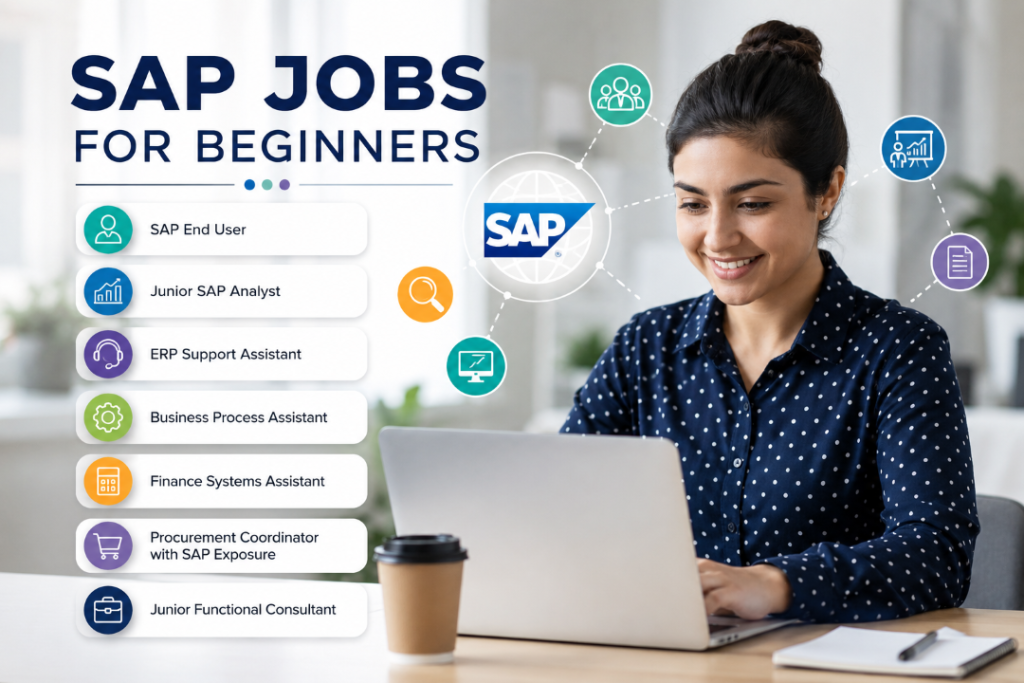
SAP Jobs for Beginners
There are several SAP jobs for beginners, but your first role may not always have the title “SAP Consultant.”
Many beginners want to become SAP consultants immediately. That is a good long-term goal, but the first step may be an entry-level or support role.
Beginner-friendly roles may include SAP end user, junior SAP analyst, ERP support assistant, SAP support trainee, business process assistant, finance systems assistant, procurement coordinator with SAP exposure, inventory coordinator, HR systems assistant, order management assistant, junior business analyst, or junior functional consultant.
These roles help you gain real workplace experience with SAP. Once you understand how SAP is used in daily business operations, you can move toward more advanced roles.
Your first SAP-related role is important because it helps you connect training with real business experience.
What Is an SAP End User?
An SAP end user is someone who uses SAP to complete daily job tasks inside a company.
For beginners, end-user roles can be a practical starting point. End users may work in finance, procurement, sales, warehouse, HR, or operations. They use SAP to enter data, create documents, check reports, process transactions, and support business activities.
For example, a finance end user may enter invoices or check payment records. A procurement end user may create purchase orders. A warehouse end user may update stock movement. A sales end user may process customer orders.
End-user experience is valuable because it helps you understand how SAP works in a real company environment.
What Is a Junior SAP Analyst?
A junior SAP analyst supports SAP users, documents issues, helps with testing, and assists with business process improvements.
This role can be a good next step for beginners who have SAP training and some business knowledge. A junior SAP analyst may not lead large projects at the start, but they can support daily operations and learn from senior team members.
The role may include troubleshooting simple issues, helping users understand process steps, testing system changes, preparing documentation, reviewing data, and communicating with functional or technical teams.
This type of role can help beginners move closer to the SAP consultant career path.
What Is an SAP Consultant?
An SAP consultant helps organizations implement, configure, support, or improve SAP systems based on business needs.
SAP consultants usually understand both the system and the business process. They work with clients or internal teams to gather requirements, design solutions, test processes, train users, and support system improvements.
There are different types of SAP consultants. Functional consultants focus on business modules like finance, procurement, sales, HR, and warehouse. Technical consultants focus on development, integrations, system administration, and technical configuration.
Becoming an SAP consultant usually takes time. Beginners often start with training, support roles, analyst roles, or end-user experience before moving into consultant positions.
SAP Consultant Career Path
The SAP consultant career path usually grows step by step from beginner learning to practical experience and specialization.
A possible career path may look like this: SAP learner, SAP trainee, SAP end user, junior SAP analyst, SAP support specialist, junior SAP consultant, SAP functional consultant, senior SAP consultant, solution lead, project manager, or SAP architect.
Not everyone follows the same path. Some people move from finance roles into SAP FI consulting. Some move from procurement into SAP MM consulting. Some move from warehouse operations into SAP EWM consulting. Some move from HR roles into SAP HCM or SuccessFactors consulting.
The common pattern is this: learn one module, gain practical experience, solve real business problems, and continue developing your specialization.
How to Become an SAP Consultant in Canada
To become an SAP consultant in Canada, you need SAP knowledge, business process understanding, practical experience, and a clear career direction.
Start by choosing a module that matches your background. Then complete structured SAP training. Practice real business scenarios and learn the language of your chosen module.
Next, prepare a resume that highlights both your previous experience and SAP training. For example, if you are from accounting and learning SAP FI, your resume should connect accounting knowledge with SAP Finance training. If you are from supply chain and learning SAP MM, your resume should connect procurement or inventory knowledge with SAP training.
Then apply for beginner-friendly roles. Do not only search for “SAP consultant” roles. Also search for SAP end user, ERP support, business analyst, finance systems, procurement coordinator, inventory analyst, HR systems, and order management roles.
As you gain experience, you can move toward consultant-level opportunities.
SAP Career Path for Accounting and Finance Students
Accounting and finance students can build an SAP career through SAP FI or SAP S/4HANA Finance.
This path is suitable for learners who understand financial records, invoices, payments, reports, accounts payable, accounts receivable, and general ledger concepts.
A beginner can start with SAP Finance training, practice basic finance processes, and apply for roles such as finance assistant with SAP exposure, accounting systems assistant, ERP finance support, junior SAP FI analyst, or accounts payable/accounts receivable roles using SAP.
Over time, this path can lead to SAP FI consultant, SAP S/4HANA Finance consultant, finance business analyst, ERP finance specialist, or finance transformation roles.
SAP Career Path for Supply Chain Students
Supply chain students can build an SAP career through SAP MM, SAP S/4HANA Sourcing and Procurement, or SAP EWM.
This path is suitable for learners interested in purchasing, vendors, materials, inventory, warehouse operations, shipping, receiving, and logistics.
A beginner can start with procurement or warehouse-related SAP training, practice purchase orders, goods receipts, inventory processes, and warehouse workflows, then apply for procurement coordinator, inventory assistant, warehouse systems assistant, ERP support, junior SAP MM analyst, or logistics coordinator roles.
Over time, this path can lead to SAP MM consultant, SAP EWM consultant, supply chain systems analyst, procurement systems specialist, or ERP logistics consultant roles.
SAP Career Path for HR Students
HR students and professionals can build an SAP career through SAP HCM or related HR technology paths.
This path is suitable for learners interested in employee records, recruitment, payroll support, workforce data, time management, and HR operations.
A beginner can start with SAP HCM training, learn how employee data is managed, understand organizational structures, and apply for HR assistant, HR systems assistant, payroll support assistant, HRIS coordinator, or junior SAP HCM support roles.
Over time, this path can lead to SAP HCM consultant, HR systems analyst, SuccessFactors consultant, payroll systems specialist, or HR technology roles.
SAP Career Path for Sales and Business Students
Sales, customer service, and business students can build an SAP career through SAP SD.
SAP SD supports customer order processes, sales documents, pricing, delivery, billing, and distribution activities.
A beginner can start by learning the order-to-cash process. This includes how a customer inquiry becomes a quotation, how a quotation becomes a sales order, how delivery is created, and how billing is completed.
Beginner roles may include order management assistant, customer service coordinator with SAP exposure, sales operations assistant, ERP support assistant, or junior SAP SD analyst.
Over time, this path can lead to SAP SD consultant, sales operations analyst, order-to-cash specialist, or business process consultant roles.
How to Build a Beginner SAP Resume
Your beginner SAP resume should connect your background, SAP training, and target job role.
Do not only write “learned SAP.” Be specific about your module and business process knowledge.
For example, if you studied SAP FI, mention exposure to financial accounting processes, vendor invoices, accounts payable, accounts receivable, general ledger, and reporting concepts.
If you studied SAP MM, mention purchasing, vendor management, material master data, purchase orders, goods receipts, and procurement cycle understanding.
If you studied SAP SD, mention customer order processing, pricing, delivery, billing, and sales process flow.
If you studied SAP HCM, mention personnel administration, employee records, HR processes, and organizational management.
Also include transferable skills such as documentation, communication, problem-solving, data accuracy, business analysis, and attention to detail.
How to Prepare for SAP Interviews
SAP beginners should prepare for both technical questions and business process questions.
Interviewers may ask why you chose SAP, which module you studied, what business process you understand, and how your background connects to SAP.
They may also ask basic module questions. For SAP FI, they may ask about accounts payable or general ledger. For SAP MM, they may ask about purchase orders or goods receipts. For SAP SD, they may ask about sales orders or billing. For SAP HCM, they may ask about employee data or HR processes.
You should also prepare examples from your training. Explain what scenarios you practiced and what you learned from them.
Beginners should be honest. You do not need to pretend to be a senior consultant. Instead, show that you understand the basics, practiced real examples, and are ready to learn in a professional environment.
Common Mistakes Beginners Should Avoid
One common mistake is trying to learn too many SAP modules at once.
SAP is large. If you try to learn everything, you may become confused and lose focus. Start with one module and build a strong foundation.
Another mistake is choosing a module only because someone said it is high-paying. Salary matters, but your module should also match your background and interest.
A third mistake is learning only theory. SAP requires practical understanding. You need examples, transactions, process flows, and hands-on exposure.
A fourth mistake is applying only for SAP consultant jobs as a beginner. Consultant roles often require experience. You should also apply for SAP end-user, ERP support, analyst, coordinator, and business process roles.
A fifth mistake is writing a weak resume. Your resume should clearly explain your SAP module, training, business process knowledge, and transferable skills.
How Long Does It Take to Start an SAP Career?
The time needed to start an SAP career depends on your background, module, training quality, practice, and job search effort.
Some beginners can understand basic SAP concepts within a short period, but building career confidence takes consistent learning and practice.
If your background matches your module, you may progress faster. For example, an accounting student may understand SAP Finance concepts more easily. A supply chain worker may understand SAP MM or EWM faster. An HR professional may understand SAP HCM more naturally.
The goal should not be to rush. The goal should be to build a strong foundation, practice consistently, and prepare for realistic beginner roles.
Learning SAP at Toronto Innovation College
Toronto Innovation College (legal name: Innovations in Business Solutions Inc.) is a Registered Career College under the Ontario Career Colleges Act, 2005.
Learners who want structured SAP training can explore career-focused programs connected to finance, procurement, sales, HR, and warehouse management. Depending on your background and career goal, you can review programs such as SAP FI / SAP S/4HANA Finance, SAP S/4HANA Sourcing and Procurement, SAP S/4HANA SD Sales, SAP S/4HANA HCM Human Capital Management, and SAP S/4HANA EWM Training in Canada.
If you are ready to take the next step, you can visit the Toronto Innovation College website or submit your interest through the Apply Now page.
Final SAP Career Path Roadmap for Beginners
A simple SAP career path for beginners can be followed step by step.
First, understand what SAP is and how companies use ERP systems.
Second, choose one SAP module based on your background and career goal.
Third, learn the business process connected to that module.
Fourth, practice SAP scenarios and build hands-on confidence.
Fifth, create a resume that connects your previous experience with your SAP training.
Sixth, apply for beginner-friendly roles such as SAP end user, ERP support assistant, junior SAP analyst, business process assistant, procurement coordinator, finance systems assistant, HR systems assistant, or order management assistant.
Seventh, gain real experience and continue learning.
Eighth, move toward advanced SAP roles, certification, specialization, or consultant-level opportunities.
This roadmap is realistic because it does not expect beginners to become experts overnight. It helps learners grow step by step.
Conclusion
Starting an SAP career as a beginner is possible when you follow a clear path.
You do not need to know every SAP module. You do not need to become a programmer unless you choose a technical SAP path. You do not need to start as a consultant immediately.
What you need is a focused learning plan.
Choose a module that matches your background. Learn the business process. Practice real scenarios. Build your resume. Apply for beginner-friendly roles. Gain experience. Then continue growing toward your long-term SAP career goal.
SAP can be a strong career path for beginners, students, newcomers, and career changers because it connects business knowledge with practical digital skills. Whether you are interested in finance, procurement, warehouse management, sales, HR, or technical development, there is an SAP path that can match your goals.
If you are wondering how to start a career in SAP, the answer is simple: start with one module, learn step by step, and build your experience with patience and consistency.
To explore SAP training options, visit Toronto Innovation College or start your application through the Apply Now page.