

Software testing has become an important part of modern software development. Every website, mobile application, business platform, financial system, and cloud-based solution needs to work correctly before users can depend on it. Behind that reliability are software testing and quality assurance professionals who identify problems, validate functionality, and help development teams deliver better software.
For someone planning to enter this field, one of the first questions is usually simple: Should I learn manual testing or automation testing first?
The answer is not about choosing one and ignoring the other. For most beginners, understanding manual testing fundamentals first creates the foundation needed to learn automation effectively later.
If you are researching a Software Testing Course in Toronto, understanding this learning sequence can help you choose training that develops both foundational testing knowledge and practical technical skills.
This guide explains the difference between manual and automation testing, what beginners should learn first, how both skills work together, and how structured QA testing training in Toronto, Canada can help you prepare for software quality assurance roles.
What Is Software Testing?
Software testing is the process of evaluating an application or system to determine whether it behaves as expected.
A software application may appear simple to an end user, but behind the interface there may be databases, APIs, business rules, integrations, authentication systems, payment services, and many other components.
A tester looks at the application from several perspectives. Does the feature work according to requirements? What happens when a user enters incorrect information? Does an error message appear when something goes wrong? Can the application handle unusual user behaviour? Does a feature that worked yesterday still work after a new update?
The objective is not simply to find bugs. Good testing helps teams understand software quality and identify risks before those problems affect customers or business operations.
This is why beginners should understand testing principles before focusing only on tools.
What Is Manual Testing?
Manual testing means a person performs test activities directly rather than relying entirely on automated scripts.
Imagine that a company has developed an online registration form. A manual tester may enter valid information and confirm that registration succeeds. The tester may then enter an invalid email address, leave mandatory fields blank, use unusual characters, test different combinations of data, and confirm that the application behaves correctly in each situation.
The tester is actively thinking: What could go wrong? What would a real user do? Does this result match the requirement?
Manual testing therefore develops one of the most valuable abilities in quality assurance: testing mindset.
For someone looking for QA training for beginners, this mindset is often more important initially than knowing how to operate a particular automation tool.
What Is Automation Testing?
Automation testing uses scripts, frameworks, and testing tools to perform selected tests automatically.
Instead of manually repeating the same sequence every time a new version of an application is released, an automation tester can create a test script that performs those actions and checks the expected results.
Consider a login page. A manual tester may enter a username and password, click the login button, and verify whether access is granted. An automated test could perform those same steps programmatically.
The major advantage appears when the process must be repeated many times. If a team has hundreds of regression tests, manually executing every scenario after every software release can require significant effort. Automation can help teams repeat suitable test cases consistently and provide faster feedback.
However, automation does not eliminate the need for testing knowledge. A tool can execute instructions, but someone still needs to determine what should be tested, why it should be tested, and whether the test itself is meaningful.
That is why jumping directly into automation without understanding manual testing can create gaps in a beginner’s knowledge.
Manual Testing vs Automation Testing: The Main Difference
The biggest difference is not simply human versus computer. The difference is how the testing activity is designed and executed.
With manual testing, the tester interacts directly with the software, observes behaviour, explores different scenarios, and evaluates results. With automation testing, the tester or automation engineer creates scripts that allow tools to repeatedly execute predetermined tests.
Both approaches are useful.
Manual testing is particularly valuable when human judgment, exploration, usability assessment, or rapidly changing functionality is involved. Automation is particularly valuable when tests need to be repeated frequently, consistently, and across multiple releases or configurations.
Modern QA teams normally use a combination rather than treating manual and automation testing as competing approaches.
Why Beginners Should Usually Learn Manual Testing First
If you are completely new to QA, starting with manual testing gives you the vocabulary and reasoning skills needed to understand what automation is actually doing.
Before writing an automated test, you should understand concepts such as test scenarios, test cases, expected results, actual results, defects, severity, priority, regression testing, functional testing, integration testing, user acceptance concepts, and software development and testing life cycles.
Without these fundamentals, automation can become little more than following tool instructions.
A beginner may learn how to click buttons using an automation framework without understanding whether the test scenario itself is valuable.
Starting with manual fundamentals helps prevent this problem.
A structured Software Testing & Quality Assurance program can help learners understand testing concepts before progressing into automation and other modern QA practices.
Manual Testing Builds the Tester Mindset
A strong QA professional learns to look beyond the happy path.
Suppose a requirement says: “A customer can create an account using an email address and password.”
A beginner may test one valid email address and one password and conclude that the feature works.
An experienced testing mindset asks many more questions. What happens if the email already exists? What happens if the password is too short? Are spaces accepted? What happens with special characters? Can the form be submitted twice? What happens if the internet connection is interrupted? Is the error message understandable? Can the user continue after correcting invalid information?
This way of thinking is difficult to gain by learning automation syntax alone.
Manual testing forces beginners to examine requirements, user behaviour, business rules, and risk. Once that thinking becomes natural, automation becomes much more useful.
Test Cases Are an Important Foundation
One of the first practical skills students encounter in software testing is writing test cases.
A test case normally describes a condition or scenario to be tested, the actions required, and the expected result.
For example, a test case for an e-commerce website may validate whether a registered customer can successfully add an available product to the shopping cart. Another test case may confirm what happens when the product becomes unavailable.
Learning how to design strong test cases teaches beginners to translate requirements into verifiable conditions.
This is directly relevant to automation. Before a scenario can be automated effectively, someone must first understand the scenario.
Automation therefore does not replace test design. It builds upon it.
Defect Reporting Is Another Essential Beginner Skill
Finding an issue is only one part of a tester’s responsibility. The tester also needs to communicate the issue clearly enough for other team members to understand and reproduce it.
A useful defect report should make the problem clear. What feature was being tested? What steps caused the problem? What was expected? What actually happened? Under what environment did it happen? How serious is the impact?
Developing clear defect-reporting habits is valuable regardless of whether someone eventually specializes in manual testing, automation, API testing, or another QA area.
Testing is deeply collaborative. Developers, business analysts, product owners, project managers, and testers frequently need to understand the same issue. Strong communication therefore remains important even as testing becomes more technical.
When Is Manual Testing Better Than Automation?
Automation is powerful, but not every test should be automated.
Consider a brand-new feature whose design is still changing every few days. Creating and constantly maintaining automation scripts for unstable functionality may require more work than manually testing it during the early stages.
Manual testing can also be valuable for exploratory testing. In exploratory testing, a tester does not simply follow a fixed script. The tester learns about the product while testing and uses observations to decide where to investigate next.
Human judgment is also useful when evaluating usability or unexpected behaviour. A page might technically function correctly while still being confusing for users. An automated script may confirm that the button exists and performs an action, but a human tester can notice that the interface is unclear or difficult to navigate.
This is one reason organizations continue to value strong manual testing knowledge.
When Does Automation Testing Become Valuable?
Automation becomes especially valuable when a team needs to execute the same tests repeatedly.
Regression testing is a common example. When developers introduce a new feature, an existing part of the application may accidentally stop working. Regression testing checks whether previously working functionality remains stable after changes.
If an application contains hundreds of repeatable test scenarios, manually executing all of them for every release may become inefficient.
Automation can help perform appropriate regression checks much faster.
Automation can also be useful for repetitive data-driven scenarios, cross-browser checks, continuous integration workflows, and other tests that benefit from repeatability.
This is why modern software testing course online options should ideally expose learners to both foundational manual QA and automation concepts rather than teaching only one side.
Do You Need Programming for Automation Testing?
Some automation testing requires programming or scripting knowledge. The exact level depends on the framework, project, and role.
Beginners should not allow this to become an unnecessary barrier.
You do not need to become an advanced software developer before learning testing.
A more practical progression is to understand software testing fundamentals first, then develop enough programming knowledge to create, understand, and maintain automated tests.
Concepts such as variables, conditions, loops, functions, objects, and basic debugging can become useful as you progress.
The objective for a QA learner is not necessarily to become a full-stack developer. It is to understand enough technology to test software effectively and work with the tools used by modern QA teams.
Where Does API Testing Fit?
Modern applications often depend on APIs to exchange information between systems and services.
A customer may see a simple screen, but behind that screen the application may be requesting information from another service through an API.
This makes API testing increasingly relevant to QA work.
API testing allows testers to validate application logic and data exchange without relying only on the visible user interface.
For example, an API test might verify whether submitting valid customer information creates the correct response, while invalid data produces an appropriate error.
Toronto Innovation College’s current Software Testing & Quality Assurance program includes API testing as part of its broader QA curriculum.
For beginners, API testing is best understood as another layer of quality assurance, not as a replacement for manual or UI automation testing.
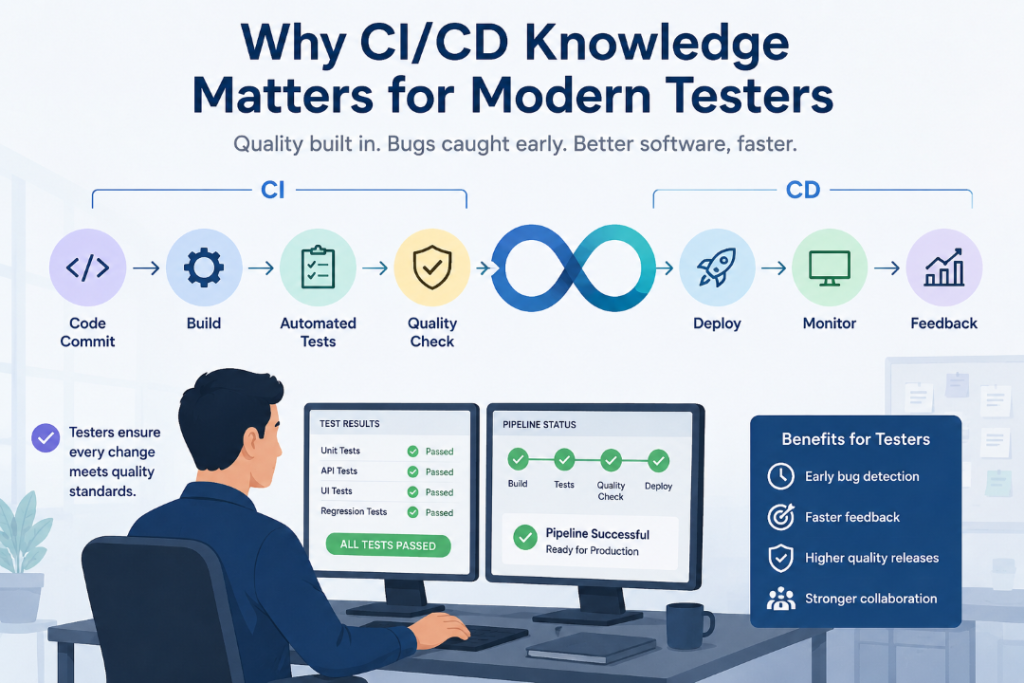
Why CI/CD Knowledge Matters for Modern Testers
Software teams increasingly aim to integrate testing earlier and more frequently into their development process.
CI/CD refers broadly to practices that help teams integrate code changes, validate them, and deliver software more consistently.
For testers, this matters because automated tests can often become part of these workflows.
Instead of waiting until the end of development to test everything manually, selected tests can run whenever important changes are introduced.
A tester who understands how testing fits into the wider software delivery process can collaborate more effectively with developers and DevOps teams.
You do not need to become a DevOps engineer to begin a QA career. However, understanding how testing fits into modern software delivery gives you a more complete picture of the profession.
Is Manual Testing Becoming Outdated?
No. What is changing is the expectation that QA professionals understand a broader set of testing approaches.
There was a time when some testing roles could focus almost entirely on manually executing predefined test cases. Modern environments increasingly value professionals who can combine manual testing fundamentals with additional capabilities such as automation, API testing, database validation, Agile collaboration, and CI/CD awareness.
That does not make manual testing irrelevant. It makes manual testing the foundation rather than necessarily the final destination.
The ability to explore software, understand requirements, identify risks, design meaningful scenarios, and communicate defects remains valuable regardless of how much automation a team uses.
Should Beginners Start With Selenium or Another Automation Tool?
A common mistake is selecting a tool before understanding testing.
Beginners may search for Selenium tutorials, automation frameworks, or testing tools because these appear frequently in QA discussions.
Tools are useful, but tools change. Testing concepts are more durable.
If you understand why regression testing is needed, you can apply that understanding to different automation technologies. If you understand test design, you can design good scenarios regardless of which framework executes them. If you understand defects and business requirements, you can contribute even when an organization uses a testing stack you have not previously seen.
The better learning question is therefore not “Which tool should I memorize?” It is “Which testing concepts and practical skills will allow me to adapt to different tools?”
A Better Learning Order for QA Beginners
For most beginners, the learning journey should progress from concepts to practical execution and then toward technical specialization.
Start by understanding software development and testing fundamentals. Learn how requirements become test scenarios. Practice writing test cases. Learn defect reporting. Understand different test types. Practice exploratory testing.
Then start learning technical areas such as API testing, database concepts, and automation. After that, understand how automated testing connects with software delivery workflows such as CI/CD.
This sequence gives each new skill context. Instead of simply memorizing commands, you understand why the technology matters.
If you are currently comparing programs, our earlier guide on how to choose a software testing course in Toronto explains what to look for in a training program before enrolling.
What Should You Look for in QA Testing Training in Toronto, Canada?
A strong program should go beyond definitions.
Software testing is a practical discipline, so students need opportunities to apply what they learn.
Look for training that helps you understand both testing fundamentals and modern QA practices.
The curriculum should ideally introduce manual testing concepts, structured test design, defect management, and real testing scenarios. As learners progress, exposure to areas such as automation, API testing, CI/CD, and emerging technologies can help provide a broader understanding of contemporary software quality assurance.
For beginners evaluating software testing certification or training options, the key question should be whether the learning experience develops usable skills rather than focusing only on terminology or exam preparation.
Is Software Testing Certification Necessary?
Certification can help structure your knowledge and demonstrate familiarity with established testing concepts, but certification should not be treated as a replacement for practical ability.
Employers ultimately need testers who can understand requirements, identify risks, communicate clearly, and contribute to quality.
A learner who knows definitions but cannot design a useful test scenario may struggle in a practical environment. Similarly, someone who understands only a particular automation tool may struggle when the technology stack changes.
Certification preparation can therefore be valuable when combined with practical learning.
What Skills Should a Beginner Build Alongside Testing?
Technical testing knowledge is important, but QA professionals also depend on transferable skills.
Attention to detail helps testers notice behaviour that others may overlook.
Analytical thinking helps identify relationships between requirements, data, user actions, and system behaviour.
Communication helps testers explain defects without creating confusion.
Curiosity encourages deeper exploration instead of simply following predefined steps.
Documentation skills help teams understand what was tested and what still requires attention.
Problem solving helps testers investigate unexpected behaviour logically.
These skills become even more valuable when combined with practical manual and automation knowledge.
Can Career Changers Learn Software Testing?
Software testing can be approachable for people from a range of professional backgrounds because many QA skills are transferable.
Someone from accounting may already have strong attention to detail. A business analyst may understand requirements and processes. A customer-support professional may understand user frustrations and application behaviour. An operations professional may be experienced in identifying process failures. A developer may already understand technical systems.
What career changers need is a structured way to translate those strengths into software testing practices.
This is one reason QA training for beginners should not assume that every learner already has a computer science background.
Manual Testing or Automation: Which One Is Better for a Career?
Rather than asking which one is better, ask which combination will make you a more capable tester.
Manual testing develops your understanding of quality. Automation helps you scale appropriate tests. API testing helps you validate application services. CI/CD knowledge helps you understand modern delivery environments. Technical skills help you communicate with developers. Business understanding helps you test the right things.
Together, these skills create a more complete QA profile.
A beginner does not need to master everything immediately. Career development happens progressively.
Why Hands-On Practice Matters
Reading about software testing is useful, but testing is learned through practice.
Take a simple website and try to design test scenarios. Test a registration form. Examine validation rules. Try different input values. Write down expected and actual results. Practice creating a clear defect report. Then consider how some of those tests could be automated.
This exercise immediately demonstrates the relationship between manual and automation testing.
The automation script is not the test strategy. The thinking that determines what needs to be checked comes first.
Hands-on practice also gives learners examples they can discuss during interviews rather than speaking only in theoretical terms.
How AI Is Affecting Software Testing
AI is beginning to influence how software teams approach productivity, test design, analysis, and automation.
AI-assisted tools can help professionals generate ideas for test scenarios, summarize requirements, examine patterns, and support other testing activities.
However, AI output still needs human review. A generated test case may look convincing while missing an important business rule.
This makes fundamental testing knowledge even more important.
The better a tester understands requirements, risk, test design, and expected behaviour, the better equipped that tester is to evaluate AI-assisted output.
For beginners, the lesson is straightforward: learn the fundamentals first, then use newer tools to enhance your work rather than allowing the tools to replace your understanding.
How to Decide Whether Software Testing Is Right for You
Software testing can be a good field to explore if you enjoy understanding how things work and investigating why they fail.
You may enjoy QA if you naturally ask questions, notice inconsistencies, like structured problem solving, and are comfortable communicating with different teams.
You should also be willing to continue learning. Software development technologies change, testing tools evolve, and applications become more complex.
A successful QA professional therefore develops both strong fundamentals and the ability to adapt.
Choosing a Software Testing Course in Toronto
When evaluating a Software Testing Course Toronto, learners can benefit from looking beyond the course title.
Review the curriculum. Does it teach manual testing fundamentals? Does it include practical scenarios? Will you learn how to create tests rather than only memorize definitions? Does it provide exposure to automation? Does it introduce API testing? Does it explain how testing connects with modern software development workflows? Is certification preparation balanced with hands-on learning?
These questions can help you identify training that supports both immediate learning and longer-term career development.
You can read our complete guide on How to Choose a Software Testing Course in Toronto for additional factors to consider.
Final Answer: What Should Beginners Learn First?
For most beginners, manual testing should come first – but it should not be where the learning journey ends.
Manual testing teaches you how to think like a tester. It helps you understand requirements, design test scenarios, identify defects, perform exploratory testing, evaluate application behaviour, and communicate quality issues.
Once those foundations are in place, automation becomes far more meaningful.
You are no longer simply learning how to operate a testing framework. You understand which tests are suitable for automation, why they matter, and how they fit into the overall quality process.
The strongest learning path therefore looks less like Manual testing OR automation testing and more like Testing fundamentals → Manual practice → API and technical testing → Automation → CI/CD awareness → Continuous skill development.
If you want structured training that combines foundational and modern QA skills, explore Toronto Innovation College’s Software Testing & Quality Assurance Program.
The goal is not simply to learn one testing tool. The goal is to become someone who understands software quality, testing strategy, practical QA processes, and the technologies used to support them.
For a beginner in Toronto or elsewhere in Canada, building that foundation first can make every advanced testing skill easier to understand later.