

Artificial intelligence is changing how Canadians work in finance, healthcare, retail, technology, manufacturing, logistics, education, and professional services. It is also creating a difficult question for career switchers:
Should you complete a Diploma in Artificial Intelligence, earn a shorter AI certificate, or join an intensive bootcamp?
For most beginners making a significant career change, an AI diploma offers the stronger foundation because it provides more time to learn programming, data, machine learning, projects, and deployment. An AI certificate may be a better choice for an experienced professional who needs one focused skill. A bootcamp can provide fast, intensive training, but its depth and employer recognition can vary widely.
The right choice depends on your current experience, career goal, available study time, budget, and the type of AI work you want to pursue.
AI Diploma vs. AI Certificate: The Quick Answer
Choose an AI diploma when you:
- Are moving from a different career field
- Need to learn Python, statistics, data, and machine learning from the beginning
- Want structured assignments and instructor support
- Need several projects for a portfolio
- Want exposure to advanced topics such as NLP, computer vision, cloud deployment, and MLOps
- Can commit to a longer period of study
Choose an AI certificate when you:
- Already work in technology, analytics, engineering, or business
- Need one focused skill rather than a full career foundation
- Want to learn a platform such as Microsoft Azure, AWS, Google Cloud, or IBM
- Need to add AI knowledge to your current job
- Have limited time for formal study
AI Diploma vs. AI Certificate Comparison
| Factor | AI diploma | AI certificate |
| Typical purpose | Broad career preparation | Targeted upskilling |
| Best suited to | Beginners and career switchers | Professionals with related experience |
| Learning depth | Broader and more structured | Narrower and specialized |
| Programming foundation | Often included | May be assumed |
| Mathematics and statistics | Usually covered in greater depth | May be limited |
| Projects | Multiple assignments or capstones | Often one project or assessment |
| Deployment skills | More likely to be included | Depends on the certificate |
| Time commitment | Usually several months or longer | Several days to several months |
| Credential focus | Academic or career-college credential | Institutional, professional, or vendor credential |
| Main risk | Greater time and financial commitment | May not provide enough depth for a complete career switch |
These are general differences. In Canada, the content behind the word “certificate” varies considerably. A certificate may be a short introductory course, a university continuing-education program, or a vendor credential based on a technical examination. Always compare the curriculum rather than relying on the credential name alone.
What Is a Diploma in Artificial Intelligence?
An AI diploma is a structured program designed to develop a broader group of technical and applied skills. A strong curriculum should move from foundations to increasingly complex applications.
Toronto Innovation College’s Diploma in Artificial Intelligence is listed as a 52-week program. Its curriculum includes Python, mathematical and statistical foundations, machine learning, data visualization, deep learning, computer vision, natural language processing, Internet of Things concepts, AI tools, deployment, project management, and an industry internship. The program brochure also identifies tools and practices such as SQL, Docker, Kubernetes, cloud deployment, testing, DevOps, retraining pipelines, and AIOps. ers for a career switch. Learning how to call an AI model or write prompts is useful, but AI work often depends on a larger process:
- Understanding the business problem
- Collecting and preparing data
- Selecting an appropriate method
- Training or configuring a model
- Evaluating its performance
- Communicating results
- Deploying the solution
- Monitoring quality, cost, security, and risk
A longer program gives learners more opportunities to connect these stages.
Who Benefits Most from an AI Diploma?
A diploma may be suitable for:
- Administrative or operations professionals moving toward analytics
- Business graduates who want technical AI skills
- IT support professionals moving toward development or cloud AI
- Engineers seeking applied machine-learning knowledge
- Newcomers building Canadian education and project experience
- Professionals returning to the workforce
- Workers whose previous roles are being changed by automation
A diploma is not a guarantee of employment. Some advanced AI occupations have degree and experience requirements. The value of the diploma depends on the quality of the curriculum, the learner’s previous education, project portfolio, communication skills, work experience, and ability to demonstrate practical results.
What Is an AI Certificate?
An AI certificate normally focuses on a smaller skill area or use case. Examples include:
- Generative AI for business
- Prompt engineering
- Microsoft Azure AI
- AWS machine learning
- Google Cloud AI
- Python for data analysis
- Responsible AI
- Natural language processing
- AI product management
A certificate can be valuable when it fills a clear gap. For example, an experienced software developer may use a cloud AI certificate to learn deployment on a new platform. A business analyst may take a generative AI course to improve process analysis and automation. A manager may study AI governance without becoming a machine-learning engineer.
AI Essentials for Business Professionals
For professionals seeking shorter, non-technical AI upskilling, Toronto Innovation College also offers AI Essentials for Business Professionals, focused on practical business applications of artificial intelligence.
The course is listed as a three-month, 60-hour program covering AI fundamentals, generative AI, prompting techniques, business productivity tools, and practical use cases. It may be suitable for managers, business analysts, administrative professionals, marketers, project teams, and other professionals who want to use AI in their current roles without completing a highly technical diploma.
This shorter professional-development course should not be presented as equivalent to the Diploma in Artificial Intelligence or described as a Ministry-approved vocational program unless that classification has been formally confirmed. It is intended for focused upskilling and may not provide the programming, mathematics, data preparation, model evaluation, deployment experience, or portfolio development required for a complete transition into a technical AI career.
AI Bootcamp vs. Diploma vs. Certificate
| Path | Best for | Main advantage | Main limitation |
| AI diploma | Beginners and major career switchers | Structured, broad learning over a longer period | Requires a larger commitment |
| AI certificate | Professionals adding a specific skill | Focused and flexible | May be too narrow for a new career |
| AI bootcamp | Learners able to study intensively | Fast, project-oriented environment | Quality, pace, support, and recognition vary |
| Vendor certification | Technical professionals using a specific platform | Demonstrates knowledge of one technology ecosystem | Does not replace broader AI foundations |
| Self-study | Highly disciplined learners | Low-cost and flexible | Limited feedback, structure, and accountability |
Bootcamps can work well for learners who already understand programming and data. A beginner may struggle when a bootcamp moves rapidly from Python basics to machine learning, APIs, cloud tools, and deployment.
Before choosing a bootcamp, ask for:
- A full weekly syllabus
- Instructor qualifications
- Expected prerequisite knowledge
- Examples of student projects
- Assessment methods
- Career-support details
- Refund and withdrawal policies
- Evidence behind employment or salary claims
Is AI a Good Career-Switch Option in Canada?
Artificial intelligence is becoming relevant across more occupations, but that does not mean every worker will become an AI engineer.
Statistics Canada reported that 12.2% of Canadian businesses had used AI to produce goods or deliver services during the previous 12 months in the second quarter of 2025, up from 6.1% one year earlier. Among businesses already using AI, 40.1% had developed new workflows and 38.9% had trained existing employees. Canada findings showed that almost half of businesses planning to use AI expected to train existing staff. Most AI-using businesses did not expect the technology to change their total employment, suggesting that AI adoption may reshape tasks and required skills more often than it immediately removes entire workforces. AI strategy states that, with appropriate investment and action, the country could support more than 250,000 new AI-relevant jobs by 2031. This is a government projection, not a promise that all learners will find AI employment. more than 12 million Canadian job postings found that demand for broad AI skills slowed after its 2021 peak, while demand for specialized capabilities such as machine learning, natural language processing, and neural networks continued to expand. Demand was concentrated in roles such as data science, cloud engineering, and AI research. son is clear: AI is a promising field, but career switchers need a specific occupational target rather than a general interest in AI.
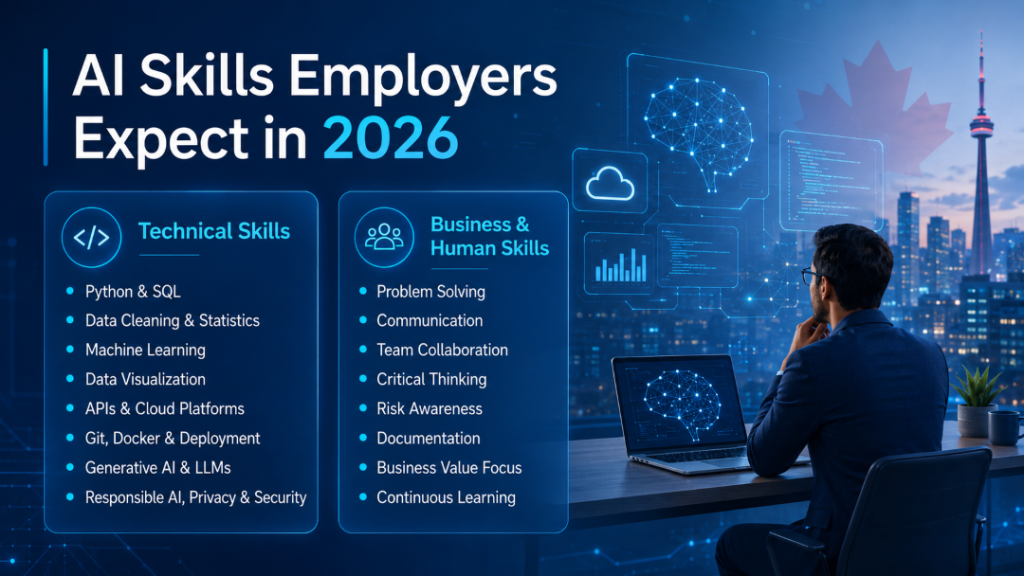
AI Skills Employers Expect in 2026
The World Economic Forum identifies AI and big data among the fastest-growing skill areas. It also highlights technological literacy, creative thinking, resilience, flexibility, curiosity, and lifelong learning. lls
Career switchers should build a combination of:
- Python
- SQL and data querying
- Data cleaning and transformation
- Applied statistics
- Machine-learning fundamentals
- Model evaluation
- Data visualization
- APIs and software integration
- Cloud platforms
- Version control with Git
- Docker or similar container tools
- Deployment and monitoring
- Generative AI and large language models
- Responsible AI, privacy, and security
Business and Human Skills
Employers also need people who can:
- Define the real business problem
- Explain technical findings in plain language
- Work with non-technical teams
- Recognize poor-quality or biased data
- Challenge unreliable model outputs
- Document decisions
- Estimate business value
- Manage risk and change
- Continue learning as tools evolve
This is why a Business Analysis program or Data Analytics and Power BI course can complement an AI pathway. AI solutions create value when professionals can connect technology to business decisions.
Career Opportunities After AI Training
Possible pathways include:
- Junior data analyst
- Business intelligence analyst
- AI application support specialist
- Python developer
- Data quality analyst
- Automation analyst
- Junior machine-learning developer
- AI implementation coordinator
- AI product or project assistant
- Technical business analyst
- Data visualization specialist
- Cloud or AI operations support
With further education and experience, learners may work toward roles such as data scientist, machine-learning engineer, computer vision engineer, NLP specialist, AI consultant, or AI product manager.
However, Job Bank Canada indicates that data scientist and several related professional technology occupations usually require a university degree. A diploma can help learners build applied skills and a portfolio, but applicants must still check the education requirements for each occupation and employer. ry Comparison
The following figures are Job Bank occupational medians, not guaranteed starting salaries or expected earnings after completing one program.
| Broad occupation | Canadian median hourly wage | Rough annual equivalent* |
| Data scientist | $46.15 | About $96,000 |
| Business intelligence specialist | $45.13 | About $93,900 |
| Database analyst | $40.87 | About $85,000 |
| Software developer/programmer | $48.08 | About $100,000 |
| Software engineer/designer | $56.49 | About $117,500 |
*Annual equivalents use 2,080 hours and do not account for unpaid time, overtime, bonuses, contract gaps, or benefits. New entrants may earn less than the occupational median. ank reported a median wage of $47.69 per hour for data scientists, while the Toronto Region median was $46.33 per hour. These figures describe workers across experience levels and should not be advertised as graduate starting salaries. ng AI in Canada
AI skills can be applied beyond technology companies.
Financial Services
Banks and insurers use AI for fraud detection, risk analysis, document processing, customer service, forecasting, and compliance support.
Healthcare
Potential applications include medical imaging support, scheduling, documentation, resource planning, and health-data analysis. Sensitive applications require strong privacy, security, and human oversight.
Retail and E-Commerce
Retailers use recommendation systems, demand forecasting, pricing analysis, inventory planning, and customer-support automation.
Manufacturing and Logistics
Manufacturers use predictive maintenance, visual inspection, production forecasting, robotics, and supply-chain analysis.
Professional Services
Consulting, legal, accounting, marketing, and recruitment organizations use AI for document review, research support, content analysis, workflow automation, and knowledge management.
Enterprise Systems
AI is increasingly connected to finance, procurement, sales, inventory, and supply-chain platforms. Learners interested in enterprise technology can explore areas such as SAP S/4HANA Sourcing and Procurement or SAP S/4HANA Finance alongside AI and analytics.
Statistics Canada found particularly strong planned AI software adoption among information and cultural industries, professional, scientific and technical services, and finance and insurance. h Roadmap
Step 1: Choose a Target Role
Do not begin with “I want to work in AI.” Choose a more specific direction:
- Data and reporting
- AI application development
- Automation
- Cloud AI
- Machine learning
- Business analysis
- AI project coordination
- AI governance
Step 2: Audit Your Existing Skills
A career switch does not mean starting from zero.
An accountant may understand financial data and controls. A supply-chain professional may understand forecasting and inventory. A marketer may understand customer behaviour. A project manager may understand implementation and stakeholder communication.
Your industry knowledge can become a competitive advantage when combined with AI skills.
Step 3: Build the Foundations
Beginners should learn:
- Python fundamentals
- SQL
- Statistics
- Data preparation
- Visualization
- Machine-learning concepts
- Model evaluation
- Responsible AI
Step 4: Build Portfolio Projects
Create three or four focused projects rather than many unfinished tutorials. Examples include:
- Customer-churn analysis
- Sales-demand forecasting
- Invoice or document classification
- A retrieval-based knowledge assistant
- Product recommendation analysis
- Visual quality inspection
- A business dashboard with predictive insights
Each project should explain the problem, data, method, limitations, results, and next steps.
Step 5: Add Deployment Experience
Employers increasingly need people who can move beyond a notebook demonstration. Learn how to expose a model through an API, use containers, work with a cloud service, monitor outputs, and update the solution.
Step 6: Build Canadian Career Evidence
Improve your employability through:
- A Canadian-style résumé
- A focused LinkedIn profile
- GitHub or an online portfolio
- Informational interviews
- Industry events
- Volunteer or internship projects
- Clear explanations of transferable experience
Toronto Innovation College lists online, in-person, and hybrid learning options for its AI diploma. Applicants should review current availability, eligibility, fees, and schedules directly with the college. The program page identifies an Ontario secondary school diploma or equivalent and a minimum age of 18 among its admission requirements. s When Choosing an AI Program
Choosing Only by Program Length
The shortest option is not always the fastest route to employment. A two-week course may take less time but leave a beginner unable to build or explain a complete project.
Choosing Only by the Credential Name
Compare modules, assignments, tools, instructors, and portfolio outcomes. Two programs called “AI Certificate” may have completely different levels of difficulty.
Ignoring Prerequisites
Ask whether the program assumes previous knowledge of Python, mathematics, databases, or cloud technology.
Believing Salary Guarantees
Occupational medians describe an entire workforce. They do not predict an individual graduate’s starting salary.
Focusing Only on Generative AI
Prompting is useful, but durable AI careers also depend on data, evaluation, software integration, privacy, security, and business understanding.
Collecting Credentials Without Projects
Employers need evidence that you can apply what you learned. A smaller number of well-documented projects is usually more persuasive than a long list of introductory badges.
Applying Only to “AI Engineer” Jobs
Career switchers may gain relevant experience through data analysis, automation, business intelligence, software support, quality assurance, cloud support, or technical business analysis before progressing to advanced AI roles.
How to Decide Which Path Is Right for You
Choose a diploma when you need a structured transition, broad technical foundations, regular feedback, and time to build several projects.
Choose a certificate when you already have relevant experience and can identify the exact capability you need.
Choose a bootcamp when you can handle a fast pace, meet the prerequisites, and verify that the program includes strong instruction, assessment, and career support.
Choose a business-focused AI course when your goal is to use AI in management, operations, marketing, finance, human resources, or project work rather than become a developer.
Before enrolling, ask:
- What will I be able to build?
- Which tools will I use?
- How will my work be assessed?
- Does the curriculum include deployment?
- Are ethics, security, and privacy covered?
- What prerequisite knowledge is expected?
- What career-support services are available?
- Are employment claims supported by transparent evidence?
Final Recommendation
For a Canadian career switcher with limited programming or data experience, a comprehensive AI diploma is generally the stronger starting point. It offers more time to develop foundations, practise technical skills, create portfolio projects, and understand how AI solutions move from an idea to deployment.
A certificate is more suitable when you already have a solid foundation and need a focused skill. A bootcamp can be effective for a prepared learner who can keep pace with intensive training.
Toronto Innovation College’s 52-week Diploma in Artificial Intelligence covers programming, statistics, machine learning, deep learning, visualization, NLP, computer vision, deployment tools, and an industry internship. Prospective students should compare the curriculum with their background and target role before making a decision. e’s admissions process, explore its placement and career services, or contact an admissions adviser to discuss program requirements, delivery options, current schedules, and whether the diploma aligns with your career goals.