

Choosing the best SAP module for beginners can feel confusing, especially if you are new to SAP and planning your career in Canada.
Many students and professionals hear that SAP skills are valuable, but they do not know where to start. Some people hear about SAP FI, some hear about SAP MM, some hear about SAP SD, and others hear about SAP HCM, SAP EWM, SAP SuccessFactors, SAP ABAP, or SAP S/4HANA. With so many options, beginners often ask the same question: which SAP module should I learn first?
The answer depends on your background, your career goal, and the type of work you want to do.
SAP is not one single course or one single job path. It is a large enterprise system used by companies to manage finance, procurement, sales, supply chain, warehouse management, human resources, reporting, and many other business functions. Because of this, different SAP modules are connected to different career paths.
If you are from accounting or finance, SAP FI may be a strong choice. If you are from supply chain, logistics, purchasing, or operations, SAP MM or SAP EWM may be better. If you are from sales, customer service, or business development, SAP SD may be suitable. If you are from HR or administration, SAP HCM or SuccessFactors may be more relevant. If you enjoy coding and technical work, SAP ABAP may be an option.
This guide will explain the most beginner-friendly SAP modules, how to compare them, and how to choose the best SAP course for beginners in Canada.
What Is an SAP Module?
An SAP module is a specific area of SAP that focuses on one business function.
Large companies have many departments. Finance teams manage payments and reports. Procurement teams purchase goods and services. Sales teams manage customer orders. Warehouses manage inventory and deliveries. HR teams manage employee records and workforce processes.
SAP modules help each of these departments work inside one connected business system.
For example, SAP FI supports finance and accounting. SAP MM supports materials management and procurement. SAP SD supports sales and distribution. SAP HCM supports human resources. SAP EWM supports warehouse management. SAP ABAP supports technical development and programming.
Each module has its own purpose, transactions, process flow, and career direction.
For beginners, the goal is not to learn every SAP module. The goal is to choose one module that matches your education, work experience, and future career plan.
Why Choosing the Right SAP Module Matters
Choosing the right SAP module is important because it can make your learning journey easier and your career path clearer.
Many beginners make the mistake of choosing a module only because someone told them it is popular. Popularity is important, but it should not be the only reason. A module should also match your background.
For example, if you have accounting knowledge, SAP FI will feel more natural because it connects with financial accounting, vendor invoices, customer payments, ledgers, and reporting. If you have supply chain knowledge, SAP MM or SAP EWM may feel easier because it connects with purchasing, inventory, materials, warehouse operations, and vendors.
When your module matches your background, you can understand the business logic faster. You can also explain your career path better in interviews.
A beginner with finance experience can say, “I chose SAP Finance because I already understand accounting processes and want to build ERP finance skills.” A supply chain student can say, “I chose SAP MM because I want to work in procurement and materials management.” This sounds much stronger than choosing a module randomly.
Is SAP Hard for Beginners?
SAP is not impossible for beginners, but it can feel difficult without proper direction.
Many new learners feel nervous because SAP has many terms, screens, transactions, and module names. At first, the system can look technical. However, SAP becomes easier when you understand that it is built around business processes.
If you are completely new to SAP, you may want to first read Is SAP Hard to Learn? A Beginner-Friendly Guide. That article explains SAP in simple language and helps beginners understand that SAP can be learned with structured training and practice.
The real challenge is not only SAP itself. The challenge is choosing the correct starting point. Once you choose the right SAP module, your learning becomes more focused.
Best SAP Module for Beginners: The Simple Answer
The best SAP module for beginners is usually the module that matches your educational or professional background.
There is no one perfect SAP module for every beginner. The right choice depends on who you are and where you want to go.
If you are from accounting or finance, start with SAP FI or SAP S/4HANA Finance. If you are from supply chain or procurement, start with SAP MM or SAP S/4HANA Sourcing and Procurement. If you are from warehouse, logistics, or inventory management, start with SAP EWM. If you are from sales or customer service, start with SAP SD. If you are from HR or payroll, start with SAP HCM. If you are from IT or programming, start with SAP ABAP or a technical SAP path.
This approach helps you build on what you already know instead of starting from zero.
SAP FI: Best for Accounting and Finance Beginners
SAP FI is one of the best SAP modules for beginners with an accounting, finance, bookkeeping, or business background.
SAP FI stands for Financial Accounting. It supports financial processes inside a company, including general ledger accounting, accounts payable, accounts receivable, asset accounting, financial reporting, and other finance-related activities.
If you have studied accounting or worked in finance, SAP FI can be easier to understand because many concepts are already familiar. You may already know what invoices, payments, vendors, customers, balance sheets, expenses, and financial reports are. SAP FI shows how these activities are managed inside an enterprise system.
SAP FI is also useful for people who want to move from traditional accounting into ERP finance, business analysis, or SAP consulting.
For example, a finance graduate may use SAP FI training to show employers that they understand both accounting concepts and enterprise finance systems. A bookkeeper may use SAP FI to upgrade their profile. An accountant may use SAP S/4HANA Finance knowledge to move toward systems-focused finance roles.
Learners interested in this path can explore SAP FI / SAP S/4HANA Finance at Toronto Innovation College.
Who Should Choose SAP FI?
SAP FI is suitable for learners who enjoy numbers, accounting processes, financial records, and reporting.
You should consider SAP FI if you are an accounting student, finance student, payroll professional, bookkeeper, accountant, financial analyst, business graduate, or newcomer with finance experience.
It may also be suitable if you want to work in roles connected to finance systems, ERP support, accounting operations, business process analysis, or SAP finance consulting.
SAP FI may not be the best first choice if you dislike accounting or have no interest in financial processes. In that case, another SAP module may match your strengths better.
SAP MM: Best for Procurement and Supply Chain Beginners
SAP MM is one of the most practical SAP modules for beginners from supply chain, purchasing, logistics, inventory, or operations backgrounds.
SAP MM stands for Materials Management. In modern SAP S/4HANA, this area is closely connected to sourcing and procurement. It helps companies manage purchasing, vendors, materials, inventory, goods receipts, purchase orders, and procurement processes.
If you are interested in how companies buy products, manage stock, work with suppliers, and control materials, SAP MM can be a strong starting point.
SAP MM is useful because every product-based company needs procurement and inventory management. Manufacturers, retailers, warehouses, distribution companies, construction companies, healthcare organizations, and many other industries depend on purchasing and materials processes.
For beginners in Canada, SAP MM can be a good choice because it connects with practical business roles such as procurement coordinator, supply chain analyst, inventory coordinator, purchasing assistant, ERP support assistant, and junior SAP MM consultant.
Learners interested in this path can explore SAP S/4HANA Sourcing and Procurement.
Who Should Choose SAP MM?
SAP MM is suitable for learners who are interested in purchasing, vendors, materials, inventory, and supply chain operations.
You should consider SAP MM if you are a supply chain student, logistics student, procurement professional, purchasing assistant, warehouse coordinator, operations professional, business graduate, or newcomer with supply chain experience.
SAP MM is also a good choice if you enjoy practical business processes. It is less about theory and more about how companies actually buy, receive, store, and manage materials.
If your goal is to work in procurement or supply chain, SAP MM can be one of the best SAP modules for beginners.
SAP EWM: Best for Warehouse and Logistics Beginners
SAP EWM is a strong SAP module for beginners who want to build a career in warehouse management, logistics, and advanced supply chain operations.
SAP EWM stands for Extended Warehouse Management. It focuses on warehouse processes such as inbound goods, outbound goods, storage, picking, packing, inventory control, stock movement, labor management, and warehouse optimization.
SAP EWM is more specialized than SAP MM. SAP MM focuses more on procurement and materials management, while SAP EWM focuses deeply on warehouse operations.
If you have experience in warehousing, logistics, distribution, inventory control, shipping, receiving, or e-commerce fulfillment, SAP EWM may be a strong option.
This module can be especially useful for learners who want to move from general warehouse or logistics roles into more system-based supply chain careers. Instead of only working physically in warehouse operations, SAP EWM knowledge can help learners understand the digital system behind warehouse activities.
Learners interested in this area can explore SAP S/4HANA EWM Training in Canada.
Who Should Choose SAP EWM?
SAP EWM is suitable for learners who want to specialize in warehouse, logistics, inventory, and distribution processes.
You should consider SAP EWM if you are a supply chain student, logistics professional, warehouse supervisor, inventory controller, shipping and receiving coordinator, operations professional, or someone interested in advanced warehouse technology.
SAP EWM may be more detailed than SAP MM, so beginners should be ready to learn warehouse process flows carefully. However, if your background is in logistics or warehousing, the concepts can feel practical and career-focused.
SAP SD: Best for Sales and Customer Order Process Beginners
SAP SD is a good SAP module for beginners who are interested in sales, customer service, order management, pricing, delivery, and billing.
SAP SD stands for Sales and Distribution. It supports the process from customer inquiry to quotation, sales order, delivery, billing, and customer-related business transactions.
This module is useful because every company needs sales and customer order processes. SAP SD helps organizations manage how products or services are sold, priced, delivered, and billed.
If you have experience in sales coordination, customer service, business development, order processing, retail operations, or administration, SAP SD may be easier to understand than finance or technical modules.
SAP SD can also connect with other modules. For example, a sales order may connect with inventory, delivery, warehouse operations, and finance. This makes SAP SD a good module for learners who want to understand how customer-facing business processes work inside SAP.
Learners interested in this area can explore SAP S/4HANA SD Sales.
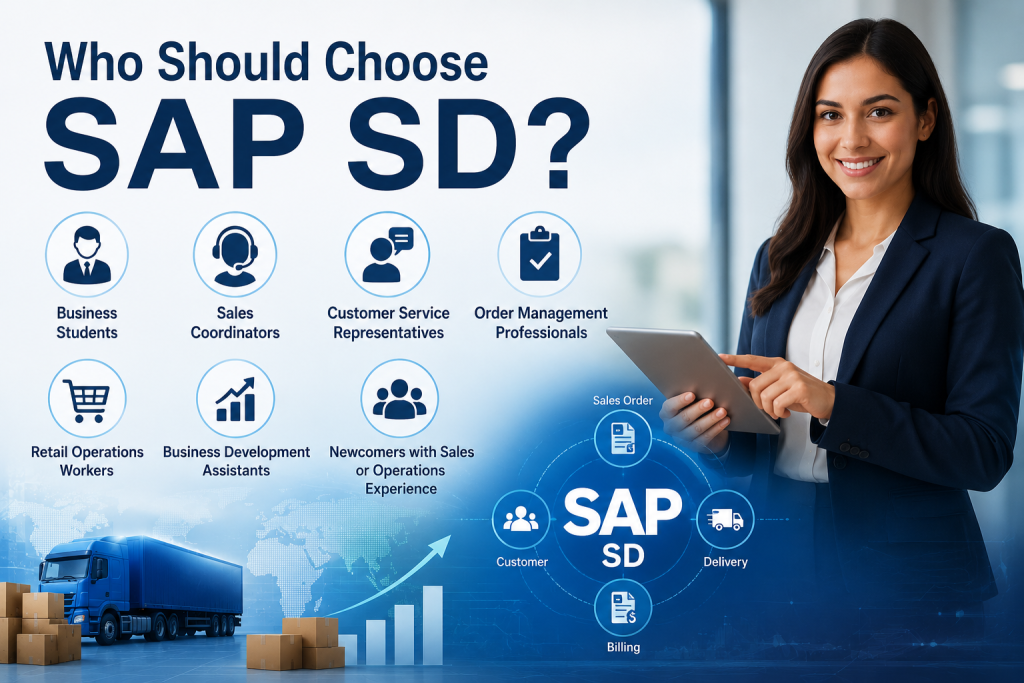
Who Should Choose SAP SD?
SAP SD is suitable for learners who enjoy sales processes, customer orders, pricing, delivery, and business operations.
You should consider SAP SD if you are a business student, sales coordinator, customer service representative, order management professional, retail operations worker, business development assistant, or newcomer with sales or operations experience.
SAP SD may be a good choice if you like working with customer-related processes but do not want to focus only on accounting or procurement.
SAP HCM: Best for HR and Administration Beginners
SAP HCM is a useful SAP module for beginners from human resources, administration, payroll, recruitment, or employee management backgrounds.
SAP HCM stands for Human Capital Management. It supports HR processes such as employee data, organizational structure, personnel administration, time management, payroll-related processes, and workforce management.
If you have HR experience or studied human resources, SAP HCM can help you understand how companies manage employee information inside an enterprise system.
HR is no longer only paperwork and manual administration. Many organizations use digital HR systems to manage employee records, reporting, payroll data, recruitment, and workforce processes. SAP HCM knowledge can help HR professionals become more technology-ready.
Learners interested in this path can explore SAP S/4HANA HCM Human Capital Management.
Who Should Choose SAP HCM?
SAP HCM is suitable for learners who want to work in HR systems, employee data, payroll support, recruitment operations, or workforce administration.
You should consider SAP HCM if you are an HR student, HR assistant, recruiter, payroll assistant, office administrator, business graduate, or newcomer with HR experience.
SAP HCM may be a good beginner choice if you understand people management processes and want to add enterprise software skills to your HR career.
SAP ABAP: Best for Technical and Coding Beginners
SAP ABAP is better for learners who are interested in coding, programming, customization, and technical SAP development.
ABAP is SAP’s programming language. It is used by developers to create reports, enhancements, forms, interfaces, and custom business logic inside SAP systems.
For beginners with no IT background, ABAP may not be the easiest first SAP module. It requires technical thinking and programming interest. However, if you enjoy coding or already have IT knowledge, ABAP can be a strong path.
SAP ABAP is not usually the best first choice for accounting, supply chain, HR, or business students unless they specifically want to become technical SAP developers.
If you are asking, “Can I learn SAP without coding?” then you should choose a functional module like SAP FI, SAP MM, SAP SD, SAP HCM, or SAP EWM instead of ABAP.
SAP FI vs SAP MM vs SAP SD
Many beginners compare SAP FI vs SAP MM vs SAP SD because these are among the most common functional SAP paths.
SAP FI is best for finance and accounting. It focuses on financial transactions, reporting, ledgers, vendor payments, customer payments, and accounting processes.
SAP MM is best for procurement and supply chain. It focuses on purchasing, vendors, materials, inventory, goods receipts, and procurement cycles.
SAP SD is best for sales and distribution. It focuses on customer orders, pricing, delivery, billing, and sales processes.
If you are from accounting, choose SAP FI. If you are from supply chain or purchasing, choose SAP MM. If you are from sales, customer service, or order management, choose SAP SD.
All three modules are valuable, but they serve different career goals.
Which SAP Module Should I Learn First?
You should learn the SAP module that matches your background first.
If you are still unsure, ask yourself a few simple questions.
Do you enjoy accounting, finance, numbers, and reports? Choose SAP FI.
Do you enjoy purchasing, vendors, inventory, and supply chain? Choose SAP MM.
Do you enjoy warehouse operations, stock movement, shipping, and logistics? Choose SAP EWM.
Do you enjoy sales orders, customer service, pricing, and billing? Choose SAP SD.
Do you enjoy HR, payroll, recruitment, and employee records? Choose SAP HCM.
Do you enjoy coding, development, and technical problem-solving? Choose SAP ABAP.
This method is simple, but it works because SAP learning becomes easier when it connects to something you already understand.
Best SAP Module for Business Students
Business students can choose SAP based on their area of interest.
Business programs often cover finance, marketing, operations, supply chain, HR, and management. Because SAP supports all these functions, business students have multiple options.
If a business student enjoys finance, SAP FI may be best. If they enjoy operations or supply chain, SAP MM or SAP EWM may be better. If they enjoy marketing, sales, or customer relations, SAP SD may be a good fit. If they enjoy HR or people management, SAP HCM may be suitable.
Business students should not think of SAP as only technical training. SAP is also business process training. It helps students understand how real companies manage daily operations through enterprise systems.
Best SAP Module for Newcomers in Canada
Newcomers in Canada should choose an SAP module that connects with their previous education or work experience.
Many newcomers already have experience in accounting, procurement, supply chain, HR, sales, administration, warehouse operations, or IT from their home country. SAP training can help connect that experience with Canadian job market needs.
For example, a newcomer with accounting experience may choose SAP FI. A newcomer with purchasing experience may choose SAP MM. A newcomer with warehouse experience may choose SAP EWM. A newcomer with HR experience may choose SAP HCM.
This approach helps newcomers build a clearer career story. Instead of changing fields completely, they can upgrade their existing background with SAP skills.
Best SAP Module for Career Changers
Career changers should choose a module that uses their transferable skills.
A person moving from bookkeeping to ERP finance may choose SAP FI. A person moving from warehouse operations to supply chain systems may choose SAP EWM. A person moving from purchasing to ERP procurement may choose SAP MM. A person moving from customer service to order management may choose SAP SD.
SAP can be a practical career-changing option because it allows learners to combine previous experience with new digital skills.
The key is to avoid starting randomly. A career changer should choose a module that makes sense based on their previous work and future job target.
Best SAP Course for Beginners in Canada
The best SAP course for beginners in Canada should be structured, practical, and connected to real business scenarios.
Beginners should look for training that explains SAP in simple language, teaches business process flow, includes hands-on practice, and helps learners understand career direction.
A good beginner SAP course should not only show where to click in the system. It should explain why each step matters. For example, in SAP MM, learners should understand why a purchase order is created. In SAP FI, learners should understand how invoices and payments affect financial records. In SAP SD, learners should understand how customer orders connect to delivery and billing.
Structured learning is especially important for beginners because SAP can feel confusing if you study random topics without a clear path.
Learning SAP at Toronto Innovation College
Toronto Innovation College (legal name: Innovations in Business Solutions Inc.) is a Registered Career College under the Ontario Career Colleges Act, 2005.
Toronto Innovation College offers career-focused SAP training options for learners who want to build practical ERP skills. Depending on your background and goals, you can explore SAP programs such as SAP FI / SAP S/4HANA Finance, SAP S/4HANA Sourcing and Procurement, SAP S/4HANA SD Sales, SAP S/4HANA HCM, and SAP S/4HANA EWM Training in Canada.
If you are not sure which SAP module is right for you, you can review the available programs on the Toronto Innovation College website or submit your interest through the Apply Now page.
Common Mistakes Beginners Should Avoid
One of the biggest mistakes beginners make is choosing a module only because it sounds popular.
A module may be popular, but if it does not match your background or interest, you may struggle to stay motivated. For example, a person who dislikes accounting may find SAP FI difficult. A person with no interest in supply chain may not enjoy SAP MM. A person who does not like coding may struggle with SAP ABAP.
Another mistake is trying to learn too many modules at the same time. Beginners should start with one module, build a strong foundation, and then expand later.
A third mistake is learning only theory. SAP is practical. You need examples, business scenarios, and hands-on exposure where possible.
A fourth mistake is expecting instant results. SAP is a professional skill. It takes time to understand the system, the process, and the career path.
How to Decide Your SAP Module Step by Step
You can choose your SAP module by following a simple decision process.
First, look at your education. Are you from accounting, business, supply chain, HR, sales, logistics, or IT?
Second, look at your work experience. Have you worked with invoices, purchasing, inventory, customers, employees, reports, or software systems?
Third, look at your career goal. Do you want to work in finance, procurement, warehouse management, sales operations, HR systems, or technical development?
Fourth, look at your learning preference. Do you enjoy business processes or technical coding? Do you prefer numbers, people, products, customers, or systems?
Fifth, choose one module and commit to it. Do not keep switching every week. SAP learning becomes stronger when you focus.
Final Recommendation
For most beginners in Canada, the best SAP module depends on background, not popularity.
If you are from accounting or finance, choose SAP FI. If you are from procurement or supply chain, choose SAP MM. If you are from warehouse or logistics, choose SAP EWM. If you are from sales or customer service, choose SAP SD. If you are from HR or administration, choose SAP HCM. If you are from IT or coding, choose SAP ABAP.
The best SAP module for beginners is the one that helps you connect your current skills with future career opportunities.
SAP is not only for IT professionals. Many successful SAP learners come from business, finance, supply chain, HR, sales, and operations backgrounds. What matters most is choosing the right module, learning step by step, and practicing with real-world business examples.
If you are ready to explore SAP training options, visit Toronto Innovation College or start your application through the Apply Now page.
Conclusion
Choosing the right SAP module is the first major step in your SAP career journey.
Do not rush the decision. Think about your background, your interests, and your career goals. SAP FI, SAP MM, SAP SD, SAP HCM, SAP EWM, and SAP ABAP each offer different pathways, but the best one for you is the one that matches your strengths.
For beginners in Canada, SAP can be a powerful skill because it connects business knowledge with digital enterprise systems. Whether you are a student, newcomer, career changer, or working professional, the right SAP module can help you build a clearer and more practical career path.
Start with one module. Learn the basics. Practice consistently. Build your resume around your chosen SAP path. Then continue growing step by step.
If you are still asking, “Which SAP module should I learn first?” the simplest answer is this: choose the SAP module that matches the work you want to do.