

Introduction
Canadian businesses depend on accurate information to manage finance, purchasing, inventory, sales, human resources, and customer service. When these departments use disconnected systems, employees may spend hours entering the same information, correcting errors, and searching for current records.
Enterprise resource planning systems help organizations connect these activities. An ERP platform can provide a shared source of information across several departments, making it easier to coordinate work and understand how one business decision affects another.
For students, newcomers, working professionals, and career changers, Enterprise Resource Planning training can provide a useful combination of business-process and technology skills. Learners can study how organizations work, how ERP systems support daily operations, and how teams plan, test, implement, and maintain enterprise software.
ERP training does not guarantee employment. Its value depends on the curriculum, hands-on practice, your previous experience, and the roles you plan to pursue. However, the right program can help you build practical skills that apply across manufacturing, retail, logistics, finance, consulting, healthcare, and public-sector environments.
What Is Enterprise Resource Planning?
Enterprise resource planning, commonly called ERP, refers to software and processes that integrate key business activities into a single system.
Instead of maintaining separate records across departments, an ERP platform can enable authorized employees to work with shared information.
For example, when a customer places an order, the system may help connect:
- The sales order
- Inventory availability
- Purchasing requirements
- Shipping or delivery
- Customer invoicing
- Financial reporting
Each step affects another department. ERP systems help organizations manage those connections.
Common ERP Business Areas
An ERP environment may support:
- Financial accounting
- Management accounting
- Purchasing and procurement
- Inventory management
- Sales and distribution
- Supply chain operations
- Production planning
- Warehouse management
- Human resources
- Asset maintenance
- Customer and supplier data
- Reporting and analytics
Not every organization uses every module. The system is usually configured according to the company’s industry, size, processes, and reporting requirements.
ERP Is More Than Software
Learning which button to select is not enough.
ERP professionals also need to understand:
- Why a process exists
- Which department owns each step
- What information is required
- Who approves a transaction
- Which controls prevent errors
- How changes affect other teams
- How problems should be tested and documented
This is why ERP training often appeals to people with both business and technical interests.
What Do You Learn in ERP Training?
The exact curriculum depends on the program. A comprehensive diploma may cover more than a short SAP or ERP certificate.
Toronto Innovation College currently describes its Diploma in Enterprise Resource Planning as a 45-week program focused on supporting ERP implementation and maintenance through analytical techniques and SAP technology. The listed career paths include ERP analyst, administrator, implementation consultant, support specialist, project coordinator, and data analyst roles.
A practical ERP program may include the following areas.
Business-Process Fundamentals
Students should learn how common business processes work before using an ERP system.
Examples include:
- Procure-to-pay
- Order-to-cash
- Record-to-report
- Inventory replenishment
- Employee onboarding
- Production planning
- Equipment maintenance
Understanding the full workflow helps learners recognize why data is entered and where it goes next.
ERP Navigation and Configuration Concepts
Students may learn how to:
- Navigate the system
- Review organizational structures
- Create or maintain master data
- Enter transactions
- Run reports
- Follow approval workflows
- Understand basic configuration
- Identify user roles and permissions
A beginner program may introduce configuration concepts without preparing learners to manage a complex production system independently.
Data Management
ERP systems depend on reliable information.
Training may cover:
- Customer records
- Supplier records
- Product and material data
- Pricing information
- Financial account structures
- Duplicate records
- Data validation
- Data migration
- Data security
Poor-quality data can affect purchasing, inventory, sales, financial reports, and customer service.
Testing and Problem Solving
ERP professionals often need to confirm that a process works correctly before a system change is released.
Students may practise:
- Writing test cases
- Following test scenarios
- Recording expected results
- Reporting defects
- Retesting corrections
- Documenting process gaps
- Supporting user acceptance testing
Reporting and Analysis
ERP systems produce information for operational and management decisions.
Learners should understand how to:
- Select suitable reports
- Apply filters
- Review transaction details
- Reconcile information
- Identify exceptions
- Explain results to stakeholders
Top Benefits of Enterprise Resource Planning Training
1. You Learn How Business Departments Connect
One of the greatest benefits of ERP training is the ability to see the organization as a complete system.
An accounting employee may understand invoices but not know how purchase orders are created. A warehouse employee may understand inventory movements but not know how those movements affect financial records.
ERP education helps connect these activities.
For example:
- Purchasing creates an order.
- The warehouse records receipt of the goods.
- Accounts payable receives an invoice.
- The system compares relevant records.
- Finance records and reports the transaction.
This cross-functional view can be valuable because many business problems are not limited to one department.
2. You Build Both Business and Technology Skills
ERP training sits between business operations and information technology.
Learners may develop business skills such as:
- Process analysis
- Requirements gathering
- Documentation
- Reporting
- Financial and operational awareness
- Stakeholder communication
They may also develop technical or system-related skills such as:
- ERP navigation
- Data management
- System testing
- User access concepts
- Configuration awareness
- Troubleshooting
- Implementation support
This combination can help professionals communicate with accountants, managers, developers, consultants, warehouse teams, and system administrators.
3. You Can Build on Previous Experience
ERP training does not always require learners to abandon their previous careers. It can strengthen knowledge they already have.
An accountant may focus on finance-related ERP processes. A procurement professional may focus on sourcing and purchasing. A warehouse supervisor may connect operational knowledge with inventory and distribution systems.
This can make career transitions more realistic.
A learner with supply chain experience, for example, may also compare general ERP education with a Diploma in Supply Chain Management with SAP specialization.
4. You Develop Process-Improvement Skills
ERP education can teach students to look beyond individual tasks.
Instead of asking only, “How do I enter this transaction?” a trained learner may ask:
- Why is this information entered twice?
- Where does the delay begin?
- Who should approve this step?
- Which data is missing?
- Can the process be standardized?
- What report would identify the problem?
- How will a system change affect other departments?
These questions are valuable during system improvements and digital-transformation projects.
5. You Gain Exposure to Implementation Work
An ERP implementation is more than installing software.
Organizations may need to:
- Define project objectives.
- Document existing processes.
- Design future workflows.
- Prepare and clean data.
- Configure the system.
- Integrate other applications.
- Test business scenarios.
- Train users.
- Move to the new environment.
- Support the system after launch.
Training can introduce learners to these stages and the responsibilities of different project team members.
Learners seeking additional implementation-focused practice can review an SAP Project Readiness Program that emphasizes project preparation and applied SAP experience.
6. You Improve Data and Reporting Awareness
Organizations need reliable data to make decisions.
ERP training can help learners understand how inaccurate master data or transaction records affect reports. A small error in a customer, supplier, product, or account record may create problems across several departments.
Students can learn to:
- Identify incomplete records
- Check data consistency
- Review transaction history
- Reconcile reports
- Investigate unusual results
- Communicate data-quality problems
These skills can be useful even when the job title does not contain “ERP.”
7. You Develop Testing and Documentation Skills
System testing and documentation are important during implementation, upgrades, and process changes.
ERP learners may practise creating:
- Process maps
- Business requirements
- Test cases
- Defect reports
- User guides
- Training materials
- Issue logs
- Status updates
- Change records
Strong documentation helps teams understand what was requested, what was tested, and what still needs attention.
8. You Can Explore Several Career Directions
ERP training can support several career directions, depending on your education and experience.
The Government of Canada’s ERP analyst occupational description places this work within business systems specialist roles. These professionals may perform system testing, prepare reports, develop system architectures, and translate organizational objectives into tasks for information-technology teams.
Possible role families include:
| Career Direction | Typical Focus |
|---|---|
| ERP support | User issues, transactions, access, and basic troubleshooting |
| Functional analysis | Business requirements, processes, testing, and configuration |
| ERP administration | System maintenance, access, monitoring, and support |
| Business systems analysis | Connecting business needs with system solutions |
| Implementation support | Data, testing, documentation, training, and issue tracking |
| Project coordination | Timelines, meetings, risks, actions, and stakeholder updates |
| Data analysis | Reports, master data, transaction quality, and exceptions |
| SAP consulting | Process expertise combined with SAP system knowledge |
A diploma does not automatically qualify a graduate for every role. Employers may require previous industry experience, a degree, technical skills, certifications, or experience with a particular ERP module.
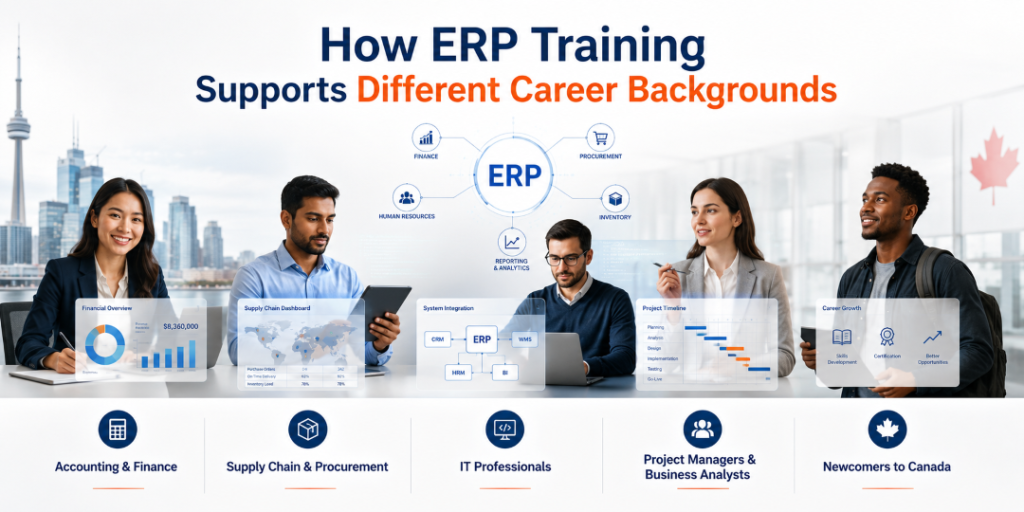
How ERP Training Supports Different Career Backgrounds
Accounting and Finance Professionals
Accounting professionals may already understand transactions, reconciliations, controls, and financial reporting.
ERP training can help connect that knowledge with:
- General ledger processes
- Accounts payable
- Accounts receivable
- Asset accounting
- Cost tracking
- Financial closing
- System-generated reports
Supply Chain and Procurement Professionals
Supply chain learners may use ERP knowledge to understand:
- Purchase requisitions
- Purchase orders
- Supplier data
- Inventory movements
- Receiving
- Demand planning
- Warehouse processes
- Invoice matching
IT Professionals
System administrators, support specialists, developers, and testers may benefit from understanding the business processes behind the technology.
Technical ability is more valuable when the professional understands why users need the system.
Project Managers and Business Analysts
ERP projects involve requirements, schedules, risks, testing, communication, and change management.
Project and business-analysis experience can support a transition into ERP implementation when combined with relevant system knowledge.
Newcomers to Canada
A newcomer may already have SAP, finance, supply chain, engineering, or IT experience from another country.
Canadian ERP training can help provide:
- Recent structured learning
- Updated system knowledge
- Local professional terminology
- Practice explaining previous experience
- New portfolio material
- Exposure to Canadian classroom expectations
It does not guarantee Canadian employment, but it can help learners connect previous experience with current target roles.
Real-World Canadian Scenarios
Scenario 1: A Purchasing Coordinator in Mississauga
The professional creates purchase orders but has limited knowledge of how those orders affect inventory and finance.
ERP training can help them understand the full procure-to-pay process and communicate more effectively with warehouse and accounting teams.
Scenario 2: An Accountant in Toronto
The accountant understands bookkeeping and reporting but wants to move toward financial systems support.
Training can introduce ERP financial processes, system testing, master data, user support, and implementation documentation.
Scenario 3: A Newcomer in Brampton
The learner has overseas SAP experience but has not worked on a recent implementation.
A diploma and carefully documented practice project may help refresh terminology and support interview preparation. The learner should still target roles that match their actual level of experience.
Scenario 4: A Project Coordinator in Ottawa
The professional wants to support enterprise technology projects.
ERP education can help them understand implementation stages, data migration, testing, user training, and post-launch support.
Scenario 5: A Warehouse Supervisor in Calgary
The supervisor knows physical inventory operations but has limited system knowledge.
ERP training can help connect receiving, storage, transfers, picking, shipping, and inventory adjustments with system records.
How to Choose an ERP Training Program in Canada
Review the Curriculum
Look for a clear balance of:
- ERP concepts
- Business processes
- SAP or another relevant system
- Data management
- Reporting
- Testing
- Documentation
- Implementation methods
- Practical assignments
Ask About Hands-On Practice
The phrase “hands-on” can mean different things.
Ask whether students will:
- Access a training system
- Complete full business scenarios
- Enter and correct transactions
- Create reports
- Prepare test cases
- Work on implementation exercises
- Complete a final project
Watching an instructor use the system is not the same as completing a process independently.
Confirm the Credential
Ask whether the program awards:
- A college diploma
- A course-completion certificate
- Preparation for a vendor exam
- An external SAP certification
Do not assume a college diploma automatically includes an SAP professional certification.
Check Instructor Experience
A strong ERP instructor should be able to explain both business processes and system use.
Ask about experience in:
- ERP implementation
- SAP projects
- Functional analysis
- Business operations
- System support
- Testing
- Adult education
Calculate the Full Commitment
Consider:
- Tuition
- Registration fees
- Books
- Software
- Exam fees
- Computer requirements
- Class schedule
- Assignment hours
- Commuting or online access
- Family and work responsibilities
Important Tips for ERP Learners
Learn the process before memorizing the screens.
Software interfaces change, but business-process knowledge remains valuable.
Choose a functional area.
General knowledge is useful, but finance, procurement, sales, supply chain, or human resources specialization can create a clearer direction.
Practise documentation.
ERP professionals must explain requirements, tests, problems, and solutions clearly.
Build a project story.
Be prepared to describe the business problem, process, data, testing, result, and lessons learned.
Do not exaggerate your experience.
Classroom projects are valuable, but they should not be described as paid implementation experience.
Common Mistakes to Avoid
Choosing a Program Based Only on the SAP Name
A course should teach business processes and practical problem-solving, not only terminology.
Expecting Immediate Consultant-Level Work
Consulting roles may require industry knowledge, implementation experience, client communication, and module expertise.
Ignoring Communication Skills
ERP professionals regularly work with users, managers, technical teams, and vendors. Clear communication is essential.
Learning Too Many Modules at Once
Build strong knowledge in one functional area before trying to study every part of an ERP system.
Collecting Credentials Without Practice
Employers may ask you to explain a complete process or solve a realistic problem. A credential alone may not be enough.
Believing Guaranteed-Employment Claims
No training provider controls hiring decisions. Career outcomes depend on education, experience, technical ability, local demand, networking, and interview performance.
ERP Training Program Checklist
- The program matches my career goal.
- I understand whether it is a diploma, certificate, or certification pathway.
- The curriculum explains complete business processes.
- I will receive practical system access.
- Data management and reporting are included.
- Testing and documentation are included.
- Implementation stages are covered.
- Instructor experience is clearly explained.
- I understand all tuition and additional costs.
- The schedule fits my responsibilities.
- I have selected a possible functional area.
- I have reviewed current job descriptions.
- I understand that training does not guarantee employment.
- I will create projects and practise interview explanations.
Frequently Asked Questions
1. What is Enterprise Resource Planning training?
Enterprise Resource Planning training teaches learners how integrated systems support finance, procurement, inventory, sales, supply chain, human resources, reporting, and other business processes.
2. Is ERP training useful in Canada?
It can be useful for learners targeting business systems, implementation, support, analysis, supply chain, finance, or project roles. Its value depends on the curriculum, previous experience, practical work, and target employer requirements.
3. Is SAP the same as ERP?
ERP describes a category of integrated business systems. SAP is a major software provider that offers ERP and other enterprise applications.
4. Do I need an IT background for ERP training?
Not always. Accounting, procurement, supply chain, operations, business analysis, and project management professionals can also enter ERP-related work. Technical roles may require stronger IT skills.
5. What jobs can an ERP diploma support?
Depending on employer requirements, it may support applications for ERP support, functional analyst, business systems analyst, project coordinator, administrator, testing, reporting, or implementation-support roles.
6. Does an ERP diploma include SAP certification?
Not necessarily. A college diploma and an external SAP certification are different credentials. Ask the school whether certification exams are included or separate.
7. Is ERP training suitable for newcomers?
Yes, particularly for newcomers with previous experience in accounting, supply chain, IT, engineering, administration, or SAP. Training should be combined with networking, resume preparation, and realistic job targeting.
8. How long does ERP training take?
Program length varies. Short courses may last several weeks or months, while diploma programs may take approximately one year. Toronto Innovation College currently lists its ERP diploma as a 45-week program.
Conclusion
Enterprise Resource Planning training can provide valuable knowledge for people who want to understand how business processes and technology work together.
Learners can study integrated workflows, SAP technology, data management, reporting, testing, documentation, and implementation. These skills may complement previous experience in accounting, supply chain, procurement, IT, project management, or business analysis.
The greatest benefit is not simply knowing how to navigate a system. It is learning how information moves across an organization, how one department affects another, and how technology can support more consistent processes.
Before enrolling, review the curriculum, confirm the credential, ask about hands-on system access, calculate the complete cost, and compare the training with realistic job requirements.
Explore the Diploma in Enterprise Resource Planning in Canada to review its duration, admission requirements, program focus, and listed career pathways. Choose ERP training that helps you develop practical, explainable skills rather than relying on software names or guaranteed-career claims.