
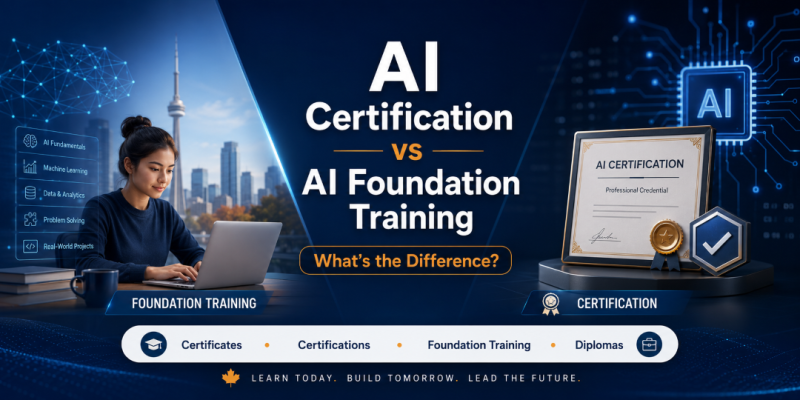
Searching for an AI course can quickly become confusing. One program promises an AI certificate, another offers foundation training, and a third prepares learners for an industry certification exam. Although these terms sound similar, they can describe very different learning experiences.
The main difference is simple: AI foundation training teaches essential knowledge and practical skills, while an AI certification usually verifies that you met a defined standard or passed an assessment. However, some schools also use “certificate” to describe a document awarded after course completion. That is not always the same as a professional or vendor certification.
Understanding this distinction can help Canadian students and professionals avoid choosing a program based only on its name. A marketing manager in Toronto may need practical AI foundation training, while an IT professional in Calgary may benefit from a technical certification connected to a specific cloud platform.
This guide explains how each pathway works, what employers may expect, and how to choose the right option for your career.
Why AI Training Terms Cause Confusion
Training providers sometimes use the words certificate and certification as though they mean the same thing. In practice, there are several possible credentials.
1. Certificate of Completion
A certificate of completion is awarded by a training provider after you meet its course requirements. Those requirements may include:
- Attending classes
- Completing assignments
- Finishing practical exercises
- Passing an internal assessment
- Completing a final project
It shows that you participated in structured learning. It does not automatically mean an independent organization tested your abilities.
2. Industry or Vendor Certification
An industry certification is usually issued by a technology company, professional organization, or recognized certification body.
It may require:
- Passing a supervised exam
- Meeting a minimum score
- Paying a separate examination fee
- Accepting a professional code or agreement
- Renewing the credential after a set period
- Completing continuing education
Some AI certifications focus on a particular platform. Others assess broader knowledge in cloud computing, machine learning, data science, or responsible AI.
3. Foundation Training
Foundation training introduces a subject at the beginner level. It may result in a certificate of completion, but the term “foundation” mainly describes what you learn.
A foundation program should help you understand:
- Basic AI terminology
- Generative AI
- Common business applications
- Prompt writing
- Limitations and risks
- Responsible AI use
- How to evaluate AI-generated output
4. Diploma-Level Training
A diploma is generally longer and more detailed than a short certificate course. It may include programming, mathematics, machine learning, data analysis, development tools, projects, and career preparation.
These four pathways can overlap, but they are not interchangeable.
What Is AI Foundation Training?
AI foundation training is designed to build a reliable starting point.
It is often suitable for:
- Beginners
- Managers
- Entrepreneurs
- Marketing professionals
- Human resources teams
- Finance and accounting professionals
- Project managers
- Business analysts
- Administrative professionals
- Newcomers updating their skills for Canadian workplaces
The goal is not necessarily to turn learners into AI engineers. It is to help them understand how AI works at a practical level and use suitable tools responsibly.
What You May Learn
A strong AI foundation course may cover:
- The difference between AI, automation, and machine learning
- How generative AI produces text, images, summaries, or ideas
- How to write effective prompts
- How to refine weak responses
- How to check facts and calculations
- How AI can support different business departments
- How to protect confidential information
- How bias can affect output
- When human review is required
Toronto Innovation College’s AI Essentials for Business Professionals course is an example of non-vocational foundation training designed for working professionals and beginners. The course focuses on practical business applications, prompt engineering, productivity tools, automation, governance, ethics, and responsible AI use.
Non-Vocational Program Notice: This program does not require approval under the Ontario Career Colleges Act, 2005.
What Foundation Training Does Not Usually Provide
A short foundation course may not provide enough technical depth for roles involving:
- AI model development
- Advanced machine learning
- Data engineering
- Python programming
- Neural networks
- Cloud architecture
- Model deployment
- Advanced mathematics and statistics
That does not make foundation training less valuable. It simply serves a different purpose.
What Is an AI Certificate?
An AI certificate usually means you completed a course offered by a school, college, university, online platform, or training organization.
The value of the certificate depends on what you had to do to earn it.
Questions to Ask About a Certificate
Before enrolling, ask:
- Who awards the certificate?
- What skills does the course teach?
- Is attendance required?
- Are assignments graded?
- Is there a final assessment?
- Will I complete a practical project?
- Does an independent organization recognize the certificate?
- Does it prepare me for a separate certification exam?
A certificate supported by practical work can be useful evidence of professional development. However, the document alone does not prove mastery.
Course Certificate Example
Imagine a human resources coordinator in Mississauga completes a three-month AI course. The coordinator learns to draft training outlines, summarize non-confidential information, create prompt templates, evaluate AI output, and recognize privacy risks.
The certificate confirms that the learner completed the program. The more meaningful career value comes from being able to explain and demonstrate those skills.
What Is an AI Certification?
An AI certification normally validates knowledge against standards established by the certifying organization.
Certifications may be:
- Vendor-specific
- Platform-specific
- Role-based
- Technical
- Fundamentals-level
- Advanced or specialist-level
A fundamentals certification may test basic cloud and AI concepts. An advanced certification may expect experience in programming, data preparation, machine learning, security, deployment, or system monitoring.
Certifications Often Focus on Defined Technologies
A certification may be useful when an employer specifically uses the related platform.
For example, an IT professional may pursue certification to demonstrate knowledge of:
- Cloud-based AI services
- Machine-learning workflows
- Data platforms
- AI development tools
- Security and governance
- Model deployment and monitoring
Because certifications can change, learners should review the official exam guide, validity period, renewal conditions, and prerequisites before registering.
Certification Is Not the Same as Experience
Passing an exam can show that you understand the tested material. It does not always prove that you can manage a complex workplace project independently.
Employers may also consider:
- Hands-on experience
- Project quality
- Problem-solving ability
- Communication
- Industry knowledge
- Portfolio work
- Previous education
- References
- Interview performance
A certification is one part of a professional profile.
AI Certification vs AI Foundation Training
| Factor | AI Foundation Training | Course Certificate | Industry Certification | AI Diploma |
| Main purpose | Build beginner knowledge | Confirm course completion | Validate defined knowledge or skills | Provide broader, structured education |
| Typical audience | Beginners and business professionals | Course participants | Technical or career-focused learners | Students and career changers |
| Technical depth | Introductory to intermediate | Depends on the course | Depends on the exam level | Usually broader and deeper |
| Coding required | Often no | Depends on the course | Sometimes | Common in technical AI diplomas |
| Assessment | Exercises or internal tests | Provider requirements | Formal external exam | Assignments, exams, and projects |
| Credential issuer | Training provider | School or training provider | Vendor or certification body | College or educational institution |
| Time commitment | Short to moderate | Depends on the program | Study time plus examination | Usually several months or longer |
| Best for | Practical AI literacy | Showing completed training | Meeting role or platform expectations | Building a more complete technical foundation |
| Employment guarantee | No | No | No | No |
Which Option Fits Your Career Goal?
The right pathway depends on what you want AI training to help you accomplish.
Choose Foundation Training When You Want To:
- Understand AI without advanced coding
- Use generative AI more effectively
- Improve productivity in your current role
- Learn responsible workplace practices
- Support AI adoption within a department
- Decide whether deeper technical study is right for you
This option may suit professionals working in Toronto, Brampton, Scarborough, North York, Vaughan, Ottawa, or Vancouver who want practical knowledge without immediately changing careers.
Consider a Certification When You Want To:
- Validate knowledge of a specific platform
- Apply for roles that mention that certification
- Strengthen an existing IT, cloud, or data background
- Prepare for implementation or support responsibilities
- Meet an employer’s professional-development requirement
Read several current Canadian job descriptions before choosing an exam. A certification has more career relevance when employers in your target field actually request or value it.
Consider a Diploma When You Want To:
- Build technical knowledge from the ground up
- Learn programming and machine learning
- Complete longer projects
- Prepare for a broader career transition
- Develop skills beyond the use of everyday AI tools
Learners seeking more technical depth can compare short training with the Diploma in Artificial Intelligence. The diploma is a 52-week program that introduces Python, machine-learning principles, AI applications, and modern robotics.
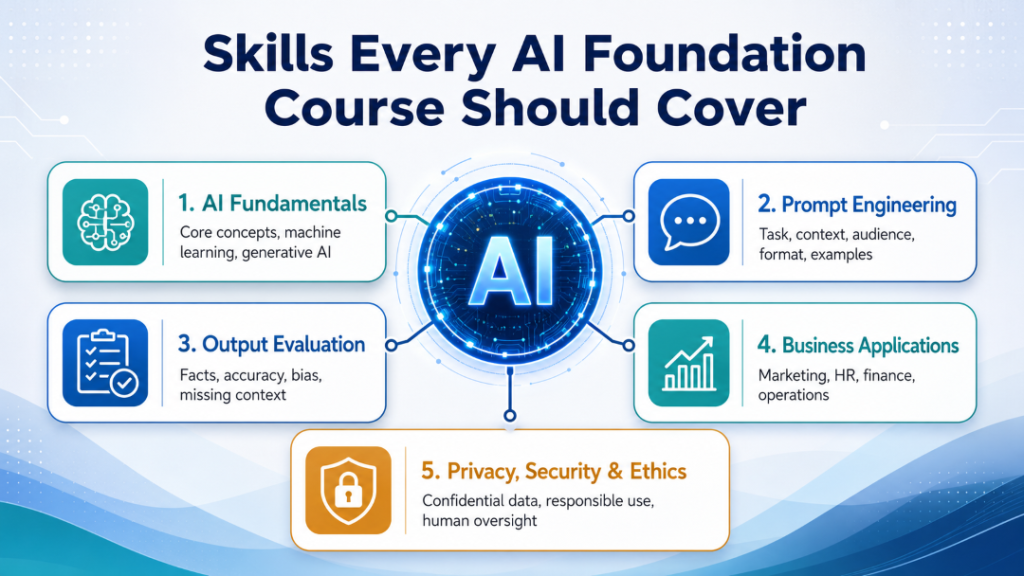
Skills Every AI Foundation Course Should Cover
A useful foundation program should go beyond showing learners how to open an AI chatbot.
AI Fundamentals
You should be able to explain:
- What AI means
- How generative AI differs from traditional software
- What machine learning does
- Why AI responses can be incorrect
- Why models do not “understand” information as humans do
Prompt Engineering
Prompt training should include:
- Defining the task
- Adding context
- Identifying the audience
- Requesting a clear format
- Setting limitations
- Supplying useful examples
- Refining the response
Learners should practise improving prompts rather than memorizing a single template.
Output Evaluation
A responsible AI user must check:
- Names
- Dates
- Statistics
- Calculations
- Sources
- Missing context
- Bias
- Unsupported claims
- Whether instructions were followed
Business Applications
Exercises should connect AI to realistic tasks in areas such as:
- Marketing
- Finance
- Human resources
- Operations
- Sales
- Project management
- Business analysis
- Customer service
- Administration
Privacy, Security, and Ethics
Learners should understand why confidential business, customer, employee, payroll, health, financial, or legal information should not be entered into unapproved AI tools.
The Government of Canada’s guidance on responsible generative AI use emphasizes accountability, secure use, validation of outputs, awareness of bias, transparency, and continued human responsibility.
How Canadian Employers May View AI Credentials
Employers do not evaluate every AI credential in the same way.
A hiring manager may ask:
- What did the program teach?
- How recent was the training?
- Did the learner complete practical work?
- Is the certification relevant to the employer’s systems?
- Can the candidate explain AI limitations?
- Can the candidate protect confidential information?
- Can the candidate show a project or workflow?
- Can the candidate apply AI to a real business problem?
What Makes a Credential More Useful?
A credential becomes more meaningful when you can connect it to evidence.
For example, you could describe how you:
- Created a safe prompt library for routine tasks
- Reduced time spent preparing meeting summaries
- Developed an AI output-verification checklist
- Mapped a workflow before proposing automation
- Tested several prompts and documented the results
- Created a policy draft that was reviewed by qualified stakeholders
Do not use confidential employer material in your public portfolio. Use fictional or anonymized examples instead.
Expert Insight
The strongest combination is often foundation knowledge, relevant certification, and practical experience. Foundation training teaches the concepts, certification validates defined knowledge, and practical projects show that you can apply what you learned.
Not every learner needs all three at the beginning.
Real-World Canadian Learner Scenarios
Scenario 1: The Non-Technical Manager
A retail manager in Brampton wants to understand AI-powered scheduling, customer-service tools, and productivity software.
Foundation training is likely the best first step. A technical certification may include topics that are not directly connected to the manager’s responsibilities.
Scenario 2: The Cloud Professional
An IT support specialist in Calgary already understands cloud services and wants to move toward AI implementation.
This learner may begin with an AI fundamentals certification and then progress to a more technical role-based credential. Practical lab work would also be important.
Scenario 3: The Career Changer
An administrative professional in Hamilton wants to move into technology but has no programming background.
Foundation training can help the learner test their interest. A longer diploma may be the next step when the career goal requires programming, machine learning, or system development.
Scenario 4: The Newcomer Professional
A newcomer in Scarborough has management experience from another country and wants to update their knowledge for Canadian workplaces.
Business-focused AI training can complement existing experience. The learner can then decide whether a platform-specific certification would add value in their target industry.
How to Compare AI Training Programs in Canada
Use this checklist before paying tuition or an examination fee.
- I know whether this is training, a certificate, a certification, or a diploma.
- I know who awards the credential.
- The program matches my current skill level.
- The curriculum supports my career goal.
- Coding and mathematics requirements are clear.
- The program includes practical exercises.
- I understand how my work will be assessed.
- Privacy, bias, security, and ethics are covered.
- Instructor qualifications are available.
- The schedule fits my responsibilities.
- All tuition, software, exam, and renewal costs are clear.
- I know whether the certification expires.
- I have checked current job postings in my target field.
- The provider does not promise guaranteed employment or income.
Organizations comparing training for several employees can also explore customized corporate training based on team responsibilities and workplace goals.
Important Tips Before Choosing
Start With the Job, Not the Credential
Look at the responsibilities and skills required for your target role. Do not collect certifications without a clear reason.
Read the Full Curriculum
A program title can sound impressive while covering only basic material. Review the learning outcomes, exercises, tools, and assessments.
Check Renewal Rules
Some certifications remain active indefinitely, while others require renewal. Confirm the current policy with the certification provider.
Build a Small Portfolio
Create safe, fictional examples that show your process, judgement, and ability to verify AI output.
Keep Learning
AI tools and workplace policies change quickly. One training program should be the beginning of continued learning, not the end.
Common Mistakes to Avoid
Believing Every Certificate Is an Industry Certification
A completion certificate and an independently assessed certification are different credentials.
Choosing Advanced Technical Training Too Soon
Beginners may struggle when a course assumes knowledge of programming, statistics, cloud computing, or data engineering.
Choosing Foundation Training for a Highly Technical Goal
A short non-coding course alone is not enough preparation for advanced machine-learning development.
Ignoring Responsible AI
Prompt writing is only one skill. Privacy, security, bias, output validation, and human oversight are equally important.
Assuming Certification Guarantees Employment
No credential can control employer decisions. Education must be supported by suitable experience, communication, job-search preparation, and demonstrated ability.
Listing Skills You Cannot Explain
Be prepared to discuss every AI skill and credential on your resume. Employers may ask for practical examples.
Frequently Asked Questions
1. What is the main difference between AI certification and AI foundation training?
Foundation training teaches beginner knowledge and practical skills. A professional certification usually verifies knowledge through a defined external assessment or examination.
2. Is an AI certificate the same as an AI certification?
Not always. A certificate may confirm course completion, while certification normally means an external organization assessed your knowledge against its standards.
3. Is AI foundation training useful for non-technical professionals?
Yes. It can help managers, marketers, HR teams, finance professionals, business analysts, project managers, and entrepreneurs use AI more effectively and responsibly.
4. Do I need coding skills for an AI certification?
It depends on the certification. Fundamentals-level exams may not require coding, while advanced machine-learning or AI engineering certifications may require programming and technical experience.
5. Should beginners take foundation training before certification?
Many beginners benefit from foundation training first. It builds the vocabulary and practical understanding needed to choose a relevant certification later.
6. Will an AI certification help me get a job in Canada?
It may strengthen your profile when it is relevant to the role, but it does not guarantee employment. Employers may also consider practical experience, projects, communication, education, and industry knowledge.
7. Is a diploma better than a short AI course?
A diploma offers broader and deeper study, while a short course is more suitable for focused upskilling. The better option depends on whether you want to improve your current role or prepare for a technical career change.
8. How can I confirm that an AI credential is valuable?
Review the issuer, curriculum, assessment process, renewal rules, employer demand, and practical skills taught. Search Canadian job postings to see whether the credential appears in roles you want.
Conclusion
Start by defining your career goal. A manager who wants to improve productivity may benefit from Toronto Innovation College’s AI Essentials for Business Professionals, a non-vocational program focused on practical workplace applications of artificial intelligence.
This program does not require approval under the Ontario Career Colleges Act, 2005.
A learner planning a technical career change may need a diploma, programming practice, practical projects, and, where relevant, an industry certification.
Choose the pathway that teaches skills you can understand, demonstrate, and apply—not simply the one with the most impressive title.