
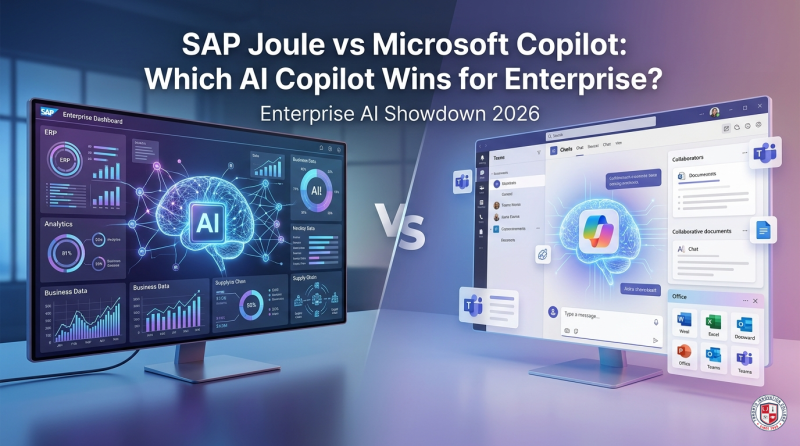
Artificial intelligence is no longer coming to Canadian workplaces — it’s already here. From Toronto’s Bay Street to Vancouver’s tech corridors, enterprise AI is reshaping how teams in finance, HR, supply chain, and IT operate every single day.
Two names keep coming up in boardroom conversations: SAP Joule and Microsoft Copilot. Both promise to make knowledge workers dramatically more productive. Both are embedded deep inside platforms that millions of businesses already use. And both are backed by companies betting their futures on AI-first enterprise software.
But they’re not the same thing. Not even close.
If you’re a student, a professional exploring SAP careers, or a business leader trying to understand which platform deserves your team’s time and training budget — this comparison is for you. Let’s cut through the marketing noise and look at what each AI copilot actually does, where it excels, and which one makes more sense depending on your world.
What Exactly Is SAP Joule?
SAP Joule is SAP’s built-in generative AI assistant, launched in late 2023 and now deeply embedded across the entire SAP product ecosystem — S/4HANA, SuccessFactors, Ariba, BTP, and more. Think of it as a highly intelligent co-worker who understands everything about your SAP environment and can actually take action inside it.
Joule isn’t just a chatbot. It draws on SAP’s vast business data — financial records, supply chain transactions, HR workflows, procurement history — and uses that context to give answers that are grounded in your company’s actual reality.
What can Joule actually do?
- Answer complex HR queries (“What’s the leave balance for my team?”) directly from SuccessFactors data
- Summarize financial reports and flag anomalies in SAP S/4HANA Finance
- Generate draft procurement requests in SAP Ariba with a single sentence of instruction
- Walk supply chain managers through inventory discrepancies in real time
- Write ABAP code and SAP BTP configurations for developers
- Explain complex SAP processes to end users in plain language
What makes Joule genuinely powerful for enterprises is its contextual awareness. It doesn’t give generic answers — it gives answers that reflect your company’s data, your SAP configuration, and your industry. That’s a significant leap from older chatbot experiences.
SAP has also made a clear architectural choice: Joule is built on business AI principles that prioritise relevance, compliance, and data security. For regulated industries — banking, pharmaceuticals, public sector — this matters enormously.
What Is Microsoft Copilot?
Microsoft Copilot is the AI layer built into the Microsoft 365 ecosystem — Word, Excel, PowerPoint, Teams, Outlook, and increasingly Dynamics 365. Powered by OpenAI’s large language models (the same family behind ChatGPT), Copilot is designed to be a general-purpose productivity enhancer across the entire Microsoft stack.
If SAP Joule is a specialist who knows your ERP inside-out, Microsoft Copilot is more like a brilliant generalist assistant who can draft your emails, summarise your Teams meetings, create PowerPoint slides from a brief, and write Excel formulas — all before lunch.
What can Microsoft Copilot do?
Microsoft Copilot — Core Capabilities
- Draft and rewrite emails and documents in Outlook and Word
- Summarise long Teams meetings and generate action items automatically
- Build entire PowerPoint decks from a few bullet points or a Word doc
- Analyse data and generate charts in Excel using natural language
- Answer questions using company knowledge stored in SharePoint or OneDrive
- Assist Dynamics 365 users with CRM tasks, customer summaries, and sales insights
Microsoft’s advantage is breadth. Copilot works across an enormous surface area — virtually every productivity tool a knowledge worker touches. It also integrates with Microsoft’s security and compliance infrastructure, which has made adoption in enterprise settings relatively smooth.
However, Copilot’s power depends heavily on how well your organisation’s data is structured and secured within Microsoft’s ecosystem. Garbage in, garbage out — as many early adopters have discovered.
The real question isn’t which AI is smarter. It’s which AI is smarter about your business?
SAP Joule vs Microsoft Copilot: The Key Differences
Now for the comparison that actually matters. Here’s how these two enterprise AI copilots stack up across the dimensions that affect real businesses:
| Dimension | SAP Joule | Microsoft Copilot |
| Primary Home | SAP S/4HANA, SuccessFactors, Ariba, BTP | Microsoft 365, Teams, Dynamics 365 |
| Data Depth | Deep ERP/business process data SAP Edge | Broad productivity + communication data |
| Use Case Focus | Finance, HR, Supply Chain, Procurement | Communication, Documentation, General Productivity |
| Best For | Transactional intelligence, ERP automation | Content creation, meeting efficiency, and collaboration |
| Industry Specialization | Manufacturing, Retail, Finance, Public Sector SAP Edge | Broad industry coverage, less vertical depth |
| Technical Extensibility | SAP BTP, ABAP, custom AI agents | Microsoft Power Platform, Azure OpenAI, Copilot Studio |
| Compliance & Security | SAP Trust Centre, GDPR-ready, Both Strong | Microsoft Purview, enterprise compliance built in |
| Learning Curve | Moderate — benefits from SAP domain knowledge | Lower — most employees already use Microsoft tools |
| Pricing Model | Bundled with select SAP cloud subscriptions | Add-on licence to Microsoft 365 (~$30 USD/user/month) |
| Integration with Non-Native Apps | Growing ecosystem via SAP BTP | Extensive via Microsoft Graph API MS Edge |
The table tells a clear story: these two tools are designed for different jobs. They’re not really competitors in the traditional sense — they’re complementary specialists. Many large enterprises are already deploying both.
Real-World Use Cases: Where Each Copilot Shines
Finance Department
Picture a senior accountant at a Canadian manufacturing company. Using SAP Joule, she asks: “What’s our accounts payable exposure in Q1 compared to budget?” Joule pulls from S/4HANA’s live financial data and generates a summary with variance analysis — in seconds, not hours.
Meanwhile, Microsoft Copilot helps her draft the executive summary email, prepare the board-ready PowerPoint, and quickly summarise the 45-minute finance review call she missed in Teams. Both tools are working — just on completely different tasks.
Human Resources
An HR manager at a Toronto-based firm uses SAP Joule in SuccessFactors to answer an employee’s query about their remaining vacation days, flag employees whose performance reviews are overdue, and suggest talent gaps in a specific department based on skills data.
At the same time, Microsoft Copilot drafts the all-staff announcement about the new hybrid work policy, writes a job description based on a rough set of notes, and summarises feedback from an HR town hall.
Supply Chain & Procurement
This is where SAP Joule genuinely pulls ahead. Supply chain is complex, multi-system, and time-sensitive. Joule’s deep integration with SAP’s procurement modules — Ariba, IBP, and S/4HANA logistics — means it can identify a vendor delay, suggest alternative suppliers, model the cost impact of a routing change, and trigger a procurement workflow, all from a single conversational prompt.
Microsoft Copilot can help with the email to the supplier. But it can’t touch the underlying ERP data.
IT & Development
Both tools compete more directly here. SAP Joule can write and explain ABAP code, configure BTP services, and guide technical teams through complex SAP architecture questions. Microsoft Copilot, through GitHub Copilot and Azure integrations, is a powerhouse for .NET, Python, and general-purpose development.
For SAP-specific development? Joule wins. For everything else? Copilot is hard to beat.
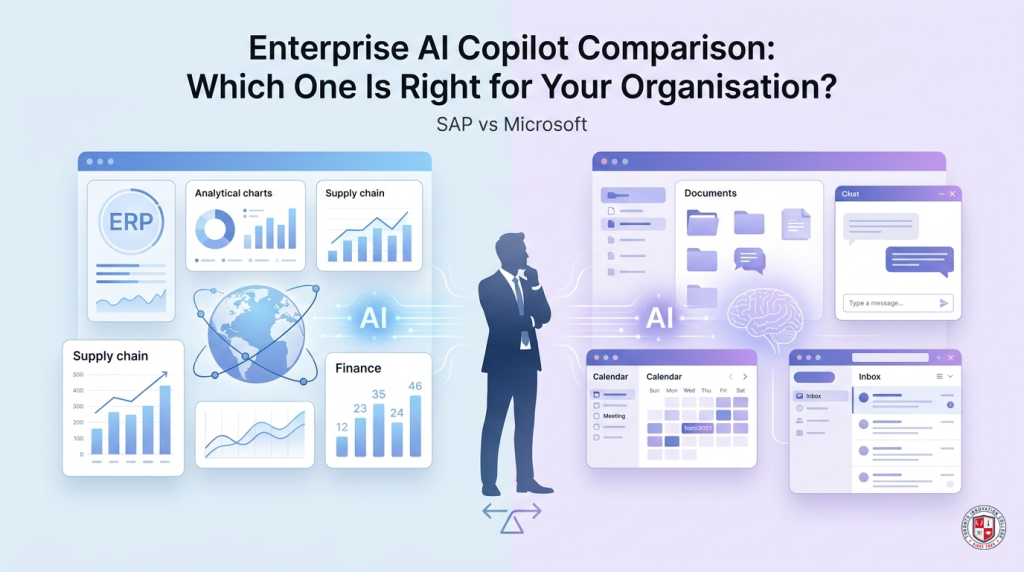
Enterprise AI Copilot Comparison: Which One Is Right for Your Organisation?
Choose SAP Joule If…
Your Core Business Runs on SAP
You’ll unlock the most value when Joule is working inside your actual SAP environment.
- You run SAP S/4HANA, SuccessFactors, or Ariba
- Your team needs ERP-level intelligence and automation
- You’re in manufacturing, finance, retail, or logistics
- Compliance and data sovereignty are non-negotiable
- You want AI that acts, not just answers
Choose Microsoft Copilot If…
Your Team Lives in Microsoft 365
The ROI is immediate when your employees already spend their day in Teams, Outlook, and Office apps.
- You need broad productivity gains across all departments
- Communication and content creation are key bottlenecks
- You want fast deployment with minimal training
- You use Dynamics 365 for CRM and sales
- You need strong integration with non-SAP systems
The honest answer? For most large Canadian enterprises, the question isn’t either/or — it’s how do we make both work together? SAP and Microsoft have already announced deep integration work between their platforms, meaning Joule and Copilot will increasingly work in concert rather than in competition.
That said, if your organisation is SAP-centric — and most large enterprises in industries like manufacturing, financial services, and government are — then SAP Joule delivers deeper, more specific, and more measurable value in your core business processes. Copilot adds polish to the surface. Joule transforms the engine.
SAP AI Training Canada: Why This Is a Career Game-Changer in 2026
Here’s the part that matters most if you’re a student or professional in Canada trying to figure out where to focus your energy.
According to SAP’s own data, there are currently more SAP-relevant roles open globally than there are qualified professionals to fill them. Canada is no exception. As enterprises accelerate their migration to SAP S/4HANA and activate AI capabilities through Joule, the demand for people who understand both SAP and enterprise AI is outpacing supply significantly.
The roles being created aren’t just for developers. Finance analysts, supply chain coordinators, HR specialists, project managers, and business consultants with SAP knowledge are in demand — especially as organisations need people who can bridge the gap between AI capabilities and actual business outcomes.
Where the Jobs Are in Canada
Toronto, Ottawa, Calgary, and Vancouver are all seeing strong hiring activity for SAP-skilled professionals. Industries actively recruiting include:
High-Demand Sectors for SAP AI Skills in Canada (2026)
- Banking and Financial Services — Big Five banks, credit unions, insurance firms
- Government and Public Sector — Federal and provincial digital transformation initiatives
- Manufacturing and Industrial — Automotive supply chain, aerospace, energy
- Retail and Consumer Goods — Omnichannel supply chain transformation
- Healthcare and Pharmaceuticals — SAP in clinical supply chain and HR management
The professionals who are going to stand out aren’t those with generic “AI experience.” They’re the ones who can walk into an SAP environment and tell a finance director exactly how to use Joule to cut their month-end close process by 40%.
That combination of SAP domain knowledge and AI fluency is rare. Which means it’s valuable.
How to Get Started
The good news is that you don’t need a computer science degree or years of coding experience to build genuine SAP expertise. Structured training programs focused on SAP S/4HANA and AI capabilities are now available in Canada, designed specifically for business professionals, career changers, and new graduates.
If you’re serious about building this skillset, exploring a dedicated SAP Joule training in Canada is one of the most direct paths. These programs combine foundational SAP knowledge with hands-on AI training — exactly the combination employers are asking for.
Why Learning SAP Joule Is One of the Smartest Career Moves You Can Make Right Now
Let’s be direct: the AI wave is happening whether you’re on it or watching from the shore. Every enterprise software platform is embedding AI, and the professionals who understand how to work alongside these tools — not just use them, but configure, evaluate, and drive adoption of them — are going to be disproportionately rewarded.
SAP Joule sits at the intersection of three powerful forces:
- Enterprise AI adoption is accelerating. The 2025–2027 window is when most large Canadian organisations are activating their SAP cloud migrations and turning on AI features. The people with the right knowledge right now will shape how these deployments unfold.
- SAP skills have historically commanded premium salaries. SAP professionals earn significantly more than general IT workers in Canada. Adding AI specialisation to that foundation further increases earning potential.
- The knowledge gap is real and wide open. Most SAP users haven’t yet been trained on Joule. Most Joule users don’t fully understand what it can do. Early movers in any technology transition tend to benefit enormously.
The combination of ERP expertise and AI fluency is the new power skill in enterprise technology. And Canada — with its growing tech sector, SAP-heavy enterprise landscape, and strong demand for digital transformation skills — is an ideal place to build that career.
Whether you’re a recent graduate exploring technology roles, a business analyst looking to upskill, or a finance or HR professional who wants to stay ahead of what AI is doing to your field, an SAP AI course in Toronto could be the practical next step that opens significantly more doors.
Ready to Build Real SAP & AI Skills for the Canadian Job Market?
Toronto Innovation College offers a structured SAP Joule certification program designed for professionals and graduates who want practical, industry-aligned skills — without needing a technical background to start.
The Final Verdict: SAP Joule vs Microsoft Copilot
If this were a boxing match, neither fighter would win on a knockout — because they’re not really fighting each other. They’re fighting for different territory.
Microsoft Copilot is the AI for how you communicate and collaborate. It’s excellent at making every knowledge worker more productive at the surface layer of their work — the emails, the meetings, the documents, the presentations.
SAP Joule is the AI for how your enterprise actually runs. It’s embedded in the systems where business decisions are made, transactions are executed, and operational intelligence lives. For organisations running SAP, it’s the most transformative technology in terms of actual business outcomes.
The enterprise AI comparison between SAP and Microsoft ultimately comes down to this: do you want to be more productive doing your work, or do you want to fundamentally improve how the work gets done? Copilot handles the former beautifully. Joule takes aim at the latter.
For Canadian students and professionals who want to be where the enterprise action is over the next decade — where AI is creating new roles, reshaping existing ones, and generating real competitive advantage for businesses — SAP Joule and the broader SAP AI ecosystem represent one of the most compelling skilling opportunities available right now.
The tools are here. The jobs are opening up. The only question left is whether you’ll be one of the people who know how to use them.