

Choosing the right career in tech can feel confusing—especially if you’re new to the field. Many students and job seekers in Canada often ask:
“Should I choose Data Analytics or Business Intelligence?”
Both fields are in high demand. Both offer great salaries. And both can lead to exciting careers.
But they are not the same.
In this blog, we will break down data analytics vs business intelligence Canada in the simplest way possible. If you’re a beginner or an international student looking to start a tech career, this guide will help you make the right decision.
What is Data Analytics?
Data Analytics is the process of collecting, cleaning, and analyzing data to find useful insights.
In simple words, a data analyst answers questions like:
- What happened?
- Why did it happen?
- What can we learn from it?
Example:
A company notices sales dropped last month. A data analyst studies the data and finds:
- Sales dropped mainly in one region
- The issue started after a price increase
Key Tasks:
- Collect data from different sources
- Clean and organize data
- Use tools like Excel, SQL, and Power BI
- Create reports and dashboards
What is Business Intelligence?
Business Intelligence (BI) focuses on using data to support business decisions.
It is more about:
- Monitoring performance
- Creating dashboards
- Helping managers make decisions
Example:
A BI professional builds a dashboard showing:
- Monthly sales trends
- Top-performing products
- Regional performance
Key Tasks:
- Design dashboards
- Work with tools like Power BI
- Analyze trends
- Present data to stakeholders
Data Analytics vs Business Intelligence (Comparison Table)
| Feature | Data Analytics | Business Intelligence |
| Focus | Understanding data deeply | Supporting business decisions |
| Goal | Find insights and patterns | Present data clearly |
| Tools | Python, SQL, Excel | Power BI, Tableau |
| Work Style | Analytical and detailed | Visual and strategic |
| Output | Reports, predictions | Dashboards, KPIs |
| Role Type | Technical | Business-focused |
Key Differences Explained in Simple Terms
Let’s simplify it even more:
- Data Analytics = Detective 🔍
Finds hidden insights in data - Business Intelligence = Storyteller 📊
Shows data in a clear and visual way
Main Difference:
- Data analysts dig deeper into data
- BI professionals present data for decision-making
Career Opportunities in Canada
Both fields are growing fast in Canada.
According to the
There is strong demand for:
- Data Analysts
- Business Intelligence Analysts
- Reporting Specialists
Common Job Roles:
Data Analytics Careers:
- Data Analyst
- Junior Data Scientist
- Reporting Analyst
Business Intelligence Careers:
- BI Analyst
- Power BI Developer
- Data Visualization Specialist
Salary Comparison in Canada
Here’s a general salary comparison:
| Role | Average Salary (CAD/year) |
| Data Analyst | $60,000 – $90,000 |
| BI Analyst | $70,000 – $100,000 |
| Power BI Developer | $75,000 – $110,000 |
Salary levels vary depending on experience, role, employer, and location. Completion of a training program does not guarantee employment or a specific salary.
Skills Required for Each Career
Data Analytics Skills:
- Excel
- SQL
- Basic Python
- Data cleaning
- Problem-solving
Business Intelligence Skills:
- Power BI
- Data visualization
- Dashboard design
- Business understanding
- Communication skills
Which Career is Better for You?
Choosing between data analytics and business intelligence in Canada depends on your interest.
Choose Data Analytics if you:
- Enjoy problem-solving
- Like working with raw data
- Want a more technical role
Choose Business Intelligence if you:
- Like creating dashboards
- Enjoy storytelling with data
- Prefer business-focused roles
👉 Good news:
You don’t have to choose only one. Many professionals learn both.
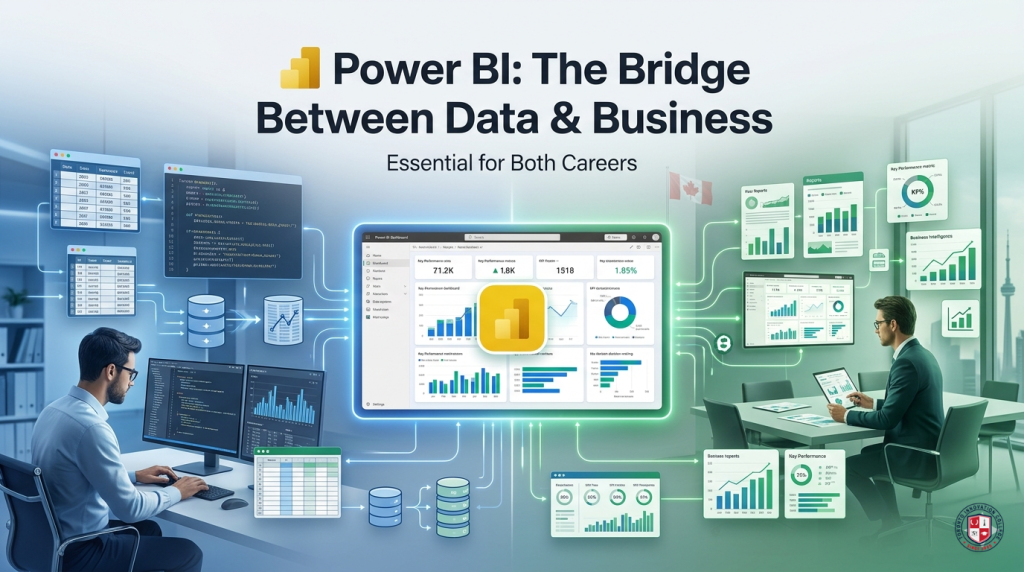
Why Power BI is Important in Both Careers
Power BI is one of the most in-demand tools in Canada.
It helps you:
- Create dashboards
- Visualize data
- Share insights easily
You can learn more from
Why employers love Power BI:
- Easy to use
- Powerful visuals
- High demand in job market
Learn Data Analytics with Power BI in Toronto
If you’re serious about starting your career, proper training is very important.
👉 Check out this program:
You can also explore:
These programs are designed for beginners and job seekers.
About the Training Institute
Toronto Innovation College (legal name: Innovations in Business Solutions Inc.) is a registered career college under the Ontario Career Colleges Act, 2005.
Benefits of Professional Training
Taking a structured course can help you:
- Learn step-by-step
- Get hands-on experience
- Build real projects
- Improve job readiness
- Gain confidence
Why training matters:
Self-learning is good—but guided training helps you faster.
Future Scope in Canada
The future looks very strong for both careers.
Trends in Canada:
- Companies are becoming data-driven
- Demand for analysts is growing
- Power BI skills are highly valued
Industries hiring:
- Banking
- Healthcare
- Retail
- Technology
- Government
Conclusion
So, data analytics vs business intelligence Canada—which is better?
👉 The answer depends on YOU.
- If you like deep analysis → choose Data Analytics
- If you like dashboards and business insights → choose BI
But the best strategy is:
Learn both with tools like Power BI.
🚀 Ready to start your career?
Enroll in the Data Analytics and Reporting with Power BI Training today and take your first step toward a high-demand tech career in Canada.
FAQs
1. Is Data Analytics better than Business Intelligence in Canada?
Both are good careers. It depends on your interests and skills.
2. Can beginners learn Data Analytics?
Yes! Many courses are designed for beginners with no IT background.
3. Is Power BI enough to get a job?
Power BI is very important, but combining it with Excel and SQL is better.
4. Which career has a higher salary in Canada?
Both offer competitive salaries depending on experience and skills.
5. How long does it take to learn Data Analytics?
You can learn the basics in 2–4 months with proper training.